
A saddle marked “17-inch medium” may look like a complete size specification. For a wholesale order, it is only the beginning.
Seat size relates primarily to the rider. Tree width and profile relate to the horse. Flap geometry influences the rider’s leg position. Panels and seat depth can make two saddles with the same label fit and feel different.
Importers, wholesalers and private-label brands must separate these variables before approving samples. This guide explains which measurements to record and how to create a manageable size assortment for the USA, UK and Europe.
English Saddle Sizing at a Glance
| Specification | Primarily relates to | Common description | Buyer decision |
|---|---|---|---|
| Seat size | Rider | Inches, often in half-inch increments | Which rider sizes to stock |
| Tree width and profile | Horse | Narrow, medium, wide or manufacturer-specific code | Which approved tree options to offer |
| Flap length | Rider’s leg | Standard, short, long or a measured length | Whether the core flap suits the customer base |
| Flap projection | Discipline and rider’s thigh | Straight, standard or forward | Which riding position and discipline the model supports |
| Panel and channel specification | Horse-facing contact area | Dimensions, shape and filling | Whether production matches the approved reference |
These specifications work together. A seat-size table alone cannot confirm that a saddle suits a particular horse and rider. Final individual fit should be assessed by a qualified saddle fitter.
HideOrax manufactures English saddles for wholesale and private-label programs in dressage, jumping, all-purpose and endurance configurations.
What Does English Saddle Seat Size Mean?
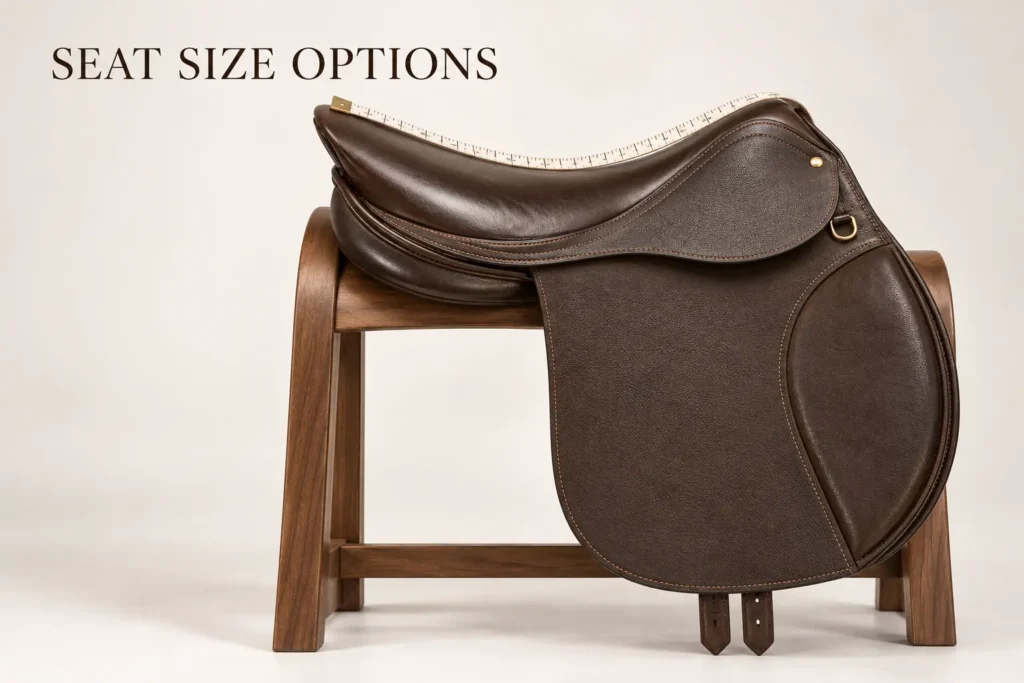
English saddle seat size is normally stated in inches. It describes the rider-facing space, but measuring points and usable room can vary by manufacturer and model.
A deep dressage seat and flatter close-contact seat can feel different at the same nominal size. Cantle height, depth, twist and blocks all influence usable space.
Common Wholesale Seat-Size Range
Many adult ranges concentrate on 16 to 18 inches in half-inch increments. Youth, pony and extended sizes may sit outside that range. This is an assortment reference, not an individual fitting chart.
| Nominal seat size | Possible wholesale role | Stocking consideration |
|---|---|---|
| 16 inches | Youth, petite or compact-seat demand | Validate demand before committing depth |
| 16.5 inches | Smaller adult and compact-seat option | Useful extension around the core range |
| 17 inches | Common core adult size | Often suitable for opening-range depth |
| 17.5 inches | Larger or more open adult option | Common companion to a 17-inch model |
| 18 inches | Taller, larger or longer-thigh demand | Stock according to dealer history and discipline |
Body measurements alone should not become an absolute size promise. Build, thigh length, discipline, seat design and preferred freedom all matter. Direct customers to a qualified fitter for final selection.
Record the Actual Measurement Method
A specification sheet should state:
- The nominal seat size
- The manufacturer’s measuring points
- The corresponding physical measurement
- Seat depth and cantle profile
- Approved tolerance between units
- Product code for each size
Record inches and centimetres for international programs. One inch equals 2.54 centimetres, but conversion does not replace an agreed measuring method.
Tree Width Is Not the Same as Seat Size
Tree width is part of the horse-facing saddle specification. It is separate from the rider’s seat size.
Narrow, medium, medium-wide and wide are useful sales labels, but not universal measurements. One system’s “medium” may not match another because point angle, head shape, rail profile and panels differ.
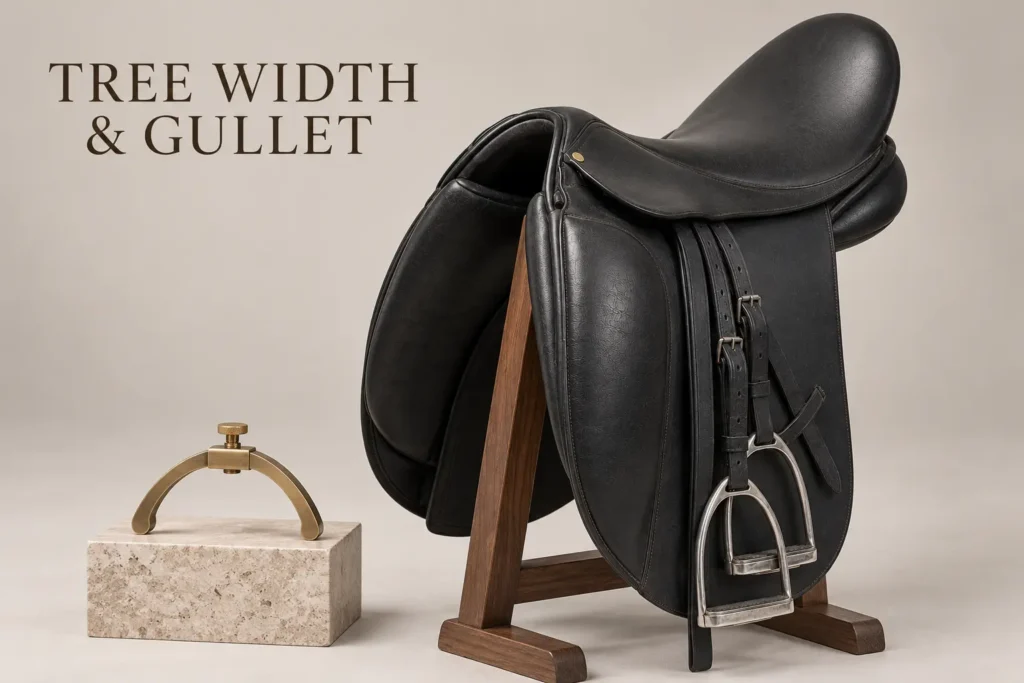
A purchase order should not say only “17-inch, medium tree.” Identify the approved tree or record the measurements that define it.
What Buyers Should Document for Each Tree Option
- Internal tree or headplate reference
- Width or angle measurement and its measuring points
- Tree-point length and direction
- Longitudinal curvature or rock
- Rail and head profile
- Tree length for each seat size
- Compatible panel specification
- Accepted production tolerance
If several tree widths are offered, assign a separate SKU or variation code to every combination. Do not allow the same “M” or “W” code to refer to different tree systems within one catalogue.
Tree Width, Gullet and Channel Width Are Different Terms
Buyers sometimes use “gullet width” as a general replacement for tree width. That can create an avoidable specification error.
Tree width usually refers to the geometry at the front of the tree. The gullet or head area describes the space around the withers at the front. The channel is the longitudinal space between the panels underneath the saddle. These areas interact, but they are not a single interchangeable measurement.
A clear specification should identify the exact location being measured and include a reference photograph or diagram. If a supplier and buyer measure from different points, both can report accurate numbers for different dimensions while believing they have agreed on the same feature.
This is why an approved physical sample remains valuable. Written measurements control production, while the sample demonstrates how those measurements combine in the finished saddle.
Flap Length and Projection Affect the Size Offer
Seat size does not fully describe rider accommodation. Flap length and forwardness also influence whether the rider’s thigh and knee sit appropriately.
Dressage saddles generally use longer, straighter flaps. Jumping and close-contact saddles use more forward-cut flaps to accommodate a shorter stirrup and a sharper knee angle. All-purpose saddles normally sit between those profiles.
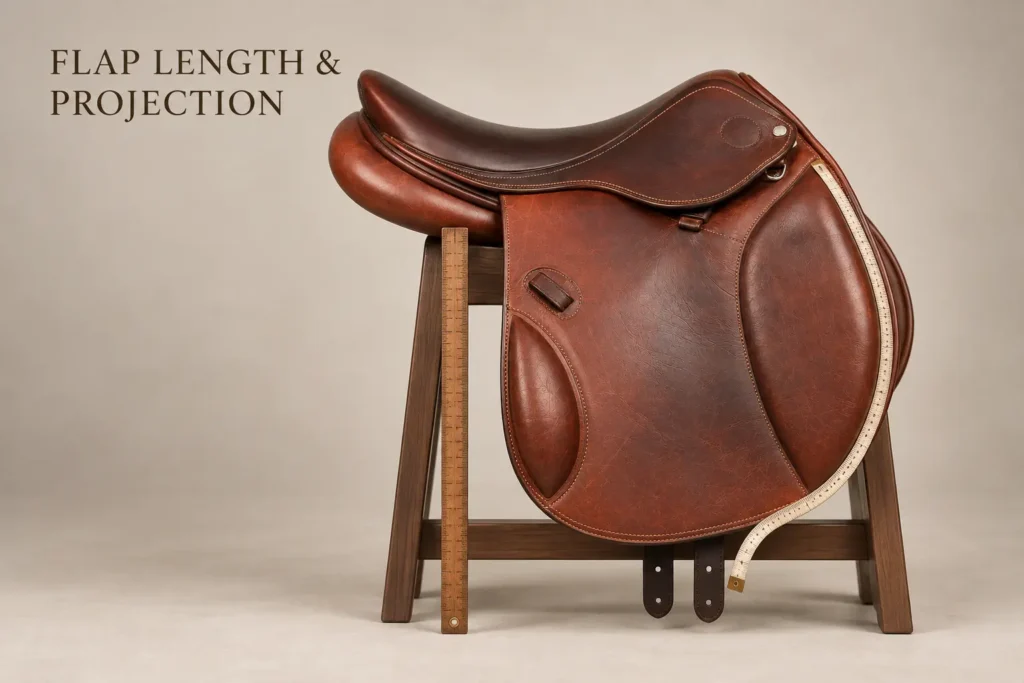
For each model, buyers should record:
- Flap length from an agreed fixed point
- Maximum flap width
- Degree of forward projection
- Knee-roll or block position
- Block length, width and thickness
- Whether blocks are fixed or removable
- Whether short, standard or long flap variants are available
Offering too many flap choices at launch can multiply inventory quickly. A new range may perform better with one well-tested standard flap, followed by short, long or more-forward variants only when customer demand is documented.
The broader HideOrax equestrian product range can also be coordinated with matching stirrup leathers, girths and saddle pads once the base saddle specification is approved.
Panel Shape and Seat Depth Can Change the Fit Experience
Two saddles with the same seat and tree labels can still differ because of the panels and upper-seat design.
Panel length, gussets, filling and channel shape influence the horse-facing contact area. Seat depth, twist and blocks affect the rider. Keep these features consistent across repeat orders.
Compare each required seat size during sampling. Check that proportions, flaps, blocks, billets and panel balance remain controlled as the pattern changes.
How USA, UK and European Buyers Should Plan Sizes
English saddle sizes are widely presented in inches across these markets, but terminology and assortment expectations vary.
USA buyers often use all-purpose and close-contact terminology. UK buyers commonly use general-purpose or GP. European buyers should confirm country-specific discipline demand, preferred tree references and whether documentation is expected in centimetres.
For international distribution, list the nominal seat in inches and add centimetres where useful. Keep one controlled internal specification across regions.
Do not assume the most-searched size will lead your dealer network. Review:
- Previous sales by size and discipline
- Dealer pre-orders and customer enquiries
- Returns or exchanges related to fit
- Local rider demographics
- The price point and purpose of the model
- Whether customers can access professional fitting support
A Practical Opening SKU Matrix
Every extra seat size, tree option, colour and flap choice multiplies inventory. One saddle offered in five seat sizes, three widths and two colours creates 30 variations before flap options are added.
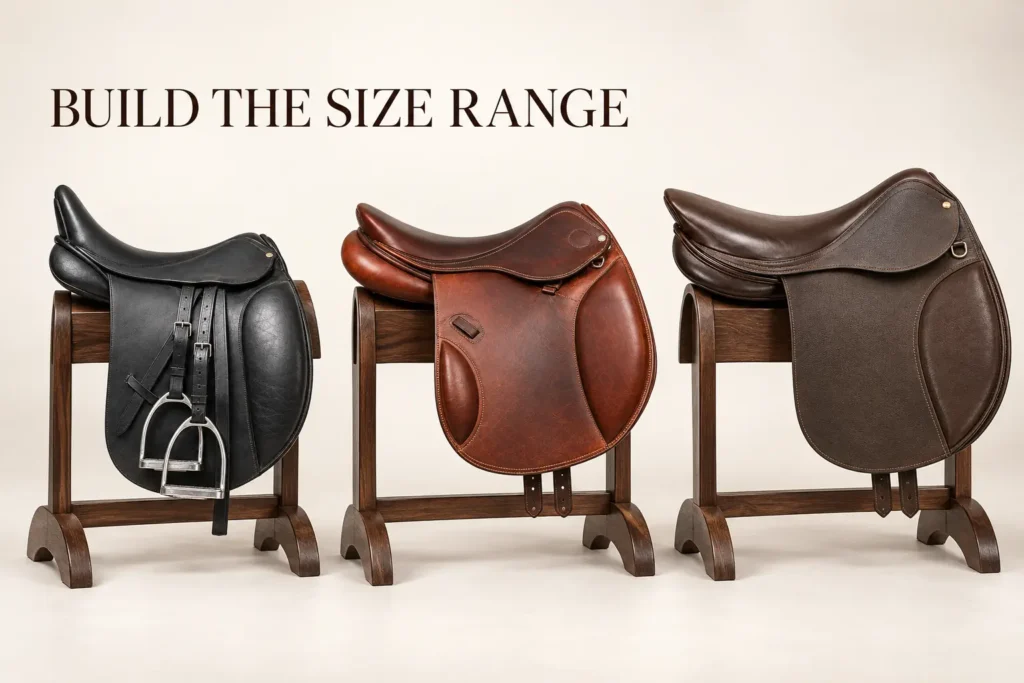
A controlled opening range could use:
- One discipline-specific base model
- Three core seat sizes supported by market feedback
- Two approved tree options rather than several vague labels
- One standard flap
- One lead colour, with a second colour added only where demand is clear
- A unique code for every approved combination
For example, a buyer might begin with 16.5, 17 and 17.5-inch seats, then add 16 or 18 inches after reviewing enquiries. This is a commercial planning example, not a universal recommendation.
HideOrax’s private-label equestrian manufacturing service allows dimensions, materials, colours, hardware, branding and packaging to be agreed during quotation and sampling.
How to Approve a Graded Size Range
Do not approve bulk production from a generic label or one reference photograph. Build a repeatable approval record.
1. Confirm the Base Specification
Define the discipline, tree, panels, seat, flap, blocks, billets, leather, hardware and branding.
2. Approve the Core Sample
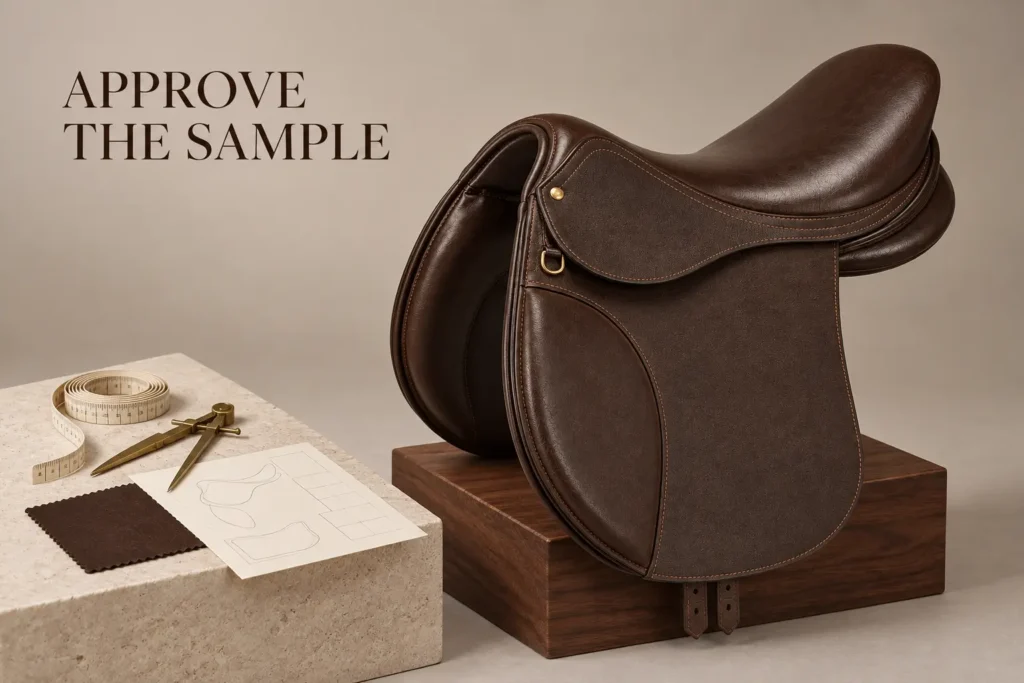
Check measurements, symmetry, balance, stitching, materials and presentation. Record every correction in writing.
3. Check Size Grading
Review how the pattern changes between seat sizes. Confirm that the flap, block, billets and panel relationships remain controlled rather than simply enlarged in every direction.
4. Assign Variation Codes
Connect every seat size and tree option to a unique SKU. The same codes should appear on the specification, order, inspection record, packaging and reorder.
5. Retain the Approved Reference
Keep the final sample or sealed reference alongside dated specifications and material records. The checklist in How to Choose a Private Label Saddle Manufacturer can help buyers assess production control and repeat-order capability.
Wholesale English Saddle Size RFQ Checklist
Include the following when requesting a quotation:
- Saddle type and intended discipline
- Target country and retail customer
- Required seat sizes
- Exact seat-measurement method
- Tree system and width options
- Panel and channel specification
- Flap length and projection
- Block configuration
- Leather, colour and hardware
- Quantity by each size and width combination
- Branding and packaging requirements
- Reference sample, drawings or measurements
- Sample deadline and bulk-delivery target
A quantity such as “20 saddles” is not enough for accurate planning. Break the order down by model, seat size, tree option, colour and any flap variation.
Frequently Asked Questions
What Are the Most Common English Saddle Sizes for Wholesale Orders?
Many adult ranges focus on 16 to 18-inch seats in half-inch increments, with 17 and 17.5 inches often treated as core options. Actual demand varies by discipline, model and market, so dealer data should determine the final assortment.
Is English Saddle Seat Size the Same as Tree Width?
No. Seat size mainly relates to the rider-facing space. Tree width and profile are part of the horse-facing fit. Both must be specified separately.
Are Medium and Wide Saddle Trees Standardized?
No universal industry definition makes every manufacturer’s medium or wide tree equivalent. Buyers should approve the exact tree system, measurement method and reference sample.
Should a Wholesaler Offer Every Seat Size and Tree Width?
Not necessarily. Too many combinations can create slow inventory and complex reorders. Begin with a controlled matrix supported by customer demand, then expand using sales and enquiry data.
Can a Saddle Size Chart Replace a Professional Fitting?
No. A chart can guide product selection and assortment planning, but it cannot confirm individual fit for a horse and rider. Final fit should be checked by a qualified saddle fitter.
Develop a Clear English Saddle Size Range
The strongest wholesale range is not the one with the most variations. It is the one in which every seat size, tree option and flap configuration has a clear customer, specification and product code.
Send HideOrax your target market, saddle style, required sizes, tree options, materials, quantities and branding details. Request a wholesale saddle quotation to discuss sampling, a five-saddle minimum order and a controlled private-label size program.