
Four saddles can share the same leather colour and still serve four entirely different retail customers.
A dressage rider, a show jumper, a riding-school customer and an endurance rider do not buy an English saddle for the same purpose. Seat depth, flap shape, block position, panel profile and accessory requirements change with the discipline. For a B2B buyer, those differences determine which models deserve shelf space and what must be approved during sampling.
This guide explains the main types of English saddles from a wholesale sourcing perspective. It is designed to help buyers plan a commercially focused range, brief a supplier clearly and avoid creating too many poorly differentiated SKUs.
Types of English Saddles at a Glance
| Saddle type | Defining profile | Typical customer | Wholesale role |
|---|---|---|---|
| Dressage | Deeper seat with a long, straighter flap | Dressage riders and specialist yards | Discipline-led specialist line |
| Jumping or close-contact | Flatter, more open seat with a forward-cut flap | Show jumping, hunter and eventing customers | Performance-led specialist line |
| All-purpose or general-purpose | Moderate seat and flap between dressage and jumping shapes | Leisure riders, beginners and riding schools | Broad-volume core line |
| Endurance | Comfort-led profile, practical weight and attachment options | Distance and trail-oriented riders | Specialist or regional extension |
These descriptions are useful starting points, not complete specifications. Two suppliers may both use the label “all-purpose” while offering noticeably different flap angles, seats and panels. Wholesale buyers should compare actual dimensions and approved samples rather than relying on the product name alone.
HideOrax develops English saddles for wholesale and private-label buyers across several discipline-led configurations.
What Actually Defines an English Saddle Type?
The category is defined by several connected features, not one visible detail.
Seat shape and balance
Seat depth, twist and cantle shape influence the intended rider position. A dressage saddle supports a longer, upright position; a jumping model accommodates shorter stirrups and a more forward leg. Assess the complete balance, not only the apparent seat depth in a photograph.
Flap angle and length
Long, straighter flaps suit the extended dressage leg. Forward-cut flaps create room for the sharper knee angle used over fences. All-purpose saddles occupy the middle ground, although that compromise varies by brand.
Knee rolls and blocks
Support may sit under or on top of the flap, or use removable hook-and-loop blocks. Specify whether blocks are fixed or adjustable and record their dimensions.
Panels and girthing
Panel shape, channel, filling and billet arrangement can vary by model. Approve these details separately even if several styles share the same upper leather and colour.
Dressage Saddles: A Specialist Line for a Defined Rider Position
Dressage saddles are identified by their long, relatively straight flaps and typically deeper seat. The design is intended for a longer leg position and close, controlled contact.
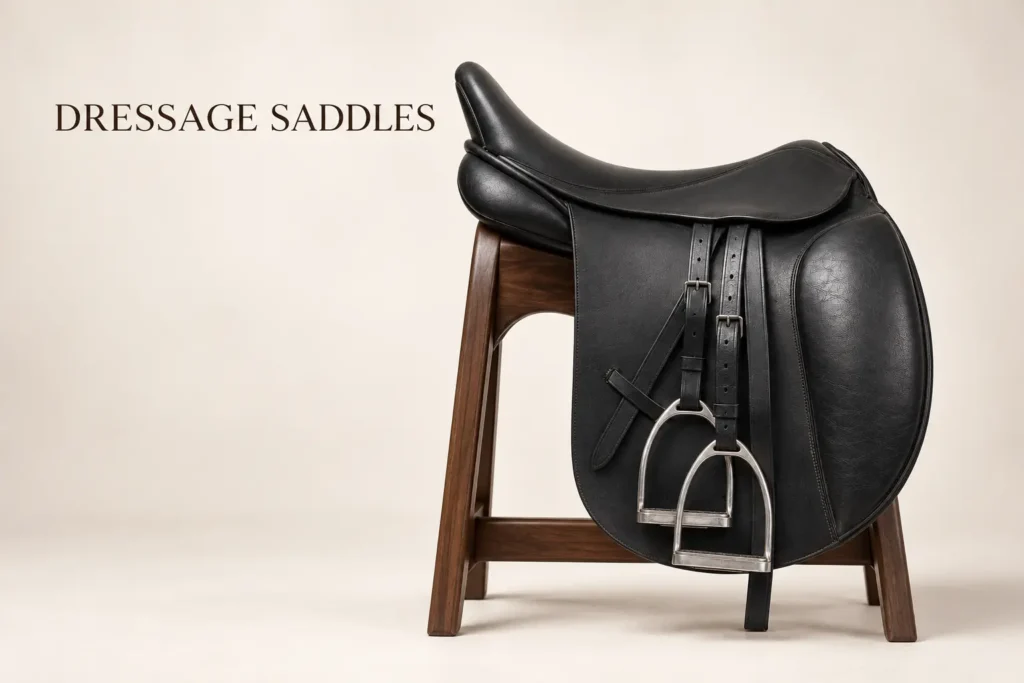
For a wholesale buyer, the main commercial question is whether the customer base is specialist enough to justify multiple dressage variants. A focused opening range might use one dependable model in black, a controlled set of seat sizes and a small number of tree-width options. A mature dressage brand may require several seat depths, block arrangements and panel specifications.
Details to include in a dressage-saddle brief
- Seat depth and cantle profile
- Flap length, width and angle
- Fixed, external or removable block configuration
- Panel shape, channel and filling material
- Billet arrangement and length
- Tree-width options and size tolerances
- Upper, seat and billet leather specifications
- Stitch colour, piping, badge and logo position
Black remains a practical lead colour for many dressage collections, but colour should follow the buyer’s market and existing brand language. Adding brown purely to create another SKU can tie up stock without creating meaningful differentiation.
Jumping and Close-Contact Saddles: Performance-Led and Forward Cut
Jumping and close-contact saddles normally use a more open seat and forward-cut flap. This creates space for a shorter stirrup length and bent knee. The terms overlap in the market, although some brands use “close-contact” for a flatter, minimal-feel design and “jumping” for a broader family of forward-flap saddles.
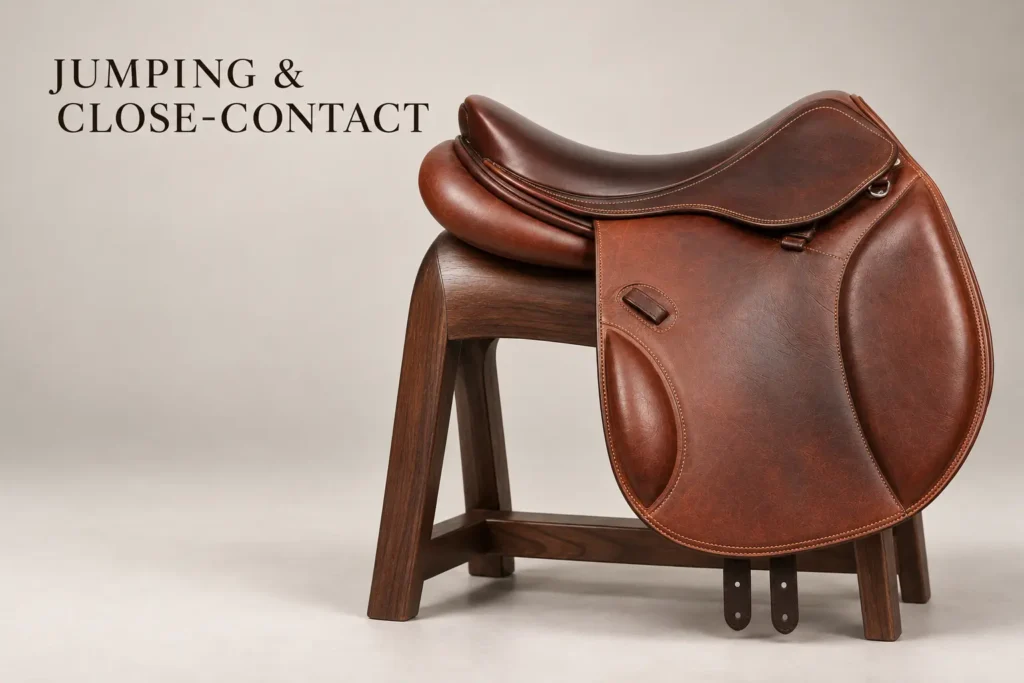
This category can serve show-jumping, hunter and eventing customers, particularly in the USA and Europe. Buyers should still avoid presenting one generic jumping model as suitable for every discipline and rider preference.
Details to include in a jumping-saddle brief
- Degree of forward flap cut
- Seat depth and balance point
- Knee-roll and calf-block dimensions
- Panel profile and front support
- Stirrup-bar position
- Billet and girthing arrangement
- Reinforcement at high-stress areas
- Finished weight and carton dimensions
Photographs can communicate the desired style, but measurable references are essential. A small difference in flap projection or block placement can change which riders view the model as suitable.
For a coordinated range, jumping saddles can be paired with matching girths, stirrup leathers, saddle pads and bridles from the wider HideOrax equestrian product collection.
All-Purpose and General-Purpose Saddles: The Broadest Commercial Entry Point
All-purpose saddles combine elements of dressage and jumping designs. They usually have a moderate seat and a flap that is neither very straight nor aggressively forward. In the UK, buyers often use the term “general-purpose” or “GP”; “all-purpose” is common in the USA. Product-page language should account for both search terms where relevant.
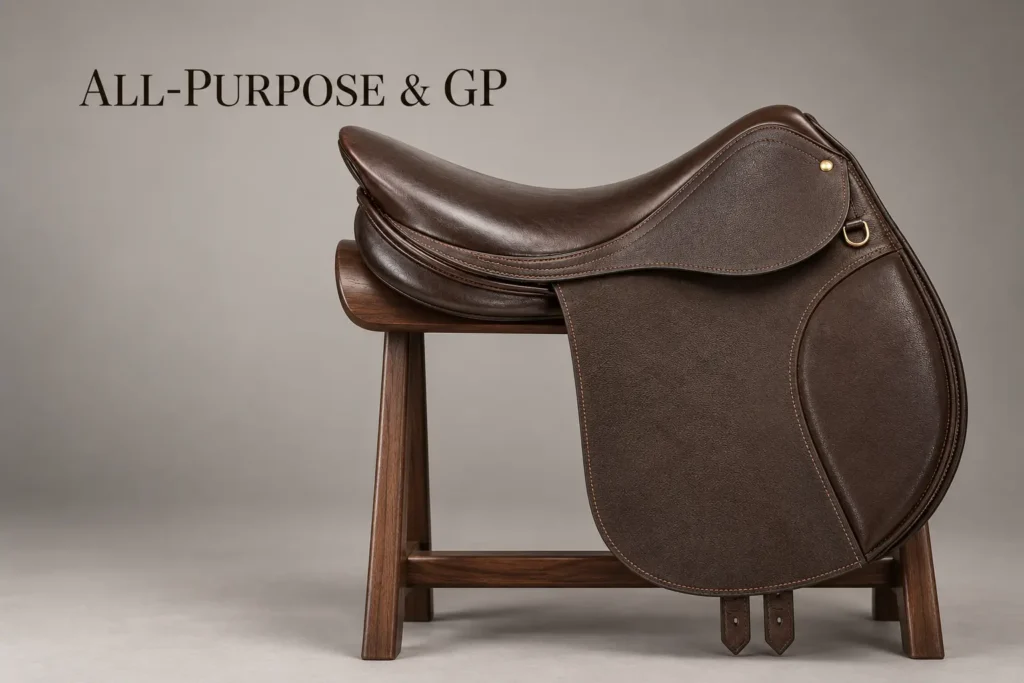
This is often the most accessible category for leisure riders, beginners, riding schools and retailers serving mixed disciplines. That breadth can make it a strong opening model for a new wholesale program.
Broad appeal does not mean the specification can be vague. Some all-purpose saddles lean toward jumping, while others are straighter and more suitable for flatwork. Buyers should decide where their model sits on that spectrum and say so in the product description.
A practical opening assortment
A controlled launch might include:
- One core all-purpose model
- The seat sizes most relevant to the target customer
- A limited, clearly labelled choice of tree widths
- Black and brown only where both colours have proven demand
- A matching girth and stirrup-leather option
This structure is easier to sample, photograph, explain and reorder than a large collection of nearly identical saddles.
Endurance Saddles: A Purpose-Led Specialist Extension
Endurance saddles are developed for prolonged riding and require a different buying discussion from arena-focused saddles. Buyers often prioritise rider comfort, practical weight, pressure distribution, secure support and attachment points for distance-riding equipment.
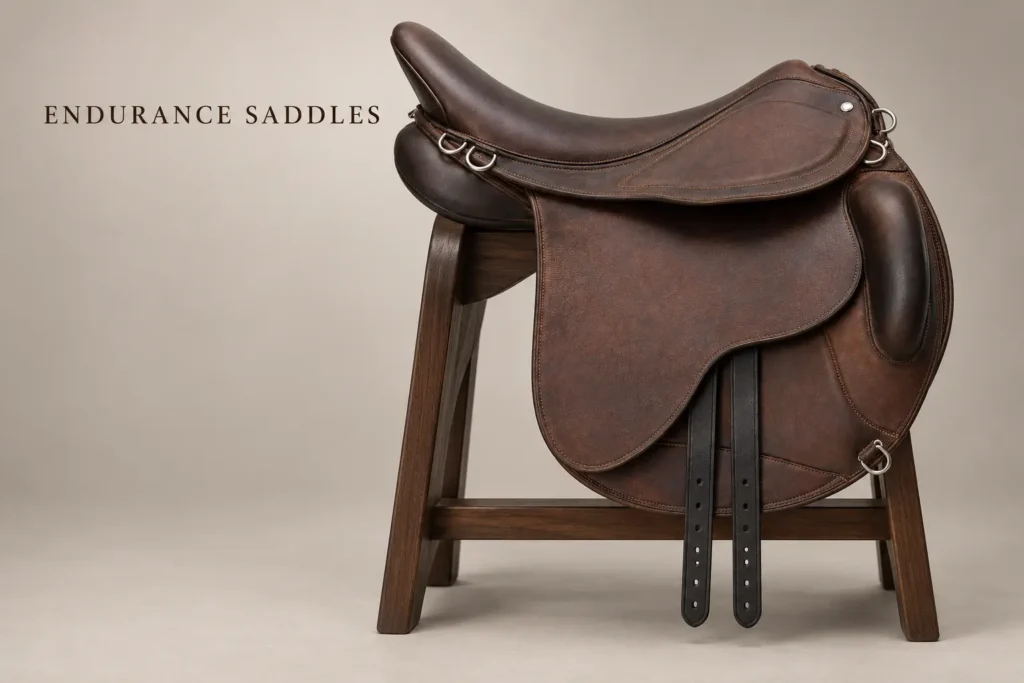
The label “endurance” covers varied regional preferences. A buyer should define the intended use, customer expectations and competition or trail context rather than asking a supplier to select a generic endurance format.
Details to specify for an endurance model
- Seat profile and rider-support features
- Flap or skirt configuration
- Panel construction and contact area
- Finished saddle weight target
- Number and location of rings or attachment points
- Billet or girthing arrangement
- Stirrup and leather configuration
- Easy-care areas or synthetic component options
Endurance can add valuable depth for retailers serving distance and trail communities, but it should usually be introduced after validating demand. Specialist inventory moves best when a buyer already understands the customer segment.
Which English Saddle Types Suit the USA, UK and Europe?
No region is one uniform market, but several planning principles help.
UK buyers commonly use “general-purpose” alongside dressage and jumping terminology. A concise GP line can serve broad retail and riding-school demand, while specialists may expect deeper discipline-specific options.
In the USA, “all-purpose” and “close-contact” are familiar terms. Hunter, eventing and dressage audiences may expect different styling, so product naming should reflect how the target retailer’s customers shop.
European demand varies by country and discipline. Confirm colour, sizing, leather and documentation expectations for each market rather than assuming one “Europe range” fits all.
Use regional insight to choose the opening assortment, then let enquiries, dealer feedback and sell-through guide expansion.
Build the Range Around Clear SKUs, Not More SKUs
Each variation multiplies inventory. Four seat sizes, three widths and two colours create 24 SKUs before block, panel or leather options are added. That may be reasonable for an established brand with dependable forecasts, but it creates risk for a new line.
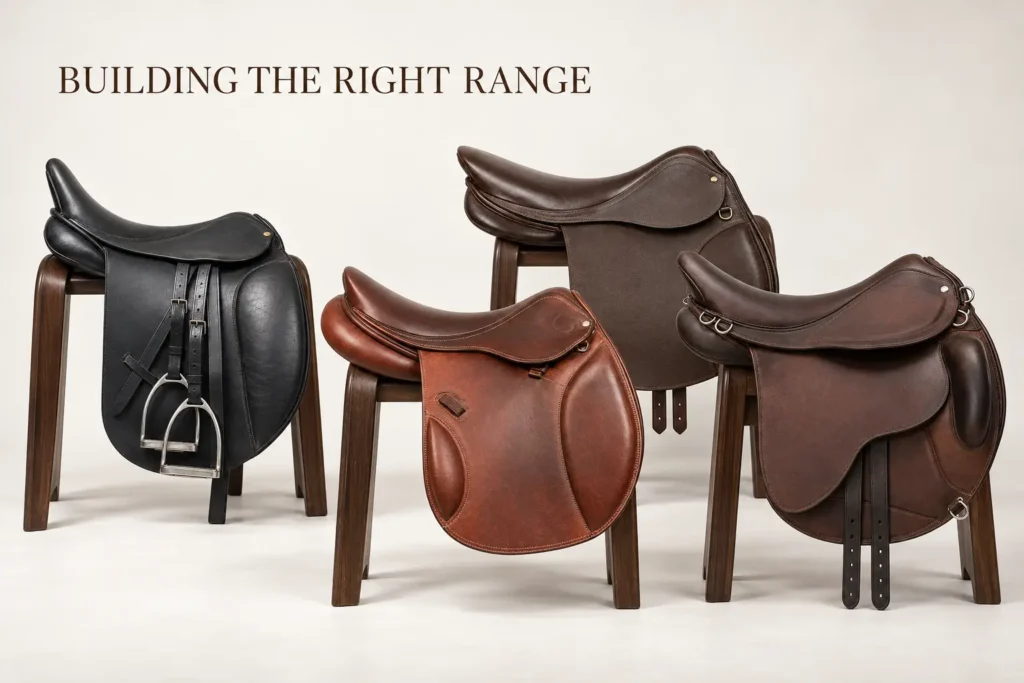
A stronger launch sequence is:
- Select the discipline and target retail position.
- Approve one base construction for each chosen saddle type.
- Limit the initial colour and size matrix to proven demand.
- Give every approved variation a unique product code.
- Record measurements, materials and branding in a specification sheet.
- Expand only after reviewing enquiries, sell-through and returns.
For OEM programs, HideOrax can develop agreed colours, materials, dimensions, hardware, branding and packaging through its private-label equestrian manufacturing service.
How to Evaluate Samples Before Placing a Wholesale Order
A polished studio image helps sell the finished product, but sample approval requires physical and documented checks.
Review each sample for:
- Match to the approved seat, flap, panel and block measurements
- Left-to-right symmetry
- Leather colour, grain, temper and finish
- Stitching alignment and edge finishing
- Billet, stirrup-bar and hardware positioning
- Logo size and placement
- Finished weight
- Protective packing and carton size
- Consistency with the intended discipline and retail description
Ask the manufacturer to record corrections before producing the next sample or beginning bulk production. Keep the signed specification, approved material references and final sample connected to the same product code.
A supplier should also explain who controls production, how repeat orders are matched and how inspection is documented. The checklist in How to Choose a Private Label Saddle Manufacturer covers those broader due-diligence questions.
Wholesale English Saddle RFQ Checklist
Send the following information to receive a useful quotation:
- Saddle type and intended discipline
- Target country and retail customer
- Required seat sizes and tree options
- Seat, flap, panel and block preferences
- Leather or synthetic material specification
- Colour and hardware finish
- Branding and packaging requirements
- Quantity by model, size and colour
- Matching tack or accessories required
- Sample deadline and target bulk-delivery window
- Reference sample, technical drawing or dimension sheet
The clearer the request, the easier it is to compare suppliers on the same basis.
Frequently Asked Questions
Which type of English saddle should a new wholesaler stock first?
An all-purpose or GP saddle often offers the broadest starting audience. A specialist retailer may be better served by dressage or jumping models. Base the choice on the existing customer mix.
What is the difference between a jumping saddle and an all-purpose saddle?
A jumping saddle generally has a forward-cut flap and more open seat for a shorter stirrup and bent knee. An all-purpose saddle uses a moderate flap and seat for mixed flatwork and light jumping.
Is a general-purpose saddle the same as an all-purpose saddle?
Usually. “General-purpose” or “GP” is common in the UK, while “all-purpose” is widely used in the USA. Check the actual geometry because brand terminology varies.
How many seat sizes should a private-label English saddle range include?
Start with sizes supported by dealer feedback or sales data, then expand after demand is proven. Every extra size, width and colour increases inventory and reorder complexity.
Can one manufacturer produce dressage, jumping, all-purpose and endurance saddles?
Yes, if the supplier has suitable trees, patterns, components and product-specific controls. Approve each type separately; a good all-purpose sample does not prove capability in dressage or endurance models.
Plan Your English Saddle Collection with HideOrax
A profitable range begins with the right saddle types, a controlled SKU plan and samples that match written specifications. Tell HideOrax which disciplines, sizes, materials, branding and target market you need. Request a wholesale quotation to discuss a five-saddle minimum order, 5–7 working-day sampling route and private-label options for your English saddle collection.