
A lower-priced saddle can produce fast volume or weaken a brand’s position. A premium leather saddle can deliver stronger margins or hold too much cash in slow-moving stock.
The material is only part of the decision. Importers, wholesalers, tack shops and private-label brands also need to consider customer expectations, retail price, weight, cleaning, climate, riding discipline and repeat-order consistency.
This guide compares leather vs synthetic saddles from a commercial buying perspective. It will help you decide whether to stock leather, synthetic or a structured combination of both.
Leather vs Synthetic Saddles: The Short Answer
Leather saddles usually suit buyers building a traditional, premium or specialist collection. Synthetic saddles often suit value-conscious, entry-level, riding-school and easy-care ranges. Neither material is automatically the better product.
The right wholesale choice depends on your intended customer and product specification.
| Buying factor | Leather saddles | Synthetic saddles |
|---|---|---|
| Typical retail position | Mid-range to premium | Entry-level to mid-range, depending on materials and design |
| Appearance | Traditional grain, patina and refined finishing | Consistent color and a more technical or practical appearance |
| Weight | Often heavier, although construction matters | Often lighter, but finished weight must be checked |
| Routine care | Requires suitable cleaning and conditioning | Usually simpler to wipe clean and dry |
| Natural variation | Grain and color can vary between hides | Surface and color can be more uniform between batches |
| Branding potential | Embossing, plates, stamps and premium packaging | Woven labels, badges, embroidery and printed packaging |
| Common buyer appeal | Traditional riders, premium stores and specialist brands | New riders, schools, leisure ranges and practical retailers |
| Main sourcing risk | Inconsistent leather grade, color or finish | Weak coating, cheap foam, poor reinforcement or an artificial glossy look |
Treat this table as a buying framework, not a quality verdict. A carefully specified synthetic saddle can outperform a poorly specified leather one in its intended market.
What Counts as a Leather Saddle?
“Leather saddle” does not mean every component uses the same material or grade. A saddle can combine different leathers across the seat, flaps, billets, panels and hidden structural parts.
A useful buyer specification should identify:
- Leather type and grade by component
- Tanning method where relevant
- Thickness and acceptable tolerance
- Firmness or softness
- Surface grain, color and finish
- Reinforcement materials
- Panel or underside construction
- Hardware and stitching requirements
Full-grain or selected top-layer leather may be chosen for visible areas, while high-stress parts need suitable density and controlled stretch. The material label alone does not confirm strength, comfort or consistency.
HideOrax’s English saddle manufacturing range includes dressage, jumping, all-purpose and endurance options developed for wholesale and private-label programs.
What Counts as a Synthetic Saddle?
Synthetic saddles may use coated textiles, microfiber-style materials, molded components, foam, webbing and other engineered layers. “Synthetic” is a broad category rather than one fixed material.
Buyers should specify:
- Outer-cover material and surface texture
- Textile backing and reinforcement
- Padding type and density
- Binding and edge construction
- Webbing specification
- Color and finish
- Hardware material
- Cleaning and care instructions
Low-cost synthetics can look shiny or feel thin. Better material systems can provide a matte surface, stable color, useful abrasion resistance and a convincing retail presentation. Ask for the material specification and approve a physical sample instead of judging from photographs alone.
The HideOrax synthetic saddle range includes all-purpose, close-contact jumping and Western trail configurations for wholesale buyers.
Cost and Retail Positioning
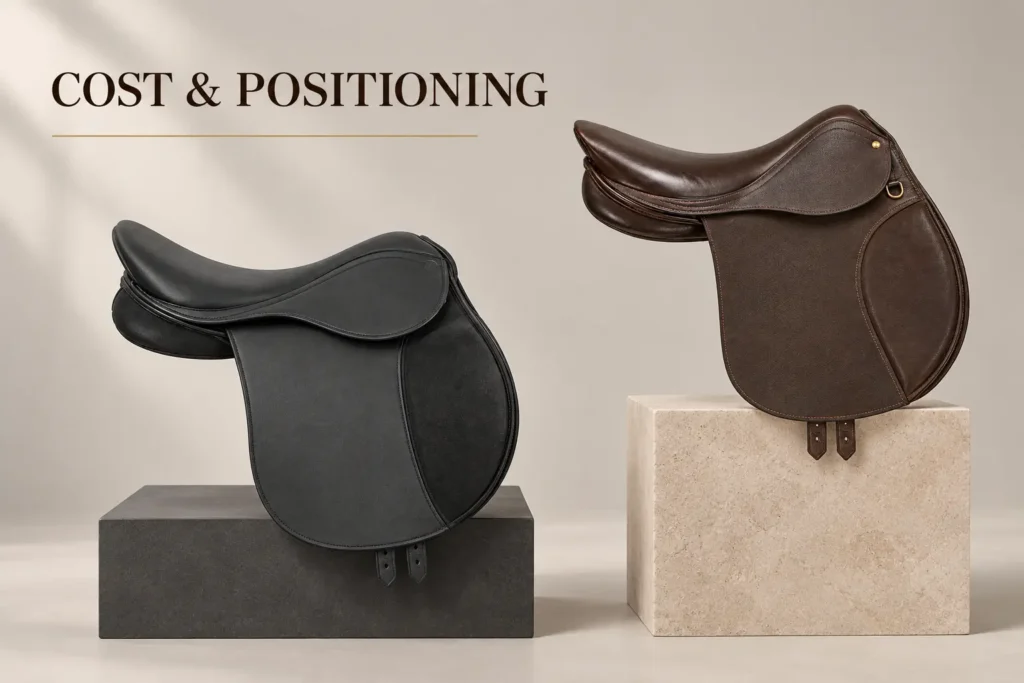
Leather generally increases material cost, cutting complexity and the need to manage natural variation. Synthetic materials can support a lower opening price, but the cheapest quote may also reduce padding quality, reinforcement, hardware or finish.
Compare quotations only after aligning the complete specification. Check whether the price includes:
- Tree and seat specification
- Outer material and reinforcement
- Panels or underside lining
- Billets, rigging or webbing
- Stirrups or other included accessories
- Branding and packaging
- Inspection and export packing
Retail positioning should be planned before the sample. If the collection promises traditional craftsmanship and premium material character, leather supports that story. If it promises easy care, lower weight and accessible pricing, synthetic may communicate the offer more clearly.
For a multi-tier range, use clear differences rather than nearly identical products at confusing prices.
Weight, Handling and Shipping
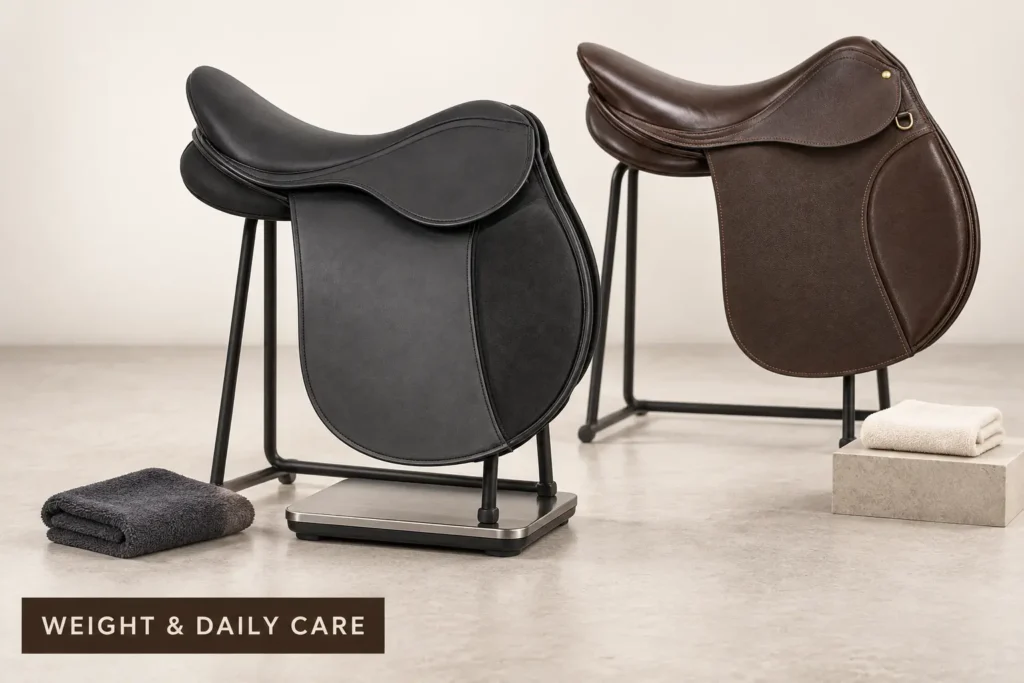
Synthetic saddles are often lighter because their covers and supporting components can weigh less than traditional leather assemblies. That can appeal to younger riders, riding schools, mobile instructors and customers who lift tack frequently.
Weight also affects a wholesale operation. Lighter units can simplify handling and may reduce freight or fulfillment costs, depending on carton dimensions and the carrier’s charging method.
Do not estimate from the material name. Ask the supplier to record:
- Finished saddle weight
- Included accessory weight
- Individual carton dimensions
- Gross packed weight
- Units per master carton or pallet, if applicable
A bulky lightweight saddle may still be charged by dimensional weight. Use packed measurements when calculating landed cost.
Durability, Cleaning and Long-Term Care
Durability depends on the complete construction, not only the outer surface.
A leather saddle can provide a long service life when the material, stitching, structure and care are suitable. Leather can develop visual character over time, but neglect, prolonged moisture, unsuitable cleaners or poor storage may lead to drying, staining or surface damage.
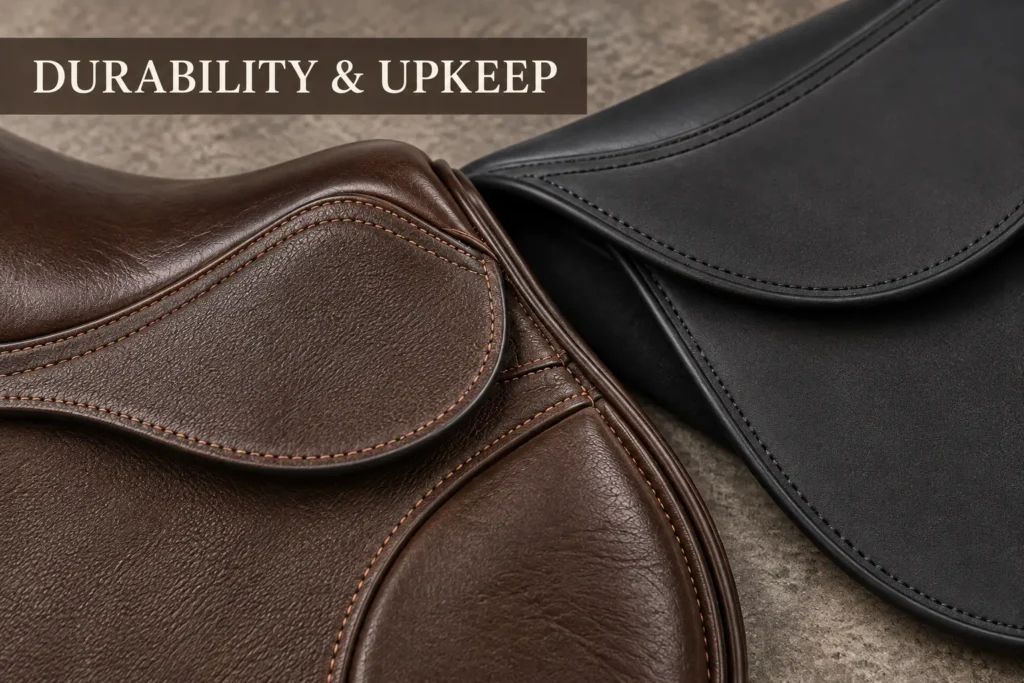
Synthetic saddles are generally easier to clean and less demanding in routine care. They can suit high-use environments where equipment is wiped down frequently. Their service life still depends on coating stability, seam quality, foam recovery, binding, reinforcement and hardware.
During sample approval, check:
- Surface response after repeated flexing.
- Stitching around loaded components.
- Edge and binding security.
- Billet, girth or rigging attachment.
- Padding recovery after compression.
- Color transfer during dry and damp rubbing.
- Cleaning response using the proposed care method.
Use tests that match the actual product and destination market. Record the accepted result so bulk units can be compared against it.
Comfort and Fit: Material Is Not the Main Answer
Leather and synthetic saddles can both be comfortable when their shape and construction are appropriate. Material does not correct a poorly chosen tree, uneven panels, unsuitable channel width or unbalanced seat.
For wholesale development, define:
- Intended riding discipline
- Seat sizes
- Tree width or fit options
- Panel or underside shape
- Channel clearance
- Seat depth and flap position
- Padding density
- Finished weight
Fit terminology is not perfectly standardized between suppliers. Approve measurements and a physical sample instead of relying only on labels such as medium or wide.
Retailers should also avoid presenting one saddle model as universally suitable for every horse. Provide accurate product measurements and encourage appropriate fitting support.
Which Customers and Markets Suit Each Material?
Leather Saddle Customers
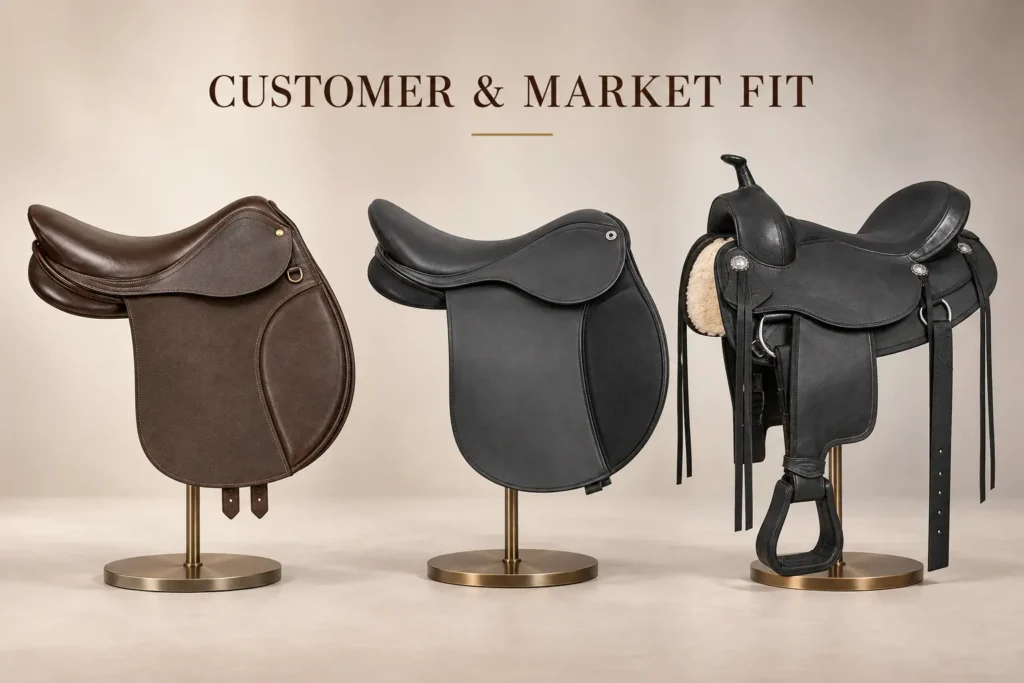
Leather can be a strong choice for:
- Premium tack shops
- Traditional English or Western collections
- Dressage, jumping and show-oriented ranges
- Riders who value natural material character
- Brands using craftsmanship and longevity in their positioning
In the UK and many European markets, leather remains closely associated with traditional English saddlery. The USA also supports strong leather demand across both English and Western categories.
Synthetic Saddle Customers
Synthetic models may suit:
- Entry-level and recreational riders
- Riding schools and lesson programs
- Buyers prioritizing lower weight
- Easy-care and wet-weather ranges
- Online retailers seeking accessible opening prices
- Practical trail and general-purpose collections
Do not treat the USA, UK or Europe as one uniform customer group. Analyze your own channel, discipline mix, target retail price and local terminology before placing the order.
HideOrax’s complete wholesale equestrian product catalog allows buyers to compare saddle categories with matching tack and accessories.
Should a Wholesale Range Carry Both?
For many retailers, a structured combination is stronger than choosing only one material.
A simple three-level assortment could include:
- Entry: A practical synthetic all-purpose saddle with controlled options
- Core: An upgraded synthetic or mixed-material model with improved padding and finish
- Premium: A leather saddle with refined materials, hardware and presentation
Each level needs a clear customer and price reason. Avoid adding variants that differ only slightly, because they divide inventory without creating a meaningful buying choice.
Start with representative colors and proven sizes. Expand after reviewing sales, returns, customer questions and reorder patterns.
Private-Label Considerations
Leather and synthetic saddles require different branding methods.
Leather can accept embossing, stamping, metal plates and selected decorative stitching. Synthetic products may use woven labels, molded badges, embroidery or printed elements. The method must suit the surface and remain secure during cleaning and use.
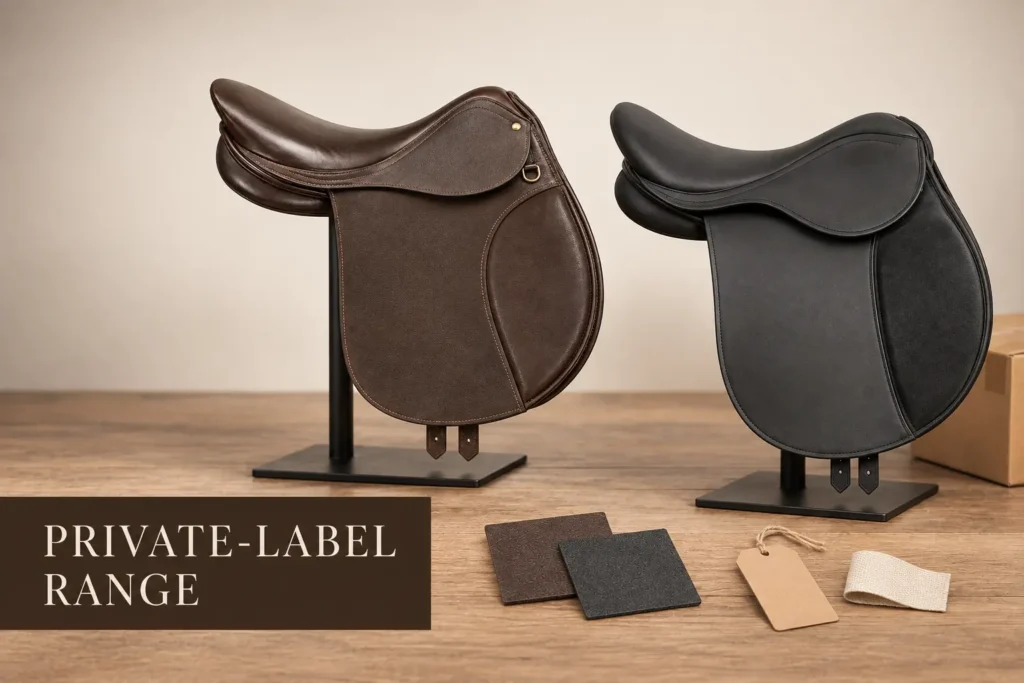
Before approval, confirm:
- Logo artwork and dimensions
- Exact placement
- Application method
- Color and hardware coordination
- Product label information
- Care instructions
- Country-of-origin marking
- Retail and export packaging
HideOrax’s private-label equestrian service supports agreed materials, colors, dimensions, branding and packaging before bulk production.
How to Approve Leather and Synthetic Saddle Samples
Use the same evaluation structure for both materials, but adjust the material-specific checks.
Check the Specification
Confirm dimensions, tree, padding, weight, color, hardware and included accessories against the quotation.
Compare Surface and Finish
For leather, review grain, shade variation, edge finish and natural markings. For synthetic material, review coating uniformity, texture, sheen, creasing and backing stability.
Inspect Structural Areas
Examine billets, rigging, stirrup bars, seams, webbing, attachment points and underside construction. Cosmetic appearance should not distract from structural inspection.
Record Corrections
Photographs should be supported by measurements and written changes. Keep the approved sample as the physical reference for bulk and repeat orders.
Frequently Asked Questions
Are synthetic saddles cheaper than leather saddles?
They are often priced lower, but not always. Cost depends on the tree, padding, synthetic material grade, reinforcement, hardware, branding and included accessories. Compare aligned specifications rather than material names alone.
Do synthetic saddles last as long as leather saddles?
Service life varies by construction, use and care. A high-quality synthetic saddle may perform well for years, while a poor leather saddle can fail early. Inspect seams, reinforcement, coating stability, padding and hardware during sampling.
Are synthetic saddles always lighter?
They are often lighter, but finished weight depends on the entire design. Request the actual saddle weight and packed shipping weight for every approved model.
Which saddle type is better for riding schools?
Synthetic saddles can be practical because they are often lighter and easier to clean. The final choice should still consider fit options, durability, replacement cost and the school’s riding disciplines.
Can a private-label brand sell both leather and synthetic saddles?
Yes. A tiered range can serve different customers and price points. Give each level a clear material, performance and branding position so the collection remains easy to understand.
Build the Range Around Your Customer
The best saddle material is the one that supports the intended customer, retail position and care expectations while meeting the approved fit and construction specification.
HideOrax manufactures leather and synthetic saddles for importers, wholesalers and private-label equestrian brands. To discuss your market, models, quantities, materials and branding, request a wholesale saddle quotation.