
A girth may be smaller than the saddle it supports, but a poor specification can create an outsized commercial problem. The wrong lengths, elastic, buckles or contour can turn a promising collection into slow stock and avoidable returns.
For importers, wholesalers and private-label equestrian brands, selecting horse girth types is not simply a choice between black and brown leather. Saddle configuration, discipline, sizing convention, horse shape, materials, hardware and regional terminology all affect the range. This guide explains those decisions from a B2B sourcing perspective.
Horse Girth vs Cinch: Start With the Correct Product Family
A girth and a cinch perform the same basic task: they help secure the saddle around the horse’s barrel. The products belong to different tack systems, however.
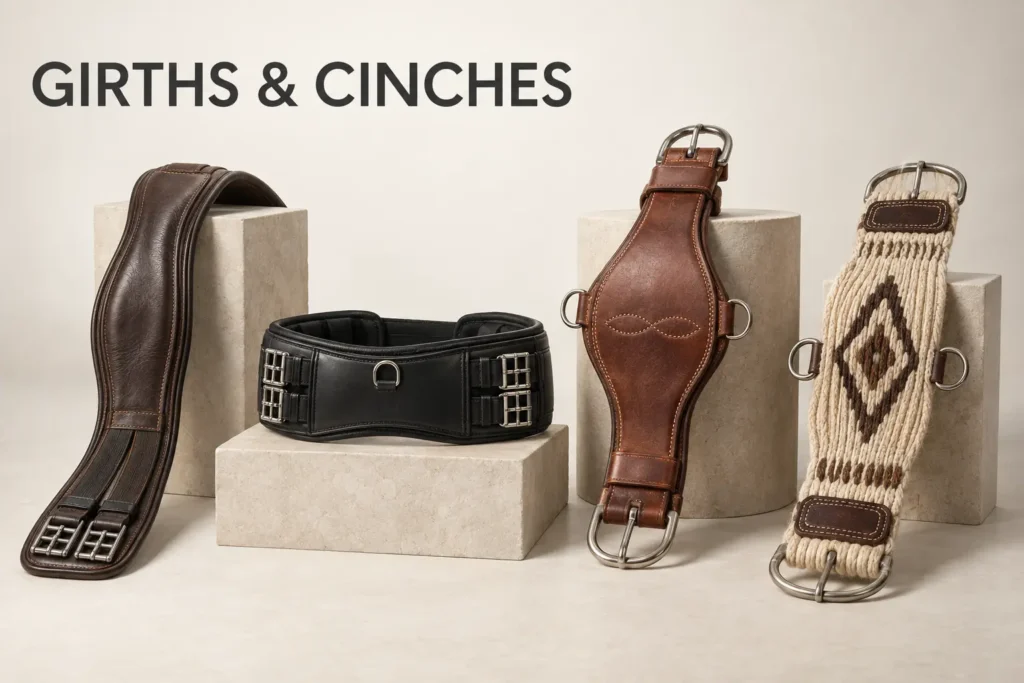
“Girth” is normally used for English saddles. Long girths connect to shorter billets on many general-purpose, jumping and close-contact saddles. Short or dressage girths connect to long billets, including those used on many dressage and monoflap saddles.
“Cinch” is the familiar Western term. A Western cinch connects to the saddle’s rigging with latigo or billet systems rather than English-style paired billets. Buyers should not treat an English girth and Western cinch as interchangeable versions of the same SKU.
| Product type | Typical saddle connection | Common use | Main wholesale decision |
|---|---|---|---|
| Long English girth | Short English billets | General-purpose, jumping and close-contact ranges | Lengths, elastic and buckle guards |
| Short dressage girth | Long billets | Dressage and many monoflap saddles | Padding, buckle position and short-size grading |
| Anatomical girth | Long or short configuration | Comfort-led English ranges | Genuine contour, symmetry and elbow clearance |
| Belly-guard girth | Usually long or monoflap configuration | Jumping and eventing | Guard dimensions, center attachments and weight |
| Western cinch | Western rigging, latigo or billets | Western riding and ranch, trail or arena ranges | Material, width, ring style and strand construction |
Main Horse Girth Types for Wholesale Buyers
Long English Girths
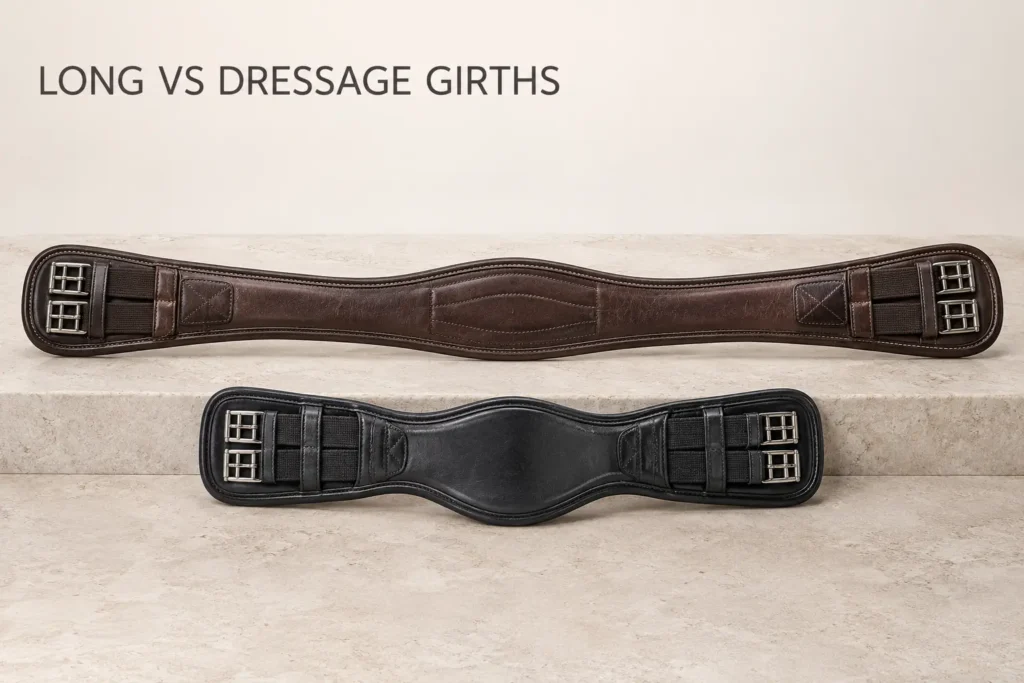
The long English girth is a core product for buyers selling general-purpose, jumping or close-contact saddles. It normally includes two buckles at each end, with optional elastic on one or both sides.
A wholesale specification should state measured length, padded-body length, elastic configuration, buckle type, strap spacing and attachment points. Two girths with the same stated size can fit differently when their elastic, buckle guards or padded ends use different proportions.
Short and Dressage Girths
Dressage girths are shorter because they work with longer saddle billets. The reduced overall length makes buckle placement and padding transitions especially important. Bulky ends, poorly positioned keepers or abrupt edges can be more noticeable in a compact design.
Confirm whether the style is intended for traditional dressage billets, a monoflap saddle or another long-billet arrangement. A matching length does not make every short girth suitable for every saddle.
Anatomical and Contoured Girths
An anatomical girth uses shaping rather than a uniformly straight body. Depending on the approved design, the pattern may create elbow clearance, broaden the sternum area or change the relationship between the center panel and buckle ends.
“Anatomical” should describe measurable construction, not serve as a decorative product name. Approve the full outline, centerline, left-right orientation and buckle angle. If the design is asymmetrical, the product and packaging must clearly show which direction faces forward.
Belly-Guard or Stud Girths
A belly-guard girth has a broad protective panel intended for jumping applications where the horse’s front shoes or studs may approach the underside of the body as the legs fold. It may also include a central ring or clip for attaching approved training equipment.
The larger leather area affects weight, cost and carton volume. Specify the guard’s dimensions, stiffness, edge profile, attachment hardware and whether the design is long, short or intended for a monoflap saddle.
Western Cinches
Western cinches may use leather, woven cord, mohair-style fibers, neoprene or other specified materials. Straight and roper profiles serve different product positions, while ring size, center D-rings and keeper details must match the intended rigging system.
For a US range, cinches should be managed as a separate product family with their own measurements, packaging language and quality checks. The English vs Western saddles guide explains why the two tack systems require separate specifications.
Straight vs Anatomical Girth Shapes
Straight girths use a relatively consistent line from end to end. They provide a simple core option, but one pattern will not suit every horse and saddle combination.
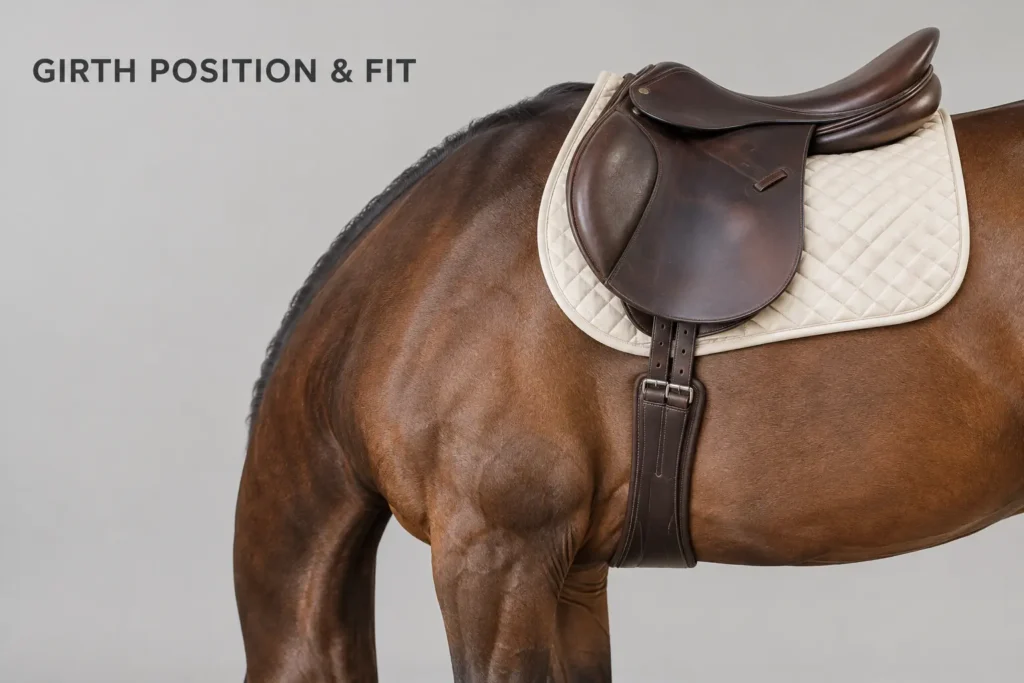
Contoured designs may narrow near the elbows, widen centrally or curve forward or backward. Because terms such as anatomical, crescent and asymmetrical are not universal standards, supply an approved sample, full-size pattern or dimensioned drawing.
Inspect the sample laid flat and curved naturally. Both sides should match the approved pattern, padding transitions should remain smooth and buckles should align without twisting the elastic.
Horse Girth Sizing and Measurement
Girth sizes are commonly sold in inches in the USA and UK and in centimeters across much of continental Europe. Many ranges use two-inch or five-centimeter increments, but those increments are not exact equivalents. Choose one measurement system as the technical master and treat the other as a customer-facing conversion.
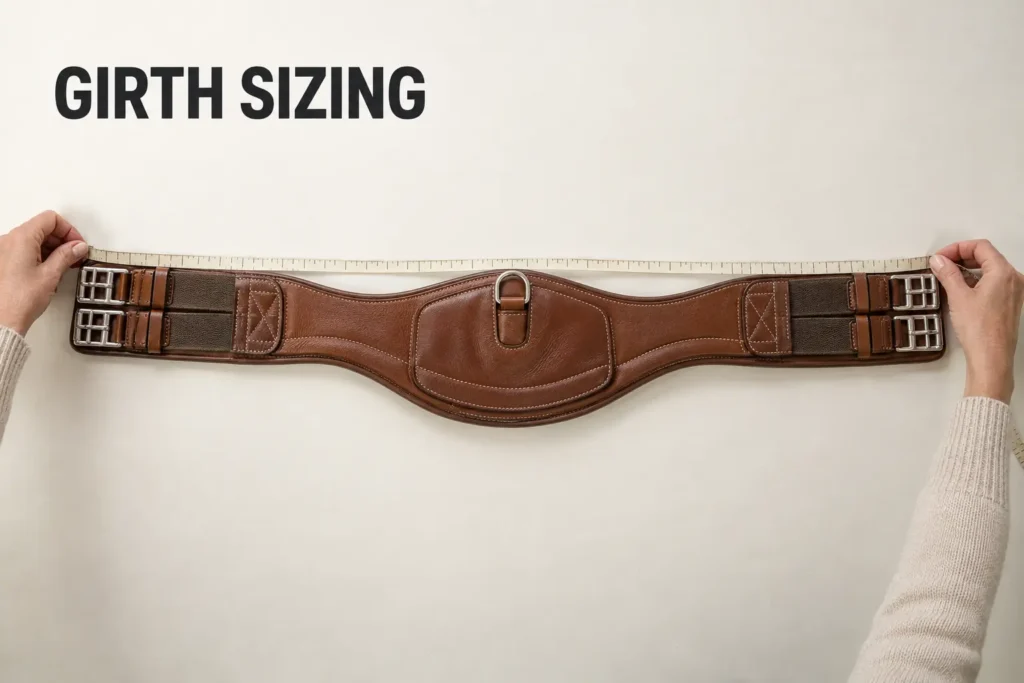
The specification should define exactly how finished length is measured. Depending on the supplier, the reference may be taken between buckle ends, inner buckle edges or another documented point. A label that says “50 inches” is not enough unless the measurement method is recorded.
For every size, document:
- Finished relaxed length and measurement points
- Padded-body length and maximum width
- Elastic length when relaxed
- Buckle and strap spacing
- Center attachment position
- Hole or adjustment range, where relevant
- Finished product weight
Saddle billets, pad thickness and tack configuration can change the required length. Approve more than one size: the shortest and longest often expose grading or proportion problems hidden in the middle sample.
Leather, Padding, Elastic and Hardware
A leather girth is repeatedly tensioned, released, exposed to sweat and cleaned. Buyers should therefore specify the construction layer by layer rather than requesting only “genuine leather.”
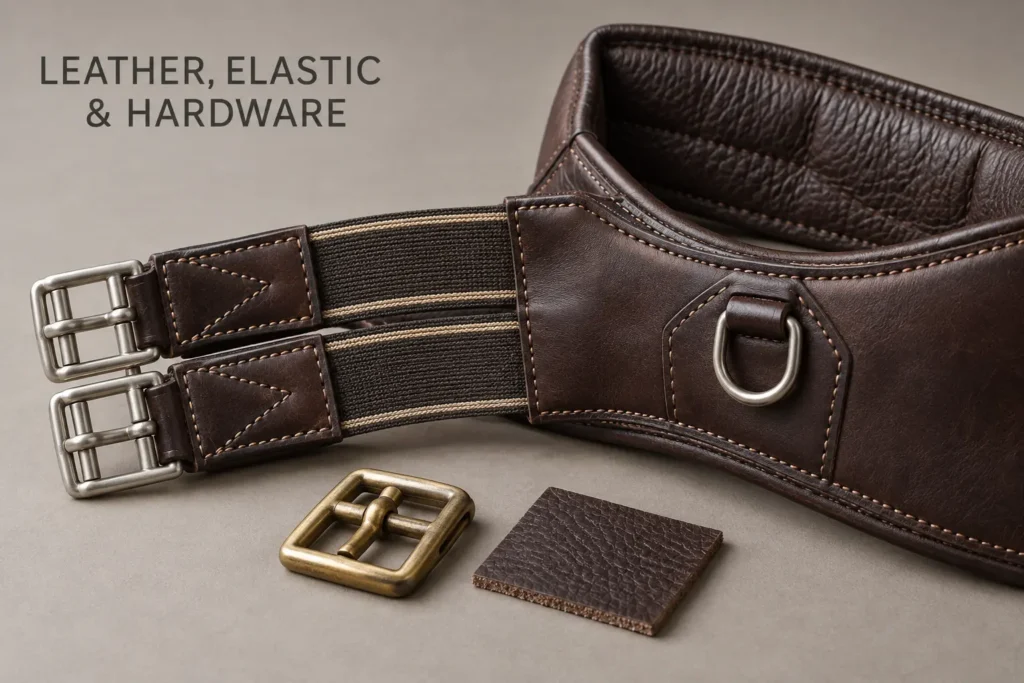
The technical sheet may include:
- Outer leather type, thickness, temper and finish
- Lining material and cleanability
- Padding material, thickness and density
- Reinforcement beneath buckles and attachment points
- Edge construction and stitching specification
- Elastic width, color, stretch and recovery expectation
- Buckle base material and surface finish
- D-rings, clips or attachment tabs
Record whether elastic appears on one side or both, its relaxed length and its behavior after repeated extension. Soft elastic may change effective sizing, while rigid elastic may provide little adjustment.
Roller buckles should turn cleanly, tongues should align with the billet or strap, and metal finishes should match coordinating tack. The finished underside should remain smooth, with no exposed edges or hardware that could create unnecessary pressure points.
HideOrax’s leather horse girth range includes long, dressage, anatomical and belly-guard configurations developed against buyer specifications.
Which Girth Range Suits the USA, UK and Europe?
USA
US buyers may serve both English and Western customers. English collections can include long jumping or all-purpose girths, short dressage models and belly guards. Western collections use cinch terminology and require their own rigging-compatible designs. Inches should be prominent on size labels, even if production records also contain centimeters.
UK
The UK market strongly supports English tack for general-purpose, jumping, eventing, dressage and showing customers. Long girths, dressage girths and anatomical options can form a focused range. Use familiar terms such as GP, girth and stud girth, and provide clear measurements rather than relying on size names.
Continental Europe
European distributors may prioritize dressage, jumping, monoflap and anatomical styles, but demand varies by country. Centimeter sizing, translated packaging and precise technical data are useful. Confirm hardware, leather finish and attachments with each distributor rather than applying one “European” assortment everywhere.
Building a Profitable Wholesale Girth Assortment
A good opening range covers clear needs without creating unnecessary size and color combinations. One practical structure is:
- A straight long girth as the core English model.
- A short dressage girth for long-billet saddles.
- A premium anatomical model.
- A belly-guard option for jumping customers.
- A separate Western cinch group if the sales channel serves Western riders.
Concentrate opening quantities in the sizes and colors supported by retailer data. Additional hardware finishes, contrast stitching and specialty linings can follow after the core range produces sales evidence.
The wholesale horse tack range guide explains how girths can be planned alongside saddles, bridles, reins, stirrups and pads instead of being purchased as disconnected accessories.
How to Evaluate a Horse Girth Manufacturer
A sample should be judged against measurable requirements, not only photographed from the front.
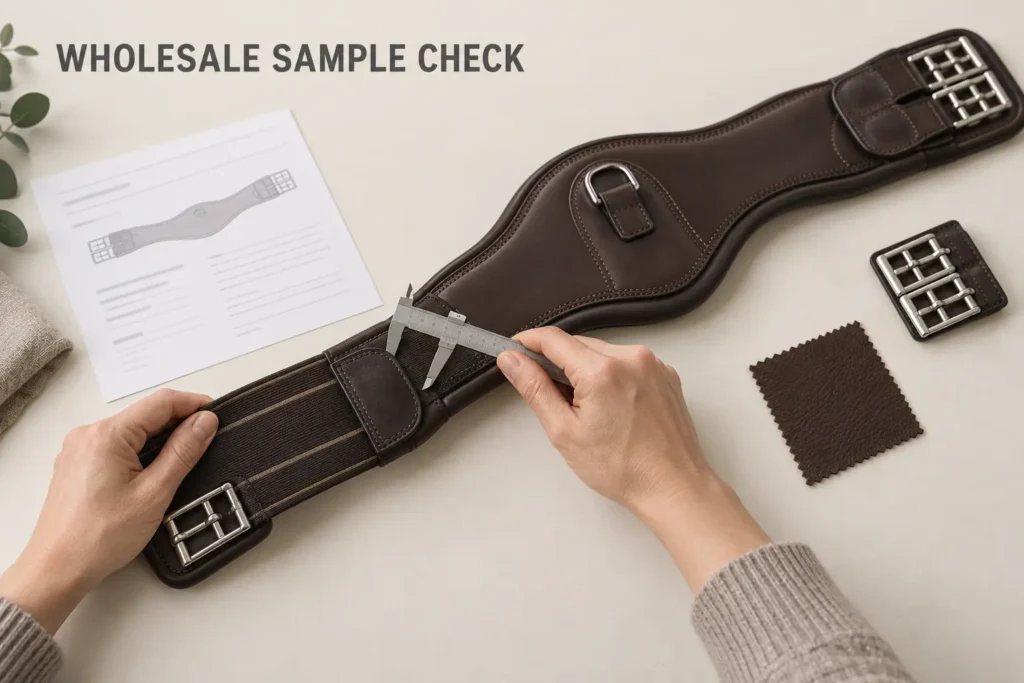
Check:
- Finished length using the agreed method
- Left-right symmetry and approved contour
- Elastic width, attachment and recovery
- Buckle alignment and roller movement
- Stitching at high-load areas
- Padding consistency and smooth underside finishing
- D-ring and clip position
- Leather shade across coordinating products
- Logo, labels, size marking and packaging
Ask how patterns are graded and how the approved sample is retained for repeat orders. A manufacturer should be able to reproduce the same contour, elastic behavior and hardware placement across sizes, not merely match the color.
HideOrax’s private-label equestrian manufacturing service covers agreed dimensions, materials, hardware, branding and packaging before bulk production. The standard MOQ for most tack products is 10 pieces, with sampling normally completed in 5–7 working days after specification confirmation.
Wholesale Horse Girth RFQ Checklist
Send the supplier:
- Girth or cinch type
- Intended saddle and discipline
- Target country and sales channel
- Measurement method and size range
- Full outline or reference sample
- Leather, lining and padding specifications
- Elastic configuration
- Buckle and attachment hardware
- Colors, stitching and branding
- Quantity by style, size and color
- Packaging and labeling requirements
Clear inputs allow suppliers to quote the same product and give buyers a reliable basis for comparing samples.
Frequently Asked Questions
What are the main types of horse girths?
The main commercial types include long English girths, short dressage girths, anatomical or contoured girths and belly-guard girths. Western saddle programs use cinches, which should be specified as a separate product family.
What is the difference between a long girth and a dressage girth?
A long girth normally works with the shorter billets found on many general-purpose and jumping saddles. A short dressage girth connects to long billets used on dressage and many monoflap saddles. Saddle configuration matters as much as the labeled length.
Are horse girth sizes standardized between brands?
No. Size labels may use inches or centimeters, and manufacturers may measure between different reference points. Buyers should approve a written measurement method and a finished-size chart for the complete range.
Is an anatomical girth always better than a straight girth?
No single shape suits every horse and saddle. An anatomical design should have a defined, repeatable contour developed for an intended fit requirement. The product still needs appropriate sizing, adjustment and professional fitting where necessary.
Can leather horse girths carry private-label branding?
Yes. Depending on the design, branding can include embossing, stamped marks, approved metal badges, labels and custom packaging. Confirm the exact position and appearance on the sample before bulk production.
Develop Your Wholesale Horse Girth Range
A successful girth collection connects the right construction with the intended saddle, market and size system. Clear measurements, controlled materials and an approved sample make the range easier to sell and more reliable to reorder.
To develop long, dressage, anatomical or belly-guard girths for the USA, UK or Europe, request a wholesale quotation from HideOrax. Include your target market, size range, materials, branding and expected quantity so the team can confirm the correct sampling route.