
Two saddles can use premium leather and skilled stitching yet require completely different trees, components, assembly methods and quality-control checks.
For importers, wholesalers and private-label equestrian brands, understanding these differences is essential. A specification that works for an English saddle cannot simply be transferred to a Western model. Tree geometry, leather weight, rigging, hardware, rider position, packaging size and target-market expectations must all be defined separately.
This guide compares English vs Western saddles from a manufacturing and sourcing perspective, helping wholesale buyers develop clearer specifications, evaluate samples and select the right range for their market.
English vs Western Saddle Construction at a Glance
English saddles are generally compact, close-contact designs with separate panels, relatively short skirts, billets and discipline-specific flap shapes. Western saddles normally use broader skirts, larger tree bars, substantial rigging, fenders, wider stirrup leathers and, on most models, a horn.
These are functional construction differences, not simply styling choices.
| Manufacturing area | English saddles | Western saddles | Why it matters to buyers |
|---|---|---|---|
| Tree structure | Compact tree with defined head, points, rails and cantle | Wider structure with bars, fork, cantle and usually a horn | Tree specifications cannot be shared between the two styles |
| Underside construction | Separate padded panels using wool, foam or another specified filling | Broad skirts normally lined with fleece or another specified material | Different inspection and material requirements |
| Leather components | Seat, flaps, knee blocks, panels, billets and small skirts | Large skirts, jockeys, fenders, stirrup leathers and rigging components | Western models usually require larger and heavier leather sections |
| Girthing system | Billets connected to an English girth | Rigging plates or rings used with cinch straps and related components | Hardware position and attachment strength must be specified |
| Typical decoration | Clean lines, contrast stitching, piping and discreet branding | Tooling, conchos, decorative stitching, silver-look fittings and horn details | Decoration can significantly affect production time and cost |
| Packing requirements | Usually lighter and more compact | Often heavier with greater carton volume | Freight and warehouse calculations differ |
Buyers developing a mixed collection should treat each style as a separate product family. HideOrax’s wholesale equestrian product range provides examples of English, Western and synthetic saddle categories alongside coordinating tack and accessories.
What Defines English Saddle Construction?
An English saddle is designed to maintain relatively close contact between the rider and horse. Its compact profile and discipline-specific geometry affect almost every manufacturing decision.
Dressage saddles commonly use long, straighter flaps and a deeper seat. Jumping and close-contact saddles normally have shorter, more forward-cut flaps. All-purpose saddles balance these characteristics for buyers serving general riding markets.
A typical English saddle may include:
- A discipline-specific saddle tree
- Seat webbing and padding
- Symmetrical underside panels
- Main and sweat flaps
- Knee rolls or blocks
- Billets for girth attachment
- Stirrup bars
- Seat, piping and edge finishing
- Branding plates, stamps or badges
Panel shape, channel width, flap angle, billet placement and block position must be controlled during sample development. Small differences can change the saddle’s appearance, balance and consistency across a production run.
Wholesale buyers should therefore provide more than a reference photograph. The manufacturer needs seat sizes, tree options, flap measurements, panel configuration, leather specification, hardware finish, colors and intended discipline.
What Defines Western Saddle Construction?
Western saddles have a broader structure designed around the tree bars, skirts, rigging, fenders and substantial rider-support components.
Most Western designs also include a horn, fork or swell, cantle, seat jockeys, rear jockeys, stirrup leathers and larger stirrups. The exact configuration varies between trail, barrel, roping, cutting and other Western styles.
A typical Western saddle may include:
- A Western saddle tree with defined bar geometry
- Fork or swell and cantle
- Horn on most conventional models
- Ground-seat layers
- Large leather skirts
- Front and rear jockeys
- Rigging plates, rings or dees
- Fenders and stirrup leathers
- Western stirrups
- Fleece or another specified underside lining
- Conchos, tooling and decorative hardware
Western saddles often require more leather surface area than English saddles. Large matching sections are needed for skirts and fenders, while decorative tooling can add several production stages.
A buyer should specify the Western discipline rather than requesting only a “Western saddle.” A lightweight barrel saddle and a reinforced roping saddle may have different trees, rigging, seat shapes, leather weights and hardware requirements.
English vs Western Saddle Tree Differences
The tree provides the main structural foundation of a conventional saddle. English and Western trees differ in shape, terminology and the way other components are attached to them.
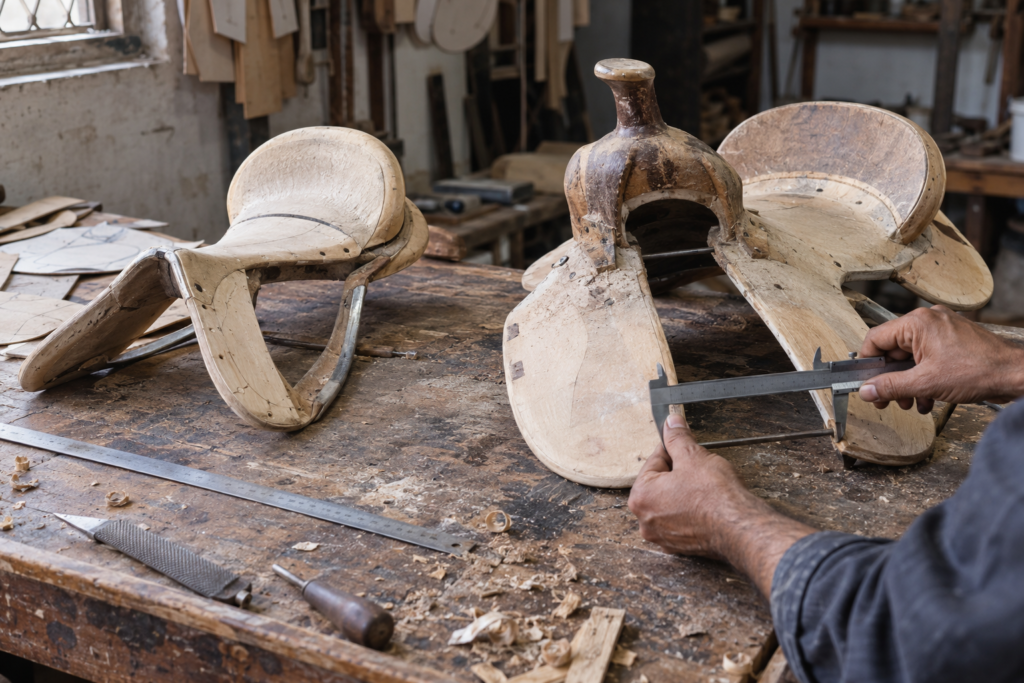
English Saddle Trees
An English tree normally includes a head or arch, tree points, rails, waist and cantle. Its shape supports a compact seat and separate panels while allowing the flaps to sit relatively close to the horse.
Depending on the buyer’s specification, tree materials may include laminated wood with metal reinforcement, moulded synthetic materials or composite construction.
Important buyer specifications include:
- Seat size
- Tree width or head configuration
- Tree-point length and direction
- Rail profile and longitudinal curvature
- Cantle height and shape
- Intended discipline
- Approved tolerances between production units
Terms such as narrow, medium and wide are not automatically consistent between manufacturers. Buyers should record actual measurements and approve a physical sample rather than relying only on a general width label.
Western Saddle Trees
A Western tree is normally described using its bars, fork or swell, cantle, gullet area and horn configuration. The bars create the foundation for the broad skirts and influence how the saddle sits along the horse’s back.
Specifications may include:
- Bar angle and spread
- Bar length, rock and flare
- Gullet width and height
- Fork or swell width
- Cantle height and dish
- Horn dimensions
- Seat size and profile
- Tree covering or finishing method
Traditional Western trees may use wood covered with rawhide or another protective material, while modern production can also use fibreglass-covered or moulded synthetic structures.
Because terminology differs between suppliers, buyers should request measurements, photographs and a written tree specification. A sample tree or approved saddle should remain the reference for repeat production.
Leather and Material Differences
English saddles usually require a clean, controlled surface finish across the seat and flaps. Western saddles frequently require heavier leather sections, larger matching hides and additional decorative finishing.
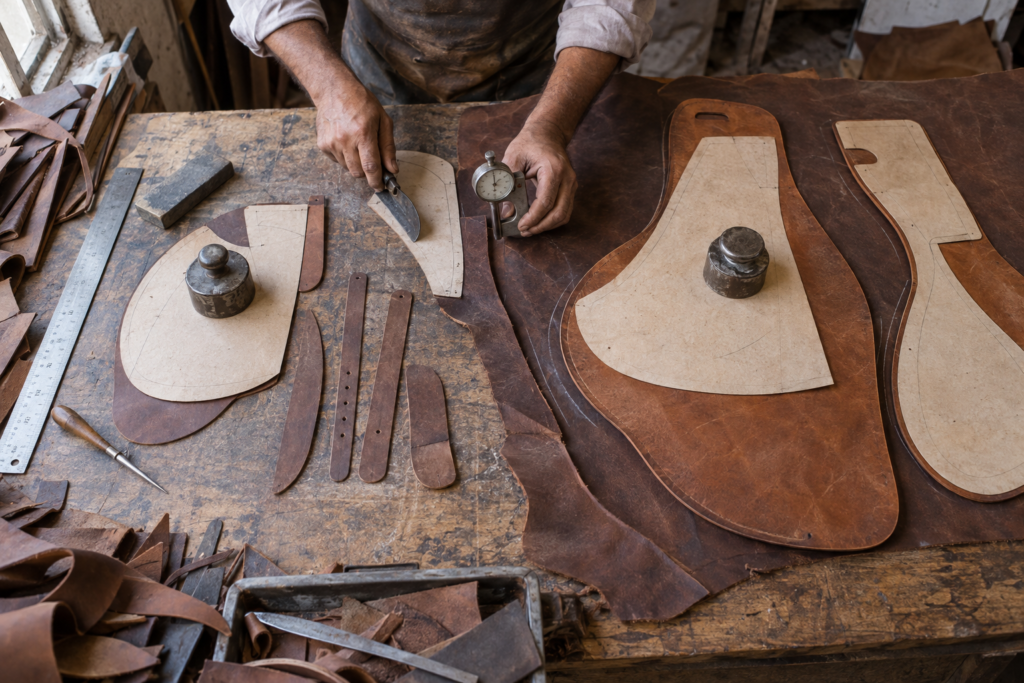
Materials Used in English Saddles
English saddle buyers should specify:
- Leather type and grade
- Thickness and temper
- Surface grain and finish
- Seat and flap color
- Panel material and filling
- Billet material
- Padding density
- Hardware material and finish
- Stitching color and specified stitch length
Leather temper matters as much as thickness. Flaps need the correct balance of structure and flexibility, while billets and high-stress components require suitable strength.
Panel filling may use wool, foam, latex or another agreed system. The material should be documented because it affects production, inspection and future servicing.
Materials Used in Western Saddles
Western saddles often use heavier vegetable-tanned leather for skirts, fenders, jockeys and tooling. Buyers may also specify suede or smooth seat materials, decorative rawhide, fleece lining, latigo components and metal fittings.
The specification should identify:
- Leather thickness for each component
- Leather color, oil content and finish
- Tooling pattern and coverage
- Skirt and fender dimensions
- Seat material
- Underside lining
- Concho and hardware finish
- Rigging components
- Stirrup material and covering
- Edge staining and surface treatment
Buyers in the USA may commonly receive leather thickness in ounces, while UK and European specifications may use millimetres. Recording both measurements can reduce confusion between the buyer, material supplier and production team.
Synthetic material is a separate decision from saddle style. Both English-shaped and Western-shaped saddles can use non-leather components, so “synthetic saddle” should not be treated as another name for an English saddle.
How the Manufacturing Processes Differ
English and Western saddle production share several foundation stages: specification review, material inspection, pattern cutting, tree preparation, assembly, stitching, hardware fitting, finishing and final inspection.
The sequence and production emphasis, however, are different.
English Saddle Manufacturing
English saddle production places strong emphasis on controlled symmetry and close alignment between the tree, seat, panels, flaps and blocks.
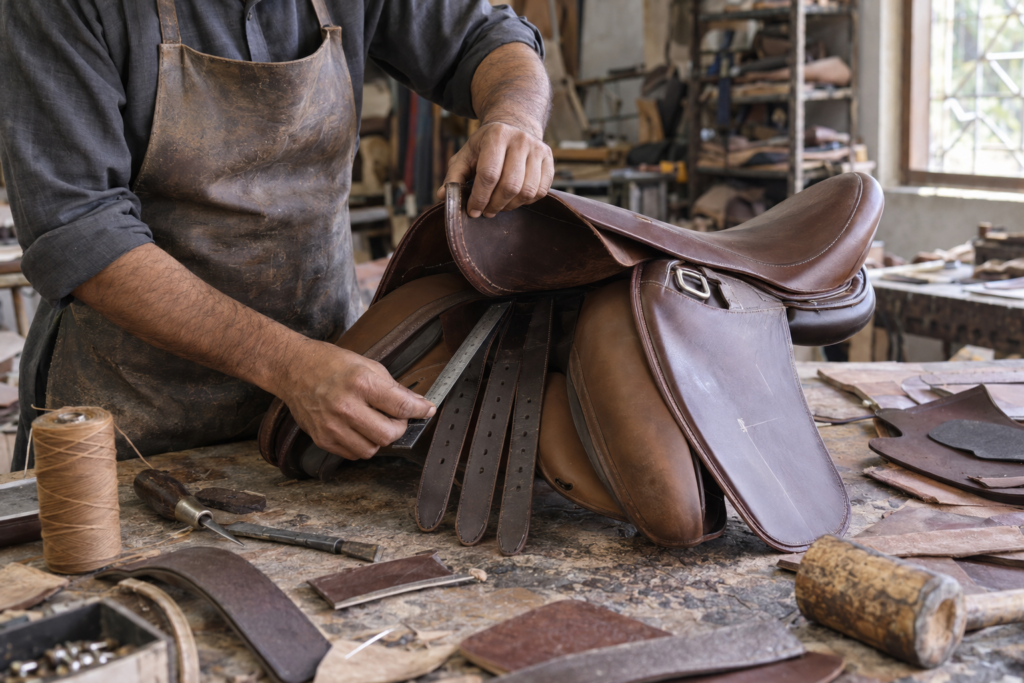
Production commonly involves:
- Checking the tree against the approved specification.
- Building the seat foundation and padding.
- Cutting and preparing leather components.
- Constructing and positioning the panels.
- Fitting the flaps, knee rolls or blocks.
- Attaching billets and stirrup bars.
- Completing structural stitching and edge finishing.
- Inspecting symmetry, measurements, hardware and surface finish.
Panel consistency is especially important. Uneven filling, different panel shapes or misaligned flaps can create visible differences between saddles within the same order.
Western Saddle Manufacturing
Western saddle production centres on the broader tree structure, ground seat, rigging, skirts and larger leather assemblies.
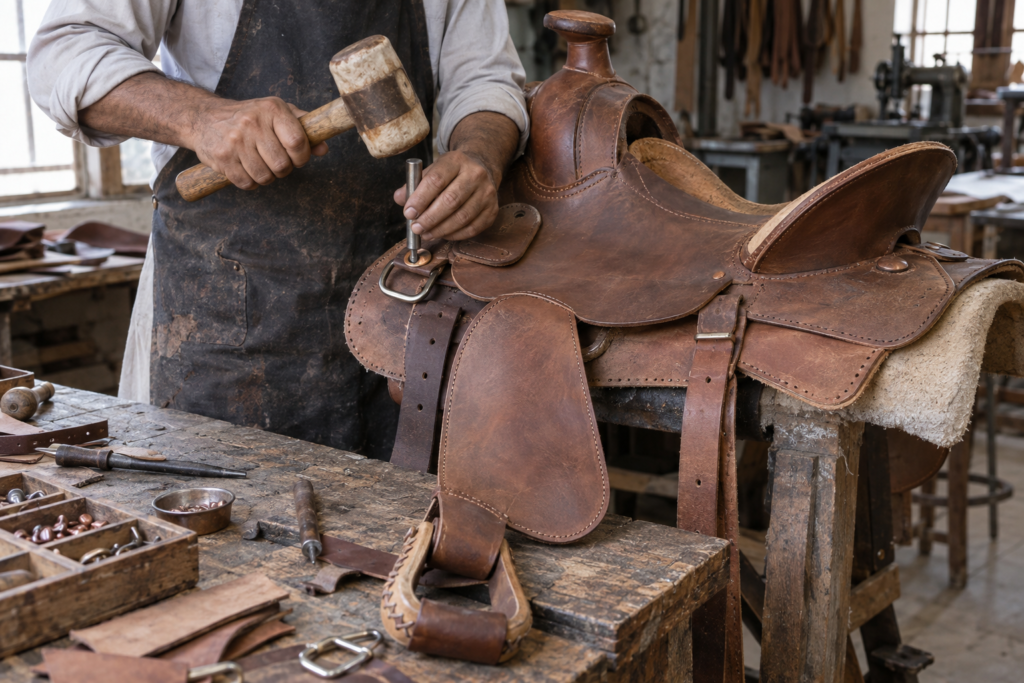
The process may include:
- Inspecting and preparing the Western tree.
- Forming the ground seat.
- Cutting skirts, jockeys, fenders and other leather pieces.
- Installing and aligning the rigging.
- Shaping and attaching skirts and jockeys.
- Preparing fenders, stirrup leathers and stirrups.
- Covering or finishing the horn.
- Adding tooling, conchos and decorative details.
- Lining the underside and completing final assembly.
- Inspecting measurements, alignment, hardware and finish.
Detailed tooling, multiple oiling stages and decorative hardware can substantially increase labour time. These features should be included in the quotation specification rather than added after sample approval.
HideOrax documents its approach from material review through inspection and export packing on the equestrian manufacturing process page.
Which Markets and Buyers Suit Each Style?
English saddle collections are generally most relevant to buyers serving dressage, jumping, eventing, schooling and general English-riding customers. These categories are particularly established in the UK and across many European markets, although the USA also has a significant English-riding sector.
Western saddles are especially relevant to American tack retailers, Western lifestyle brands, trail-riding suppliers and businesses serving barrel, roping, cutting or ranch-related disciplines. Western riding also has specialist markets in Europe and the UK, but product selection should reflect the buyer’s actual customer base.
A buyer choosing between the two should review:
- Disciplines served by existing customers
- Common local seat sizes
- Preferred tree and fit options
- Expected retail price
- Leather and decoration preferences
- Acceptable product weight
- Freight and warehouse costs
- Required matching tack
- Branding and packaging expectations
For private-label programs, each product should have its own specification sheet, sample record and reference code. HideOrax’s private-label equestrian manufacturing service covers custom materials, dimensions, colors, padding, hardware, branding and packaging agreed before bulk production.
How to Evaluate an English or Western Saddle Manufacturer
A manufacturer should be assessed on production control and repeatability, not only the appearance of one finished sample.
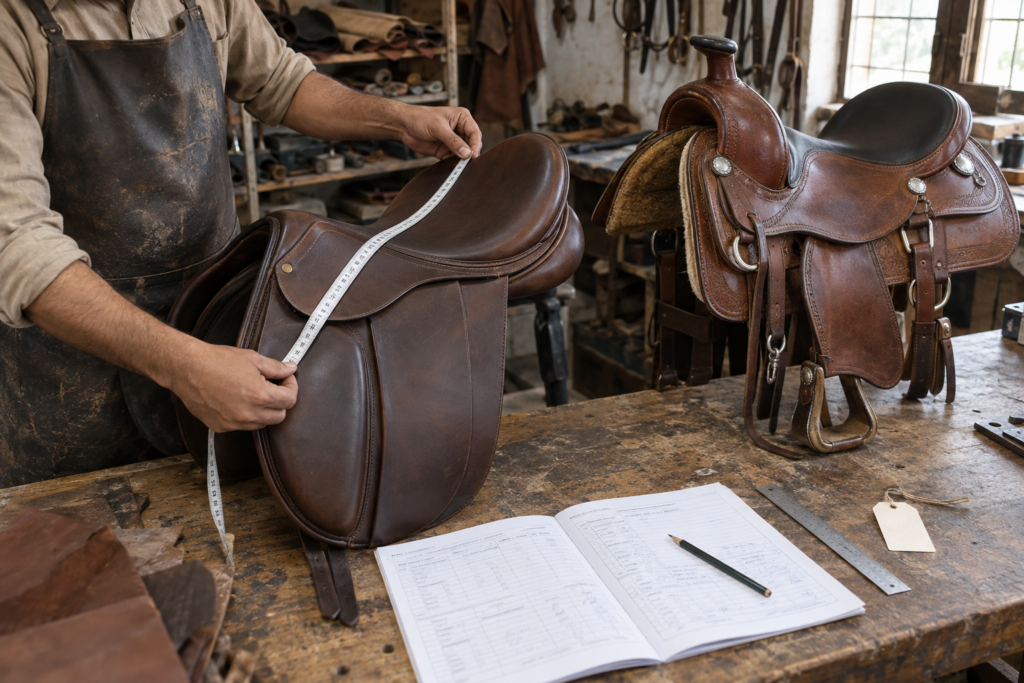
Before placing a wholesale order, ask the following questions:
Does the supplier control production?
Confirm where trees are inspected, leather is cut, components are assembled and final inspection is completed. Factory photographs should show real production stages connected to the products being ordered.
Can the supplier work from a written specification?
The quotation, sample and bulk order should refer to the same materials, measurements, hardware and branding details. Verbal descriptions alone leave too much room for variation.
Is a sample produced before bulk manufacturing?
The approved sample creates a physical reference for dimensions, construction, color, stitching, hardware and branding. Corrections should be recorded in writing before production begins.
Are English and Western saddles inspected differently?
They should share a general quality-control system, but the checkpoints must match the product.
English saddle inspection may focus on panel and flap symmetry, billet positioning, channel consistency and block alignment. Western saddle inspection may focus on rigging alignment, skirt balance, fender movement, horn finishing and decorative consistency.
Can repeat orders match the approved reference?
Ask how patterns, component specifications, leather colors, tree details and branding positions are recorded. Repeatability matters more to a long-term wholesale program than a single attractive sample.
For a broader supplier checklist, read How to Choose a Private Label Saddle Manufacturer.
Wholesale Specification Checklist
Before requesting a quotation, prepare:
- Saddle type and discipline
- Target country and customer segment
- Required seat sizes
- Tree specifications
- Leather or synthetic material details
- Color and surface finish
- Panel or underside construction
- Hardware and rigging requirements
- Branding placement
- Packaging requirements
- Initial quantity
- Reference photographs or technical drawings
- Required sample and delivery schedule
A complete specification allows manufacturers to quote the same product and gives buyers a clear basis for comparing samples.
Frequently Asked Questions
Which costs more to manufacture, an English or Western saddle?
There is no universal answer. Western saddles often use more leather, larger components and heavier hardware. Tooling and decorative finishing can also increase labour. A premium English saddle with specialised leather, detailed panels and complex block construction may cost more than a simple Western model. Compare quotations only after defining the full specification.
Are Western saddles always heavier than English saddles?
Western saddles are generally heavier because they commonly use broader trees, large skirts, fenders, substantial rigging and larger stirrups. Lightweight Western models and heavier specialist English saddles are exceptions, so buyers should request the finished sample weight and packed carton weight.
Can the same manufacturer produce both English and Western saddles?
Yes, provided the manufacturer has the correct trees, patterns, equipment, skilled workers and product-specific quality controls. Buyers should review samples from both categories rather than assuming experience with one style automatically proves capability in the other.
What information should I send for a wholesale saddle quotation?
Send the saddle style, discipline, target market, seat sizes, tree requirements, leather and color preferences, hardware, branding, packaging, quantity and destination country. Include reference photographs or technical measurements where available.
What is HideOrax’s minimum order for saddles?
The standard minimum order is five saddles. A sample can be developed before bulk production after the product specification is confirmed. Final quantities, pricing and timing depend on the selected style, materials and customization.
Develop Your Wholesale Saddle Range
Whether you are sourcing English saddles for a UK or European collection, Western saddles for the USA, or a mixed private-label range, begin with a written specification and an approved sample.
Request a wholesale quotation from HideOrax with your required saddle type, quantity, destination, materials and branding details. The team will review your requirements and confirm the appropriate sampling and production route.