
A wholesale horse girth order can look straightforward until the first sample arrives. The stated length may have been measured from different points, the buckles may sit differently against the saddle’s billets, or the padding may change the way the girth lies against the horse.
For equestrian brands, tack retailers and importers in the USA, UK and Europe, a useful girth specification begins with the intended saddle and riding use. It then defines the style, finished dimensions, materials and sample checks. This guide takes you through those decisions so a manufacturer can quote a product that you can inspect and reorder.
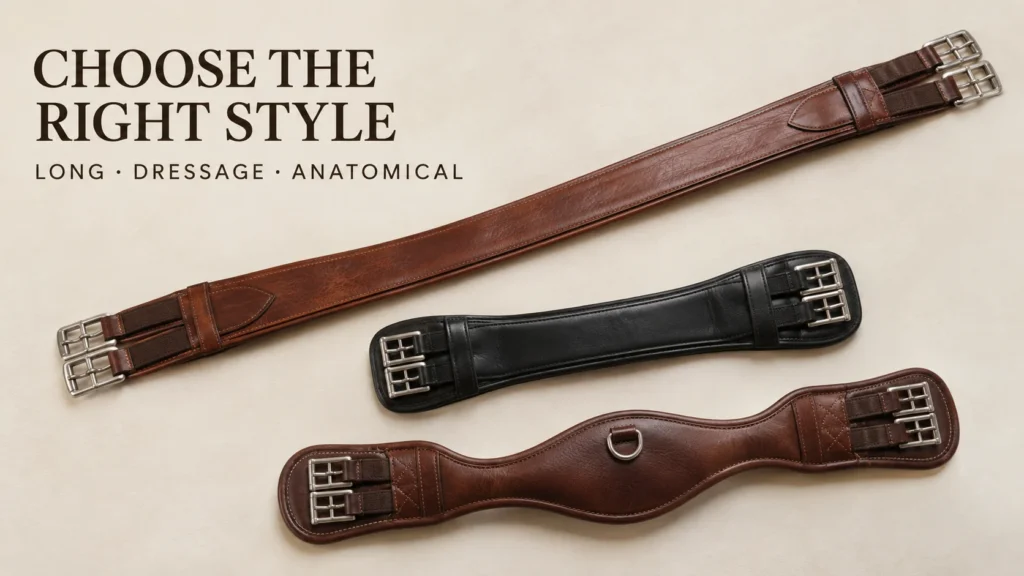
HideOrax lists long, dressage, anatomical and belly-guard leather configurations in its horse girth manufacturing range. The final dimensions, lining, elastic and hardware are agreed against the buyer’s specification and approval sample. HideOrax
Start with the saddle, then choose the girth
A product brief should identify the saddle arrangement before it names a girth style. Note the saddle type, billet or girthing arrangement, intended use and the sizes your customers request. If you already sell an English saddle range, send the saddle model or clear photographs of its billets with the girth enquiry. That gives the manufacturer a better reference than the phrase “standard English girth.”
| Girth style | Typical buying question |
|---|---|
| Long leather girth | Does this length and buckle position work with the intended English saddle and billet arrangement? |
| Short dressage girth | Where should the buckles sit when used with the saddle’s longer billets? |
| Anatomical girth | What exact contour is required, and has that shape been checked on the intended horse and saddle combination? |
| Belly-guard girth | What protective profile, clearance and attachment details does the jumping range require? |
These names describe starting points, not universal fit. An “anatomical” label does not establish that a particular contour will suit every horse. Approve the actual design in use and describe it accurately on your retail page.
HideOrax publishes all four configurations and offers custom lengths, contour shapes, padding, lining, elastic, buckles and attachment points through sampling. HideOrax
Define how the length is measured
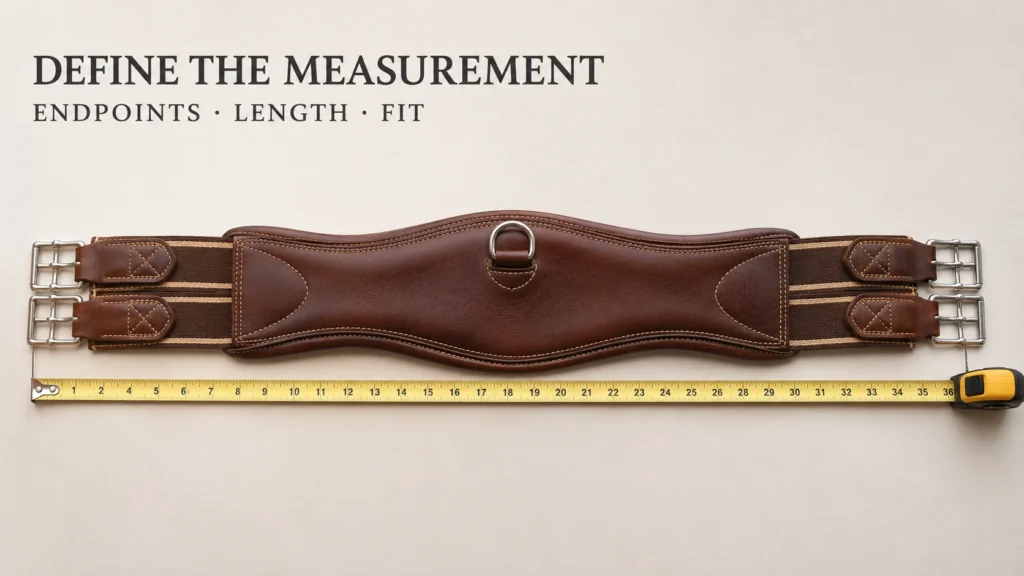
A number on a girth label is useful only when the buyer and manufacturer measure the same finished points. Do not send a size list without its measurement method.
For each size, provide:
- The two endpoints used to measure finished length, shown on a photograph or drawing.
- Whether the girth is measured laid flat and under what condition.
- The master unit used for production, such as centimetres or inches.
- The required lengths for every variation.
- Any agreed production tolerance.
- The width at important points, including the centre and buckle ends.
- The position and usable length of any elastic section.
The USA commonly uses inches in retail descriptions; UK and European buyers may also expect centimetres. A product listing can display both, but the production specification should identify one master unit and a single measurement method. Convert the other unit for the customer-facing size chart, rather than creating two independently rounded specifications.
A size chart should also explain what the number measures. For example, a diagram identifying the agreed buckle-related endpoints is more helpful than an unexplained list of “20, 22, 24.” Have the finished sample measured by the same method before approving its label.
Specify the materials component by component
“Full-grain leather girth” does not describe every layer or fitting. The buyer’s technical sheet should identify what goes into the body and what the horse and rider will actually encounter.
| Area | What to specify |
|---|---|
| Outer body | Leather type, colour, finish, shape and visible stitching |
| Horse-facing side | Lining material, surface, seam placement and edge finish |
| Padding | Position, thickness and finished profile |
| Elastic | Whether present, which end or ends, width and approved feel or construction |
| Buckles | Number, size, finish, placement and required compatibility with the intended billets |
| Attachment points | Any D-rings or other fittings, with position and intended function |
| Brand details | Logo method, position, size mark, label and packaging |
HideOrax describes full-grain leather with buyer-specified lining and hardware for this product family. Its published options include padding, elastic and buckle configurations, attachment points and private-label finishing. Specify the exact combination you want rather than assuming every option shown on a page is included in one standard model. HideOrax
If you want the girth to coordinate with a saddle, send leather and hardware references from that saddle collection. A matching colour name by itself may not produce a matching finish. Approve swatches or a physical sample under ordinary light.
Treat the approval sample as a fit test
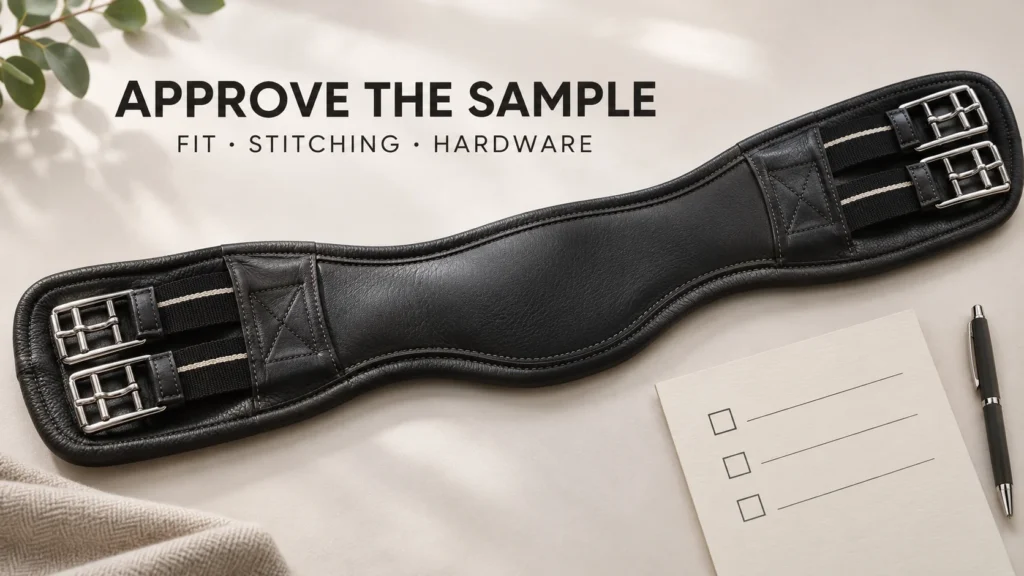
The approval sample establishes more than appearance. Inspect it laid flat, measure it, buckle it to the intended saddle and evaluate it with the appropriate horse under the supervision of someone competent to assess tack fit. A studio image cannot show pressure, movement or how the buckles sit once fitted.
Use this checklist before approving bulk production:
- Measurements: Match the agreed endpoint method, length, widths and buckle placement.
- Shape: Check the contour and finished profile against the drawing or reference sample.
- Horse-facing finish: Inspect the lining, seams, edges and padding.
- Elastic and buckles: Check attachment, operation and consistency on both ends as specified.
- Stitching: Inspect the agreed stitch lines and attachment areas for consistent construction.
- Saddle compatibility: Fit the girth to the intended billet arrangement.
- In-use assessment: Check positioning and movement on the intended horse and saddle combination.
- Branding: Confirm the logo, size marking, labels and packed retail unit.
Write down each requested change and obtain an updated approval reference before bulk production. Keep the final specification, measurement photograph and sample together for repeat orders. HideOrax describes a sample-first process on both its girth page and private-label manufacturing page. HideOrax
Plan a small range you can reorder
A first wholesale collection does not need every shape, length and colour. Start with the saddle arrangements your customers already buy. For example, a shop serving general English riding might begin with one long girth design in its most requested lengths. A dressage-focused brand might prioritise a short model. Introduce a contoured or belly-guard variant when there is a clear use case and a sample can be evaluated properly.
List every proposed variation in a simple order sheet:
| Model | Colour | Length | Construction | Quantity |
|---|---|---|---|---|
| Long girth | Brown | Enter length | Approved specification A | Enter quantity |
| Long girth | Black | Enter length | Approved specification A | Enter quantity |
| Dressage girth | Black | Enter length | Approved specification B | Enter quantity |
Ask whether the minimum applies across all variations or separately by model, colour or length. Also confirm whether optional fittings, logo application and retail packing change the quoted price.
HideOrax currently states a 10-piece standard wholesale minimum for leather girths, with samples typically taking 5–7 working days after specification confirmation and bulk production typically taking 15–25 working days after sample approval. These are published starting terms; request a current schedule and price for your exact design and destination. HideOrax
Prepare a quotation request that answers the first questions
A manufacturer can give a more useful response when your enquiry describes one identifiable product. Include:
- Your business and destination country.
- Intended riding use and saddle model or billet arrangement.
- Girth style and reference photographs or a physical sample.
- Finished size list, measurement endpoints and master unit.
- Body leather, lining, padding and elastic requirements.
- Buckle finish and any attachment points.
- Quantities by model, length and colour.
- Logo artwork, label and packaging requirements.
- Sample quantity and target order timing.
- Any specific inspection or documentation requirements.
For a branded range, HideOrax’s private-label service describes how the product specification, logo placement and packaging are agreed before the approved design moves to bulk production. HideOrax
Copyable enquiry:
We are a [wholesaler/equestrian brand] serving [USA/UK/country]. Please quote a private-label [long/dressage/anatomical/belly-guard] leather girth for use with [saddle model and billet arrangement]. We require [lengths and measurement method], [colour], [lining and padding], [elastic arrangement], and [buckle finish]. Our proposed quantities by variation are attached. Please confirm the sample cost, applicable minimum quantity, logo and packaging options, bulk lead time after approval, and shipping terms to [destination].
You can send this through HideOrax’s wholesale quotation form. Attach a marked measurement photograph or drawing when you follow up, so the sample and quotation refer to the same product.
Frequently asked questions
What leather horse girth styles does HideOrax manufacture?
Its published range includes long, dressage, anatomical and belly-guard configurations. Exact construction and dimensions are confirmed during sampling. HideOrax
Is an anatomical girth suitable for every horse?
No single contour should be described as universally suitable. Evaluate the intended model with the saddle and horse for which it will be sold, and have fit assessed by a qualified person.
Can a buyer request a girth based on an existing sample?
HideOrax says it can review a physical reference or specification, confirm feasibility and then produce an approval sample. Provide the measurements and identify which details should be retained or changed. HideOrax
Can the girth carry our brand?
HideOrax lists logo embossing, private labels and branded packaging as options. Approve the actual method and position on the sample before bulk production. HideOrax
What should we send first if we do not have a technical drawing?
Send clear photographs of the desired style and intended saddle, the sizes and quantities you expect to sell, and the material and branding details you already know. Identify what remains undecided so it can be resolved during quotation and sampling.
Build your girth around a clear specification
A dependable wholesale girth range begins with the intended saddle, an unambiguous measurement method and a physically reviewed sample. Once those are agreed, colour, branding, packaging and repeat-order checks become easier to control.
Explore HideOrax’s leather horse girth manufacturing options, view its complete equestrian product range, or request a quote with your sizes, specifications and planned quantities.