
A private-label leather bridle collection starts with a simple question: what, exactly, should the customer receive? Two bridles can look similar in a photograph yet differ in adjustment range, noseband construction, leather finish, buckle placement and whether reins are included.
For an equestrian brand or tack wholesaler, those details affect product descriptions, inventory and repeat orders. A clear specification also gives a manufacturer something concrete to sample and quote.
This guide explains how to plan a focused bridle range for the USA, UK and Europe, from the first product brief through sample approval. If you are comparing the available product families first, explore HideOrax’s bridles and halters manufacturing page and complete wholesale equestrian range.
1. Start with the customer and riding use
Before selecting a browband or buckle, define the intended customer. A general-purpose tack shop, a dressage-focused brand and a riding school supplier may all need different price points, finishes and replacement options.
Write down:
- The principal market: USA, UK or specific European countries.
- The intended rider and discipline.
- The expected retail positioning.
- The preferred leather colour and hardware appearance.
- Whether the bridle will be sold alone or with matching reins.
- Which sizes the initial collection needs.
For a first range, one well-specified core bridle is easier to compare, sample and reorder than several designs with unclear differences. You can expand the range once you know which sizes and finishes customers actually request.
Illustrative product-development image; it does not document a specific HideOrax production order.
2. Define the bridle as a complete set of components
“Black leather bridle, full size” is a starting description, not a production specification. List each component and the decisions that affect its appearance and use.
| Component | Decisions to record |
|---|---|
| Headpiece or crownpiece | Shape, width, padding, lining and how the other straps attach |
| Browband | Shape, length, plain or raised finish, padding and stitching |
| Cheekpieces | Width, adjustment-hole spacing, buckle type and connection method |
| Throatlatch | Length and adjustment range |
| Noseband | Selected style, width, padding, placement and adjustment method |
| Reins | Included or separate; material, grip, length, width and attachment |
| Hardware | Buckle and fitting style, colour and consistent finish |
| Branding | Logo method and position, label, packaging and care information |
If your collection uses a particular noseband arrangement, provide a reference sample or clear drawings. Terms can be interpreted differently across markets. The approved sample should establish the construction that future orders must match.
A bit should also be treated as a separate specification. Do not assume it is included merely because a product is described as a bridle.
3. Build a useful size chart, not just size labels
Pony, cob and full are familiar labels, but labels alone do not tell a buyer the finished dimensions or usable adjustment range. A full-size bridle from one range may not match another range in every component.
For each size, agree on the measurement method and record the relevant finished measurements: browband length, cheekpiece adjustment range, noseband circumference and adjustment, throatlatch range, and any dimensions specific to your design. State whether measurements are taken flat, along the leather or around a fitted shape.
Then review the sample on an appropriate horse with a knowledgeable fitter. Check whether the straps sit and adjust as intended, whether the noseband design is suitable for the stated use, and whether the selected size leaves a practical adjustment range. Document changes before approving the grade to other sizes. A single “full” sample should not silently determine every pony and cob measurement.
For cross-border sales, put the actual measurements on your product page in centimetres and inches, with a short explanation of how they were taken. This helps customers compare sizes without relying only on regional naming conventions.
4. Match leather, hardware and reins across the range
A collection looks coherent when its parts are specified together. Record the approved leather colour and finish, edge treatment, stitching colour, padding appearance and hardware tone. If you sell matching reins separately, compare them directly with the bridle sample under normal light.
HideOrax lists selected full-grain leather, configurable finishes and hardware for its bridle and halter program. Its horse reins manufacturing page provides a starting point for a coordinated rein specification. Confirm the precise materials and construction for your own order rather than assuming that every pictured or discussed option is part of a standard set. HideOrax
For reins, specify the finished length, width, grip section if applicable, attachment method, stops if required, and whether the quoted price is per pair. Agree on the colour reference and hardware finish. If a black bridle and black reins use visibly different finishes, customers may see the set as mismatched even when each item is individually sound.
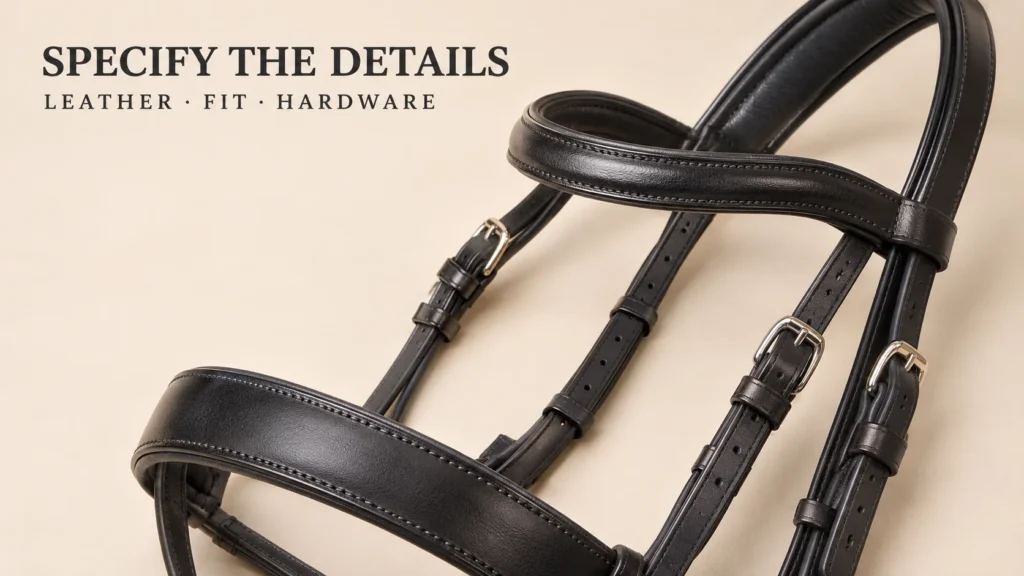
5. Make branding part of the sample
A private-label order should identify where and how your brand appears before bulk production. Potential choices include an agreed logo application, product label and retail packaging. The method must suit the component: a subtle mark on leather, a sewn label and a printed packaging card are different production decisions.
Send the manufacturer the final artwork and specify its size, colour and placement. Ask to inspect a branded sample or a clear approval proof. Check that the mark is legible, consistently positioned and does not interfere with adjustment or normal use.
Packaging deserves the same attention. Decide what the customer should receive: a bridle alone, a bridle and reins, a protective bag, a hang tag, a care card or another agreed combination. Your online listing, carton contents and supplier quotation should describe the same package.
If you are developing more than one tack product, review HideOrax’s wholesale product range so the branding and finish can be planned across related items.
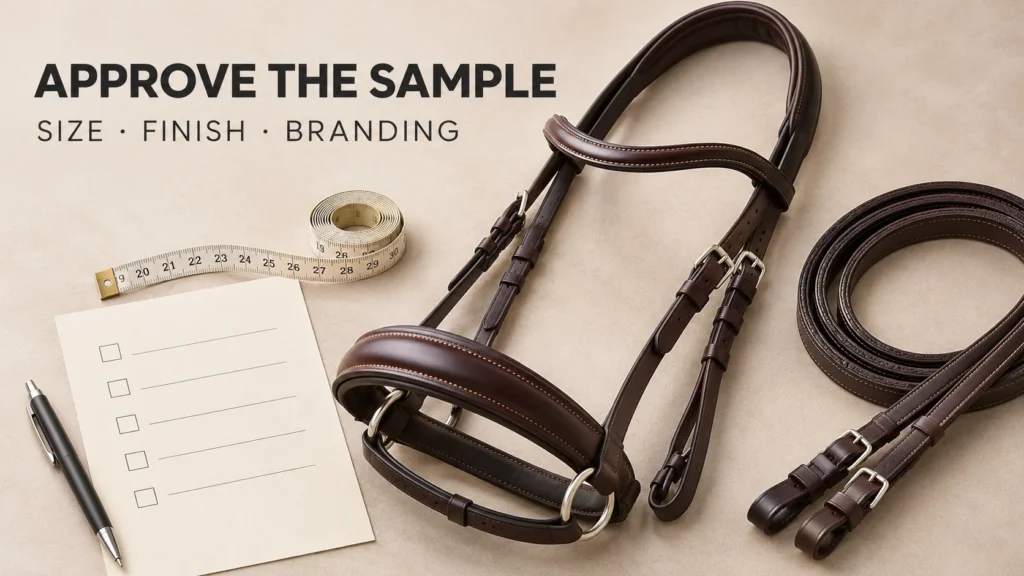
6. Approve a physical sample against a written checklist
A photograph can show the overall style, but it cannot fully establish how the leather feels, how buckles operate or whether the measurements match your chart. Keep the approved specification beside the physical sample and record any corrections in writing.
Use this sample review checklist:
- Identity: Does the sample match the agreed model, colour and size?
- Dimensions: Are component measurements and adjustment ranges recorded correctly?
- Assembly: Are the straps, keepers and attachments in the agreed positions?
- Finish: Are edges, stitching, lining and padding consistent with the brief?
- Hardware: Do buckles and fittings match the approved type and finish, and operate properly?
- Reins: If included, do they match the agreed length, grip, colour and connection?
- Branding: Are the logo, labels and packaging correct?
- Fit review: Has the bridle been evaluated for its intended use by someone competent to assess horse tack fit?
- Corrections: Is every change written into the final specification and reflected in the approved sample?
Retain the approved sample or a full photographic and measurement record. It becomes a useful reference when checking a later delivery or placing a repeat order.
7. Plan the opening order by variation
A small, focused range can still produce many stock-keeping units. One model in two colours and three sizes creates six bridle variations. Adding separately sold reins, different hardware or a second noseband increases the count.
Create an order table before asking for a final quotation:
| Style | Colour | Size | Reins | Proposed quantity |
|---|---|---|---|---|
| Core bridle | Black | Cob | Quoted separately | Enter quantity |
| Core bridle | Black | Full | Quoted separately | Enter quantity |
| Core bridle | Brown | Cob | Quoted separately | Enter quantity |
| Core bridle | Brown | Full | Quoted separately | Enter quantity |
Add pony or another size only when it suits your customers. Ask whether the minimum applies to the total order, each style, each colour or each size. That distinction changes the real cost of an opening collection.
HideOrax currently publishes a 10-piece standard minimum for its bridle and halter program, a stated sample lead time of 5–7 working days after specification confirmation, and a stated bulk production window of 15–25 working days after sample approval. Treat these as published starting terms and confirm the current quote and schedule for your exact variations, branding and delivery destination. HideOrax
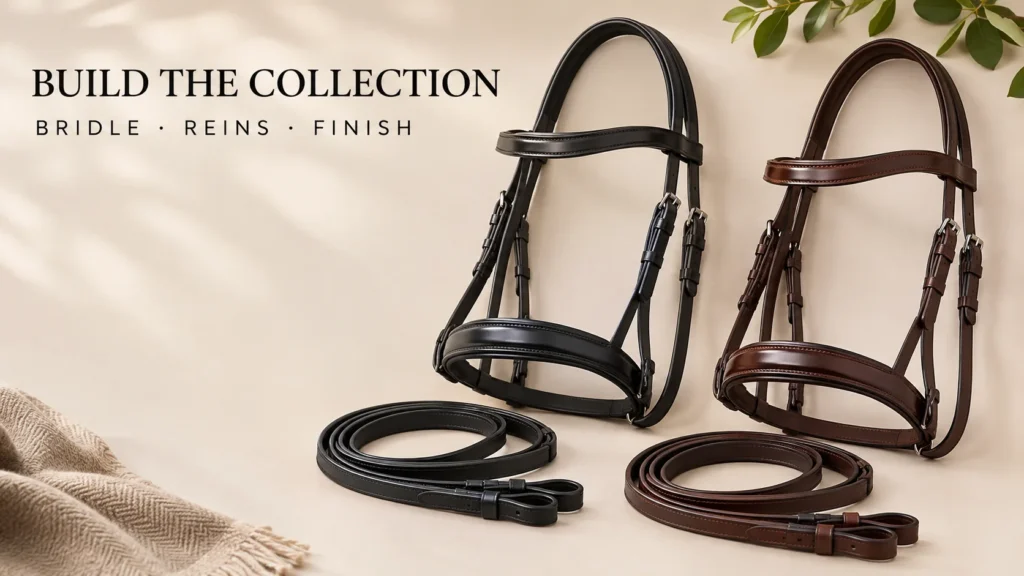
8. Request a quote that can actually be compared
A useful wholesale quotation should make its assumptions visible. Send the product brief, size chart, reference images or sample, colour choices, quantity by variation, logo artwork and packaging request. Also name the destination country and desired delivery timing.
Ask the supplier to identify:
- What is included in each quoted bridle.
- Whether reins are included or priced separately.
- The material and hardware specification used for pricing.
- Sample price and any revision costs.
- Minimum quantities by style, size and colour.
- Branding and packaging costs.
- Production timing after sample approval.
- Shipping terms, freight responsibility and export documents.
That information helps a US or European buyer compare offers on the same basis. A lower unit price is difficult to interpret if one quotation includes reins and branded packaging while another excludes them.
Copyable enquiry example:
We are developing a private-label English leather bridle for our [country] market. Please quote one core model in black and brown, in cob and full sizes, with [selected noseband], [hardware finish] and our logo at [location]. Quote matching reins separately and confirm the contents of each bridle package. Our proposed quantities by variation are attached. Please advise the sample cost, applicable minimum quantities, branding and packaging options, production timing after sample approval, and shipping terms to [destination].
Frequently asked questions
Can a bridle be supplied with matching reins?
HideOrax lists coordinated reins within its tack program and has a separate reins product page. Specify whether you want the reins included in the retail set or quoted and packed as a separate product. HideOrax
Is one sample enough for every size?
One sample can establish the style and finish, but it does not prove that every size has the correct dimensions or adjustment range. Agree on a size-check plan and document the measurements for all variants.
Should we start with many bridle styles?
A focused initial range is often easier to specify, photograph and reorder. Select the styles your customers are most likely to need, then use their enquiries and sales to guide expansion.
Can we put our own logo on the bridle?
HideOrax publishes custom logo, label and packaging options for its bridle program. Confirm the method, artwork requirements, placement and price during sample development. HideOrax
Develop your bridle range with HideOrax
A successful wholesale bridle program is repeatable: the manufacturer and buyer share the same component specification, size chart, approved sample, packaging description and order breakdown. That groundwork makes the first quotation clearer and gives later orders a reliable reference.
Explore HideOrax’s leather bridles and halters and matching reins. When your brief is ready, request a wholesale quotation with your proposed styles, sizes, quantities, branding and destination.