
Five saddles may sound like a straightforward first order. The planning becomes more complicated when your range needs two styles, several seat sizes, different colours and matching tack. Before you commit to stock, you need to know exactly what the minimum order quantity covers.
A private-label saddle MOQ is the smallest quantity a manufacturer will accept under an agreed specification. It does not automatically tell you how many styles, sizes or colours can be combined. For importers, tack-shop owners and equestrian brands, those details determine whether a first order is a useful market test or an awkward collection of unsold variants.
HideOrax manufactures saddles and equestrian leather goods in-house in Sialkot, Pakistan. Its stated standard minimum is five saddles, or ten pieces for most other product families. The mix and customization still need to be confirmed during quotation. This guide shows what to decide before requesting one.
What does a saddle MOQ actually apply to?
Ask the manufacturer to define the unit of the minimum. “Five saddles” could describe a total order, a single construction, one colour, or one combination of specifications. Never build a purchasing plan around the headline number alone.
Confirm these points in writing:
- Product family: Are English, Western and synthetic saddles counted separately?
- Style: Can dressage and jumping saddles share a minimum?
- Seat size and tree option: Can the quantity be split across the sizes you intend to stock?
- Material and colour: Does a different leather or finish create a separate production run?
- Branding: Does a different logo, label or packaging design change the minimum?
- Repeat orders: Will the same minimum apply when you reorder an approved style?
A manufacturer may be able to combine some variants and may need to separate others. The answer depends on the construction, materials and production setup. Request an itemized quotation that shows the quantity of every proposed variant.
For the broader development process, see HideOrax’s private-label equestrian manufacturing overview.
Begin with the range you can evaluate
A first order should answer a specific commercial question. You might be testing one English saddle construction with several seat sizes, introducing a Western style to an established customer base, or checking demand for a coordinated saddle-and-tack range.
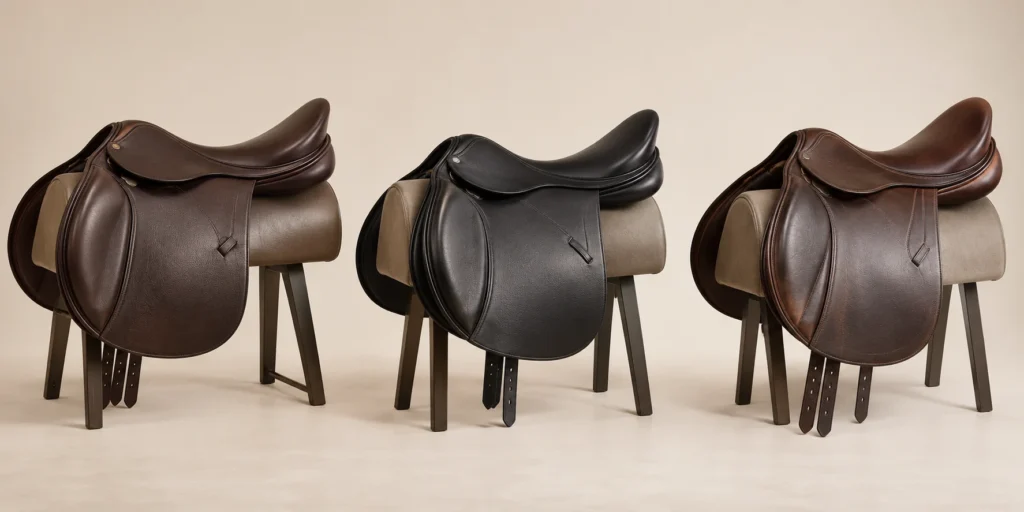
Write down the purpose of the order before choosing products. Then separate essential options from options that can wait for a reorder. A restrained starting range makes sample feedback, stock tracking and sales results easier to interpret.
For example, a buyer considering two saddle styles in two colours should first decide which combinations customers have actually requested. Ordering every possible combination can spread a small quantity too thinly. A better quotation request might identify one core style and colour, list the necessary sizes, and ask separately whether a second style can be included.
This is a planning example, not a claim that a particular mix meets HideOrax’s MOQ. HideOrax should confirm the permitted mix in its quotation.
Plan seat sizes before deciding the total quantity
A total saddle quantity means little without a size breakdown. List the seat sizes and any tree or fit options your customers require. If you already sell saddles, use your own enquiries, sales and returns to guide the initial mix. If this is a new category, label your size choices as assumptions and keep the first range focused.
For each proposed saddle, record:
| Specification | What the buyer should state |
|---|---|
| Style | Dressage, jumping, all-purpose, Western or another defined construction |
| Seat size | The exact size and unit used in your market |
| Tree or fit option | The agreed specification, where offered |
| Materials | Leather or synthetic components, colour and finish |
| Construction details | Flap, panel, padding, rigging or other relevant features |
| Branding | Logo method, position and labels |
| Quantity | Units required for that exact variant |
Do not assume that one sample proves every size option. Ask which dimensions and construction details stay constant, which change by size, and how those changes will be checked during production. Record the agreed measurement points so a repeat order can be compared with the original approval.
If you are still comparing suppliers, HideOrax’s guide to choosing a private-label saddle manufacturer provides a broader supplier checklist.
Decide whether matching tack belongs in the first order
Bridles, reins, girths and other accessories can make a saddle range more useful to retailers. They also add specifications and stock commitments. Plan them as separate product lines rather than assuming they count toward the saddle minimum.
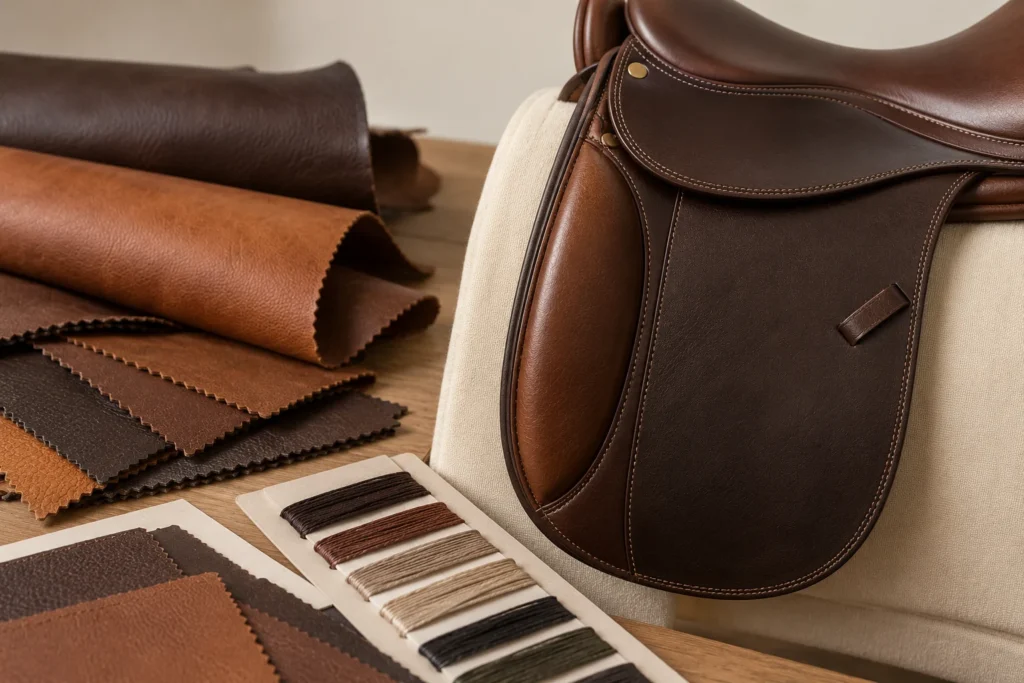
Start with the products your customers are most likely to buy together. For each tack item, specify dimensions or sizes, leather and colour, hardware, stitching, branding and quantity. Matching brown leather, for instance, needs an approved colour reference; the word “brown” alone is not a production standard.
HideOrax states a standard minimum of ten pieces for most other product families. Ask whether that minimum applies to each product type, size or colour, and whether any mixed arrangement is available for your proposed range. Its product catalogue can help you identify the product families to include in your enquiry.
Treat material and branding changes as separate decisions
Two saddles can share a silhouette but differ substantially in materials, finish or branding. A change to leather grade, colour, hardware or padding may affect the sample, price and production planning.
For a first quotation, provide one clear base specification. Then ask for alternatives as separately priced options. This lets you compare the cost of a material upgrade or an additional colour without confusing the specification you intend to approve.
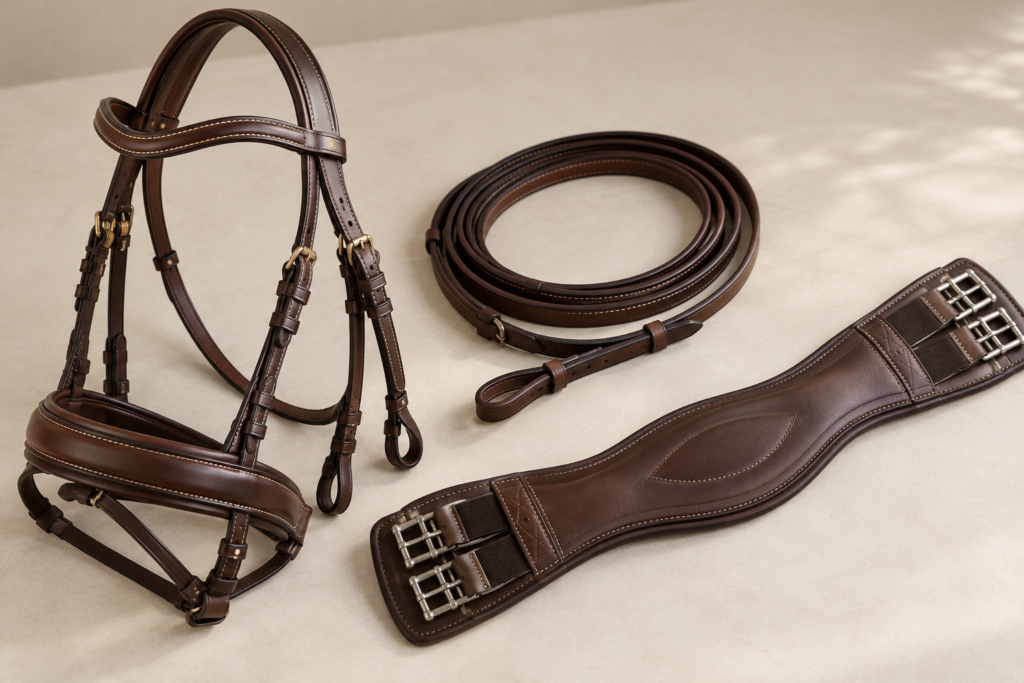
For private-label products, supply approved artwork and define the logo method, placement, labels and packaging. Check how the branding appears on the physical sample. If several retail brands or packaging versions are involved, ask whether each requires its own minimum.
A useful material brief includes physical swatches or reliable colour references where possible, along with written descriptions. Describe acceptable natural leather variation rather than expecting every hide to look identical.
Price the complete order, not only the unit
A low unit price does not tell you what it will cost to put saleable stock into your warehouse. Compare quotations using the same product specification and ask for each charge to be identified.
Your comparison should cover:
- Sample development and any sample revisions
- Unit price by product and variant
- Branding, labels and packaging
- Carton quantities, dimensions and weights
- Freight and insurance responsibilities under the agreed delivery terms
- Import charges and local handling, assessed for your destination
- Payment terms and the point at which production begins
Customs classification, duties and other import obligations depend on the product and destination. Have your customs broker or compliance specialist check them for your actual order; do not apply a rate taken from another buyer’s shipment.
When comparing quotations, also calculate how much stock each variant represents. Ten units of one reliable seller may be more useful than a wider range containing variants your shop cannot readily move. The appropriate choice depends on your customers, cash available for stock and reorder plan.
Approve a sample before committing to bulk production
The sample turns a written description into a physical reference. Inspect it against the specification you sent, record corrections, and approve the final version in writing before bulk production begins.
For saddles, review the agreed dimensions, construction, leather or synthetic materials, stitching, hardware, colour, finish and branding. For tack, inspect sizing, strap layout, buckles, edge finishing and consistency with any matching saddle materials. Include packaging if it affects your retail presentation.
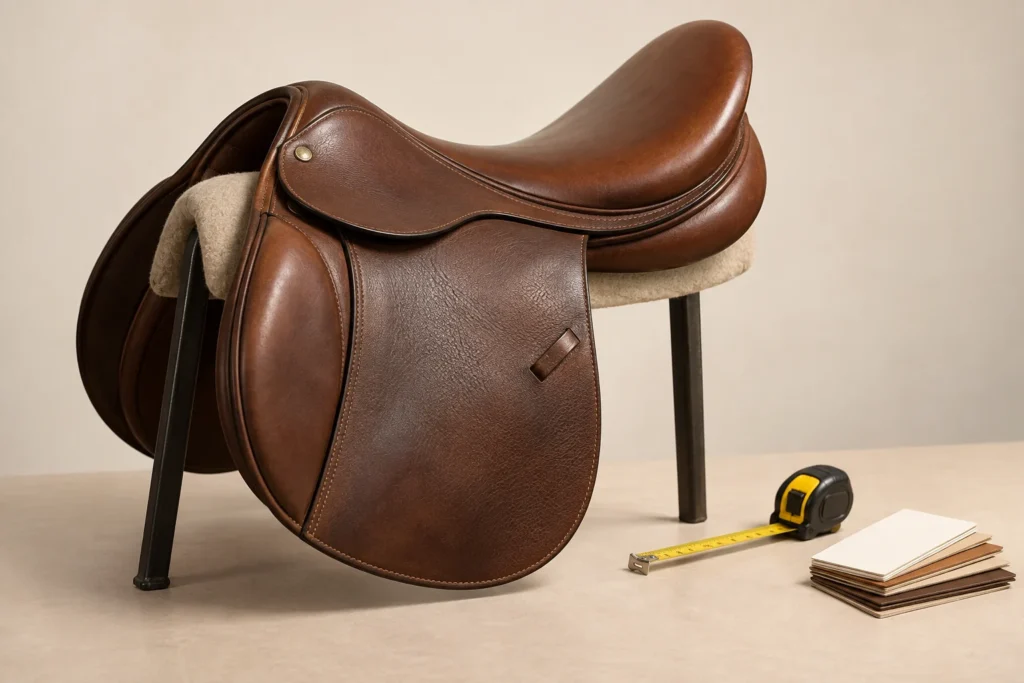
HideOrax describes sample approval as a stage before bulk production and says a sample typically takes approximately 5–7 working days after specifications are confirmed. Confirm the timing for your particular materials and requested changes in the quotation.
Keep the approved sample, measurements, photographs and revision notes together. Ask how bulk inspection will compare finished units with that reference. You can review HideOrax’s manufacturing process while preparing your inspection questions.
A practical first-order enquiry
A clear enquiry helps the manufacturer tell you what can be combined and what must be quoted separately. Send one table with a row for each proposed product variant, then include:
- Your business type and destination country
- Saddle or tack type and intended customer segment
- Style, size and quantity for each variant
- Materials, colours and hardware preferences
- Branding artwork and intended placement
- Packaging and labelling requirements
- Reference images, drawings or an existing sample
- Target date for reviewing a sample and your planned order sequence
Mark anything still undecided. A supplier can suggest options more effectively when it knows which requirements are fixed and which are open.
Before accepting the quotation, check that its variant quantities add up to the order you intended, that each minimum is explained, and that the sample approval stage is written into the process.
Frequently asked questions
What is HideOrax’s minimum order for private-label saddles?
HideOrax states a standard minimum of five saddles. Confirm with the team how your requested styles, sizes, colours and materials can be combined before treating five as the final quantity for your range.
Can I order different saddle sizes within the minimum?
Ask for a written size breakdown in the quotation. Whether sizes can be mixed within a minimum depends on the specification and the manufacturer’s agreement for that order.
Do bridles and reins count toward the saddle MOQ?
Do not assume they do. HideOrax lists ten pieces for most other product families as its standard minimum. Request a separate MOQ and price breakdown for each tack product you want to include.
Should I approve a sample for a small first order?
Yes. A small order still needs an agreed construction, materials, dimensions, finish and branding reference. Document any corrections and give written approval before bulk production.
What should I send to get a useful wholesale quotation?
Send the product type, target market, quantity by variant, saddle seat sizes or tack dimensions, materials, colours, branding, packaging and destination country. Include reference images or drawings and identify any specifications on which you need the manufacturer’s advice.
Plan your order with HideOrax
A workable MOQ is one you understand variant by variant, can inspect against an approved sample, and can stock with a clear sales plan. HideOrax manufactures private-label saddles and equestrian leather goods in Sialkot, Pakistan for wholesale buyers.
Request a wholesale quotation with your product type, destination country, quantities, seat sizes or dimensions, materials, branding and packaging requirements. Ask the team to show how the minimum applies to each proposed variant.