
A saddle sample can look ready for sale and still be wrong for your order. The leather may be the wrong finish, the flap may differ from your drawing, or the logo may sit where a retailer’s label needs to go. Once bulk production starts, a small unresolved detail can become a repeated problem.
Saddle sample approval is the point at which a wholesale buyer compares a physical pre-production saddle with the agreed specification and decides whether production can proceed. It should produce a clear record: what was checked, what needs correction, and which exact version is approved.
This guide is for importers, distributors, tack shops and private-label equestrian brands. It covers the complete product rather than only its appearance, so the approved sample can guide manufacturing, inspection and future reorders.
1. Agree on the specification before the sample is made
A sample cannot be judged fairly against instructions that were never written down. Before development begins, send the manufacturer a specification for the particular saddle you want to sell.
At minimum, identify:
- Saddle type and intended use, such as English dressage, jumping, all-purpose or a defined Western style
- Seat size and the agreed method for measuring it
- Tree and fit-related options, where applicable
- Flap, panel, padding and other construction details
- Leather or synthetic material assigned to each relevant component
- Colour, surface finish, stitching and edge finish
- Hardware type and finish
- Logo artwork, placement and labels
- Packaging and the quantity planned for bulk production
Include drawings or reference photographs, but label their purpose. A photograph may show the silhouette you want while its hardware, leather colour or stitching differs from your actual specification. Mark which features are required and which are visual references only.
HideOrax’s private-label manufacturing process begins with a review of the buyer’s reference, specification, quantity and branding before quotation and sampling.
2. Compare the complete shape and construction
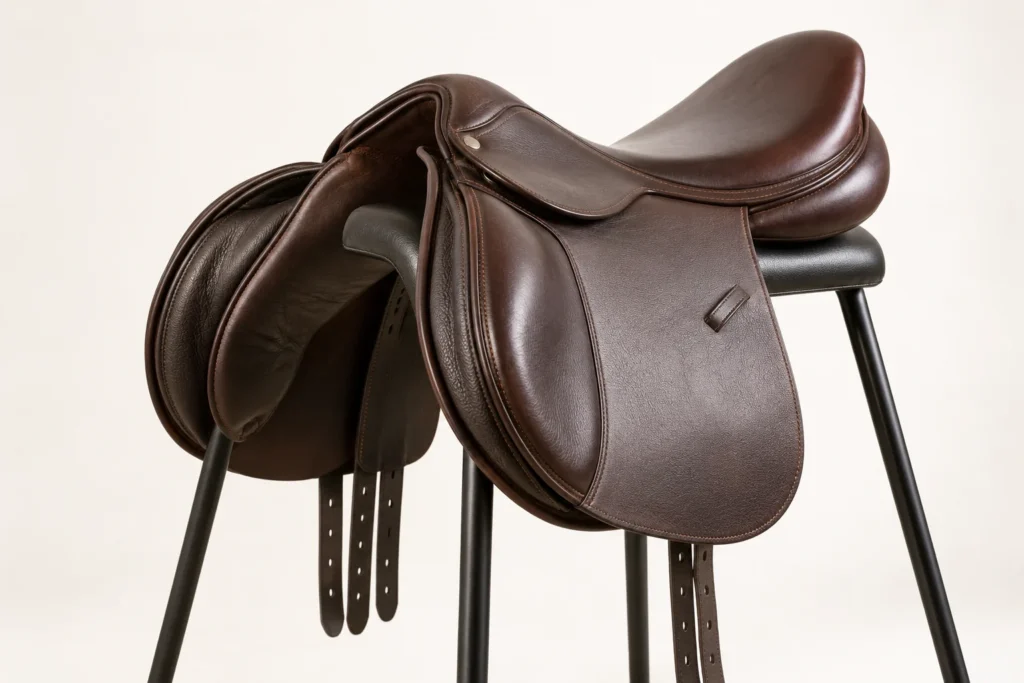
Start with the whole saddle before examining small details. Put the sample beside the approved drawing or reference and view it from both sides, front, rear and above. Check that it is the style you ordered, with the agreed proportions and component layout.
For an English saddle, inspect the seat profile, flap shape and length, knee area, panels, billets and the placement of relevant hardware. For a Western saddle, use a checklist suited to its own tree, skirts, rigging, fenders and other specified parts. Do not apply an English-saddle diagram to a Western product.
Ask the manufacturer to explain any construction detail that differs from your reference. Some changes may be necessary or beneficial, but they should be recorded and accepted by the buyer rather than silently carried into production.
A visual inspection alone does not prove that a saddle fits every horse or rider. If your brand makes specific fit or performance claims, agree on the appropriate evaluation with a qualified professional before offering those claims to customers.
3. Measure the points that matter to your range
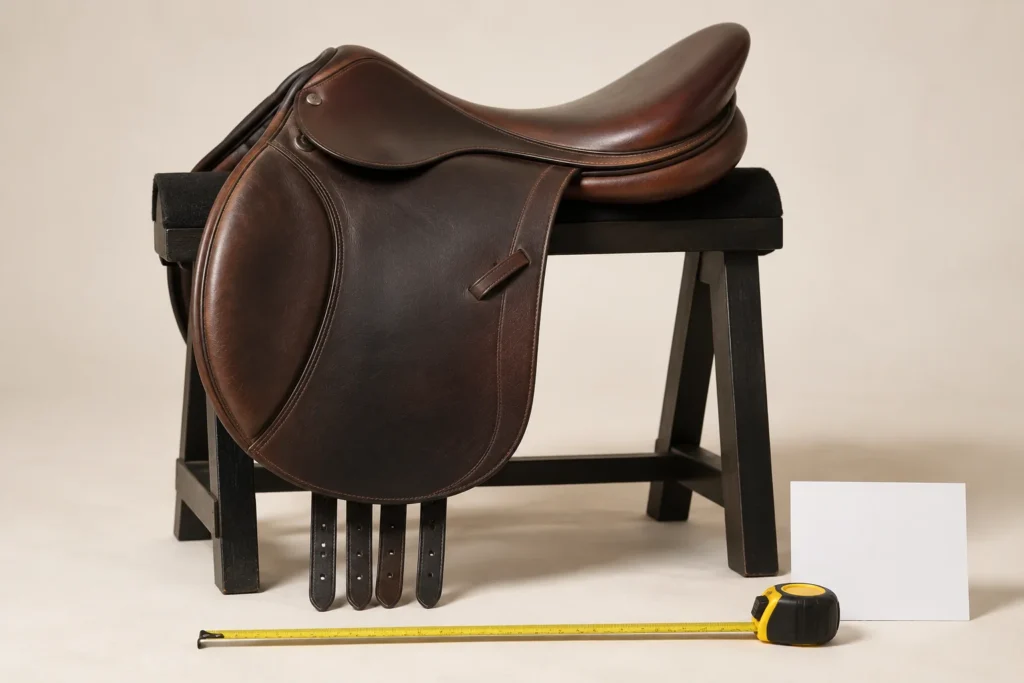
“Looks like the right size” is not a repeatable inspection method. Identify measurement points before reviewing the sample, then record the actual results beside the agreed target and tolerance.
Your measurement sheet might cover the stated seat size, flap dimensions and other dimensions relevant to that design. For tack supplied alongside the saddle, measure each product separately. Note the units used; buyers and suppliers may use centimetres, inches or both.
Use the same measuring method each time. If one person measures along a curve and another measures in a straight line, their figures can differ even when the saddle has not changed. A simple photograph showing where the tape starts and ends can prevent confusion on later samples.
For a range with several seat sizes, confirm which dimensions change with size and which should remain consistent. One approved size should not automatically stand for every size in the bulk order. Ask how the remaining variants will be checked.
4. Check materials by component
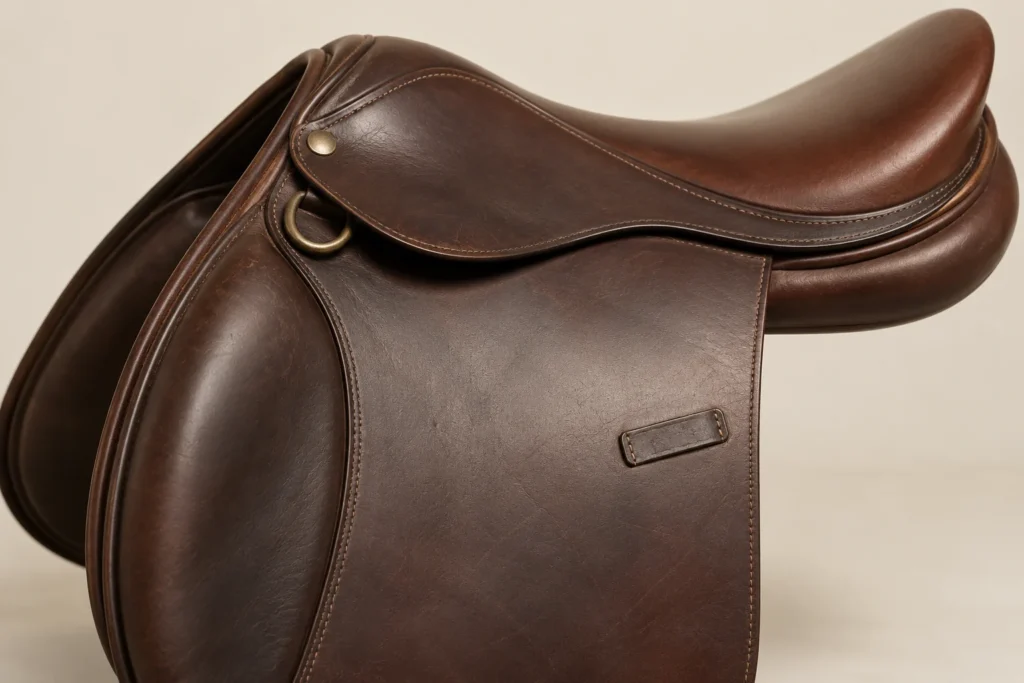
A material description such as “brown leather saddle” leaves too much open to interpretation. Review the seat, flaps, billets and other relevant parts against the material specification for each component. They may require different properties.
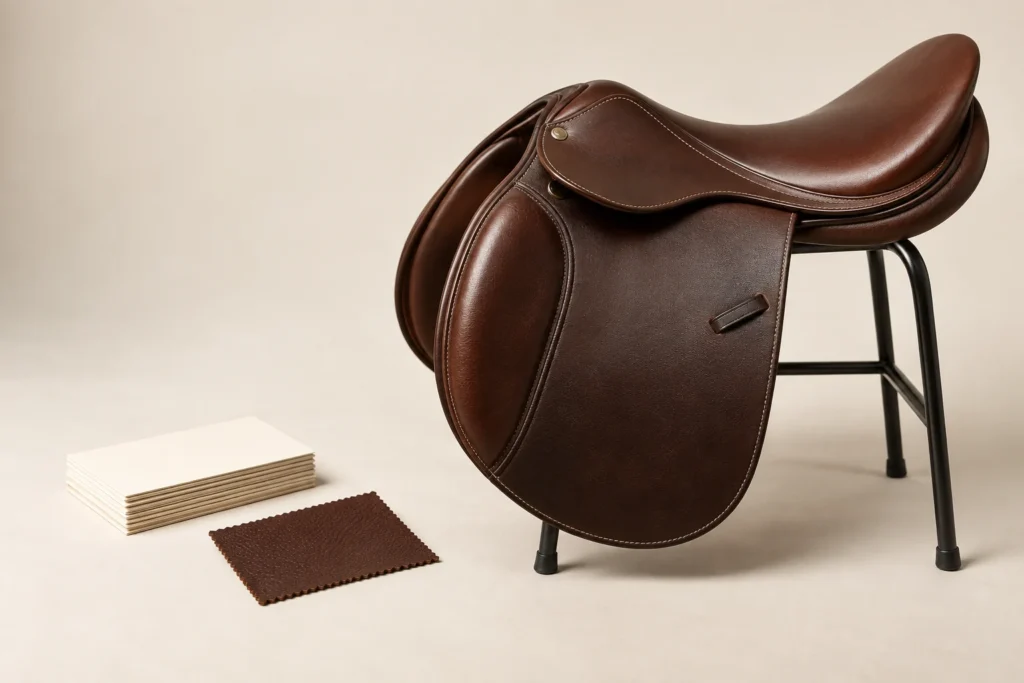
Check the agreed grain type, tanning method where specified, thickness or substance, firmness, colour and surface finish. Compare the sample with a physical swatch in neutral light when possible. A phone photograph is useful for records, but screens and lighting can shift the apparent colour.
Natural leather can show grain and shade variation. Decide what variation your brand accepts and record it. If a uniform surface is essential to your retail range, state that requirement before bulk materials are cut.
Look closely at exposed edges, folds and areas around stitching. Note any finish cracking, unexpected stretch, excessive stiffness, loose fibres or colour that differs from the approved reference. Record the location of a problem rather than saying only “leather quality needs improvement.”
HideOrax’s saddle leather guide for wholesale buyers explains how to specify grain, tanning, thickness, temper and finish by component.
5. Inspect stitching, hardware and finishing
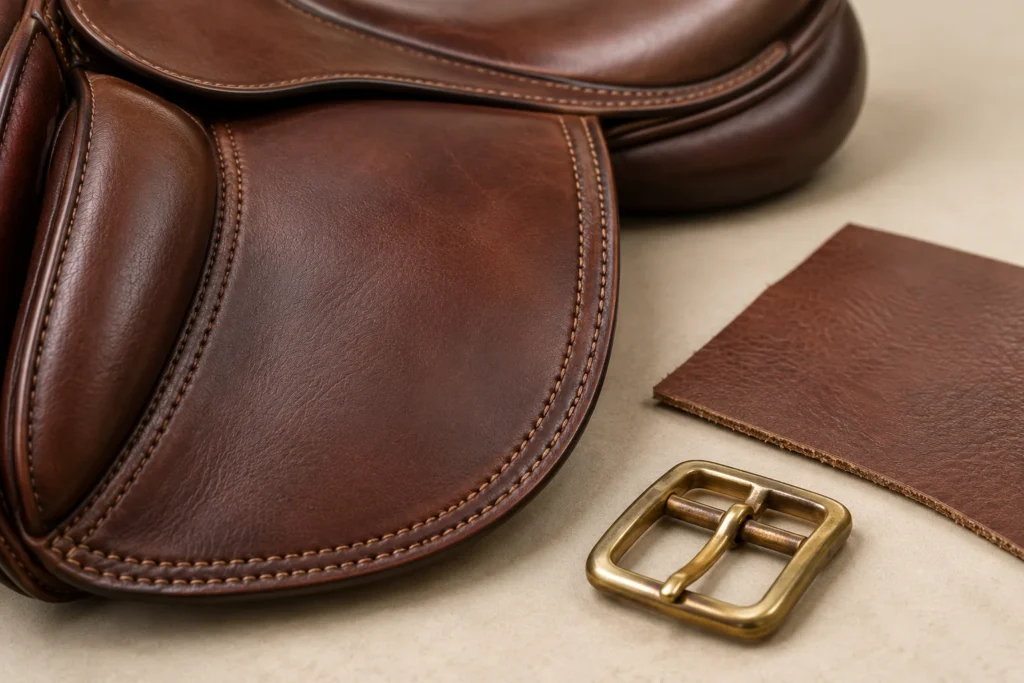
Work around the sample in a consistent order. Check stitch placement and tension, seam alignment, edge finishing, attachment points, hardware position and the operation of adjustable parts. Look at both visible and less visible areas.
For hardware, compare the actual material and finish with the quotation. Check that buckles and other specified fittings are securely attached, correctly positioned and suitable for the design. Do not infer “solid brass” or another material merely from a gold-coloured appearance; have the specified material confirmed in writing.
List every correction by location. “Fix the stitching” is vague. “Correct the uneven stitch line at the lower edge of the left flap to match the approved right-side reference” gives the manufacturer something actionable. Photographs with simple annotations can make the instruction clearer.
Separate a cosmetic difference from a construction issue. Both may matter to your brand, but a correction request should state its priority and whether the sample must be remade, adjusted or simply documented as an accepted variation.
6. Approve branding and packaging as part of the product
For a private-label or own-label order, the physical sample should show the agreed brand presentation. Check the logo method and size, placement, orientation, labels and any decorative elements. Compare them with the artwork version you supplied.
Review packaging before approving it for bulk. Confirm what touches the product, how components are protected, what appears on the retail packaging, and which details belong on the outer carton. If you require barcodes, product identifiers or destination-market information, supply the exact approved content and have your market requirements checked separately.
A logo displayed in a digital mockup does not establish how it will look embossed, stitched or attached to the actual material. Where branding is important, approve its physical execution or a clearly identified branding proof before it is repeated across the order.
7. Send corrections in one numbered review
Scattered messages are a common cause of delay. One person comments on colour in an email; another asks for a flap change over WhatsApp; a later photograph appears to show an older sample. The manufacturer then has several possible instructions and no single approved version.
Prepare one numbered review sheet. For every issue, include:
| Record | What to enter |
|---|---|
| Item and sample version | Product name, size, colour and sample date or reference |
| Location | The exact component and side |
| Expected result | The agreed drawing, measurement, swatch or artwork reference |
| Actual result | What you observed on the sample |
| Required action | Correct, clarify, accept as variation or provide another proof |
| Evidence | A labelled photograph and measurement, where useful |
| Decision | Open, resolved or approved |
If several people at your business review the saddle, combine their comments before sending them. Name the person authorized to give final approval.
Ask the manufacturer to respond against the same numbered list. That creates a record of which issues were resolved and reduces the risk of approving a version while one correction remains open.
8. Decide what needs another physical sample
Not every change requires the same proof. A minor wording correction on a removable hang tag may be checked through an updated artwork proof. A change to a saddle’s construction, fit-related dimension, material or attachment should receive a review appropriate to its effect on the finished product. In some cases, that means another physical sample.
Before agreeing on a revision, ask:
- Does the change affect construction, dimensions or material performance?
- Can it be checked reliably in photographs and measurements?
- Is the changed area visible and accessible for inspection?
- Will the revised part be made the same way in bulk?
- Who will approve the evidence, and what will be retained as the reference?
Settle sample revision costs and timing with the supplier rather than assuming they are included in the first sample price. Keep the agreed changes attached to the quotation and purchase order.
HideOrax states that a sample is normally prepared in approximately 5–7 working days after specification and quotation approval, with bulk production following buyer approval. Confirm timing for your particular product, materials and revisions when you request a quotation.
9. Give an unmistakable final approval
A message saying “looks good” may not identify which sample, size or version is approved. Final approval should specify the product, sample reference, date and documents that control the bulk order.
A useful approval statement might say:
“We approve sample reference SA-02 dated [date] for the agreed product specification and the corrections marked resolved on review sheet [reference]. Bulk production may proceed for the quantities and variants listed in purchase order [reference]. Any material or construction change requires our written approval.”
That is an example of clear communication, not a substitute for your purchase terms. Adapt it to your actual order.
Retain the physical approved sample if practical, along with photographs, measurements, leather swatches, artwork, packaging proof and the final correspondence. Confirm whether the manufacturer retains a matching reference. During final inspection, compare production units with the approved version, not an early prototype or a marketing photograph.
HideOrax describes this sample-to-bulk comparison in its manufacturing process overview.
10. Connect approval to the bulk order
Sample approval establishes the product standard; the purchase order establishes what will be made and shipped. Check that both documents agree before production starts.
Confirm quantities by style, size and colour; the agreed materials; the exact branding and packaging versions; inspection arrangements; and how a proposed substitution will be handled. If your first order combines saddles with bridles, reins or other tack, give those products their own specifications and approval references.
The total order must also match the quantity and variant conditions in the quotation. The private-label saddle MOQ planning guide helps buyers check how minimums apply across styles, sizes and product families.
A disciplined approval process is useful beyond the first shipment. When you reorder months later, the retained references give both buyer and manufacturer a shared answer to a crucial question: which product are we repeating?
Frequently asked questions
What should I check first on a saddle sample?
Confirm that its style, size and overall construction match your written specification. Then check measured dimensions, materials by component, stitching, hardware, finish, branding and packaging. Record findings against a named sample version.
Can I approve a saddle sample from photographs alone?
Photographs can help resolve visible details, but they may not show material feel, precise dimensions or construction adequately. Decide what evidence the change requires. For a new product or a significant construction change, request an appropriate physical review.
How do I request corrections without delaying production?
Send one numbered review that identifies the exact location, expected result, observed issue and requested action. Include annotated photographs and measurements. Have one person combine feedback and provide final approval.
Does one approved sample cover every saddle size?
Do not assume so. Agree on which features remain the same, which dimensions change with size, and how other sizes will be checked. List every size and quantity in the bulk order.
When should bulk production begin?
After the buyer has approved an identified sample version and the final specification, quantities, branding and commercial terms are aligned. Any later material or construction change should go through an agreed approval process.
Request a saddle sample and wholesale quotation
HideOrax manufactures saddles and equestrian leather goods in-house in Sialkot, Pakistan for importers, wholesalers and private-label brands. A clear starting specification makes sampling and approval more efficient.
Request a quote from HideOrax and include your product type, target market, quantity, seat sizes or dimensions, materials, branding, packaging and destination country. Attach any drawings or references and identify the details you want confirmed in the first sample.