
Two stirrups can look similar in a catalogue but belong in different product ranges. Their tread dimensions, material, attachment opening, finish and construction may all differ. For a wholesaler, those differences affect what can be paired with a saddle, how a product is described to retailers and what must be checked before bulk ordering.
A useful stirrup enquiry therefore goes beyond “silver English irons” or “Western stirrups.” It defines the intended design and asks the supplier to confirm the measurable details on a sample.
HideOrax supplies horse stirrups for wholesale and saddle programs from Sialkot, Pakistan. Its listed range includes traditional Fillis irons, safety-oriented designs, flexible and wide-tread models, and Western stirrups. This guide explains how a trade buyer can build a focused assortment and write a specification that is clear enough to quote, sample and repeat.
Start with the buyer and the saddle program
Before choosing finishes or colours, decide where the stirrups will sit in your range. A tack shop replacing a basic English iron has different stock needs from a brand assembling a complete Western saddle package. An online retailer may need particularly clear size and compatibility information because its customer cannot compare products in person.
Write down:
- The saddle types your customers buy
- Whether stirrups will be sold as an individual retail product or with a saddle
- The footwear and stirrup-leather combinations for which each model is intended
- The price position of the collection
- The sizes and finishes you can realistically stock
- Any brand or packaging requirements
Keep English and Western configurations separate in your product records. Similar retail labels do not mean their attachment, shape or dimensions are interchangeable.
A small, well-specified range is usually easier to sample, explain and reorder than many designs with only superficial differences. Ask customers or retailers which styles they need before adding a new variant.
Compare the main stirrup types
HideOrax’s horse stirrups product page provides the starting range. The table below translates those categories into sourcing decisions for a wholesale buyer.
| Type | Range position | Main specification questions |
|---|---|---|
| Traditional Fillis iron | Classic English tack assortment | Frame material, internal width, tread insert, finish and top opening |
| Wide-tread model | English range with a larger foot platform | Usable tread width and depth, insert pattern, weight and replacement parts |
| Flexible model | Design-specific technical assortment | Which part moves, permitted movement, component materials and durability checks |
| Safety-oriented model | Range built around a defined release or open-side design | Exact mechanism, operating conditions, size, testing evidence and permitted marketing claims |
| Western stirrup | Western saddle and trail-related assortment | Frame construction, covering, footbed, hanger compatibility and finish |
These descriptions identify design families; they do not establish that a particular product is suitable for every rider, saddle or event. Review the actual model before writing retailer-facing claims.
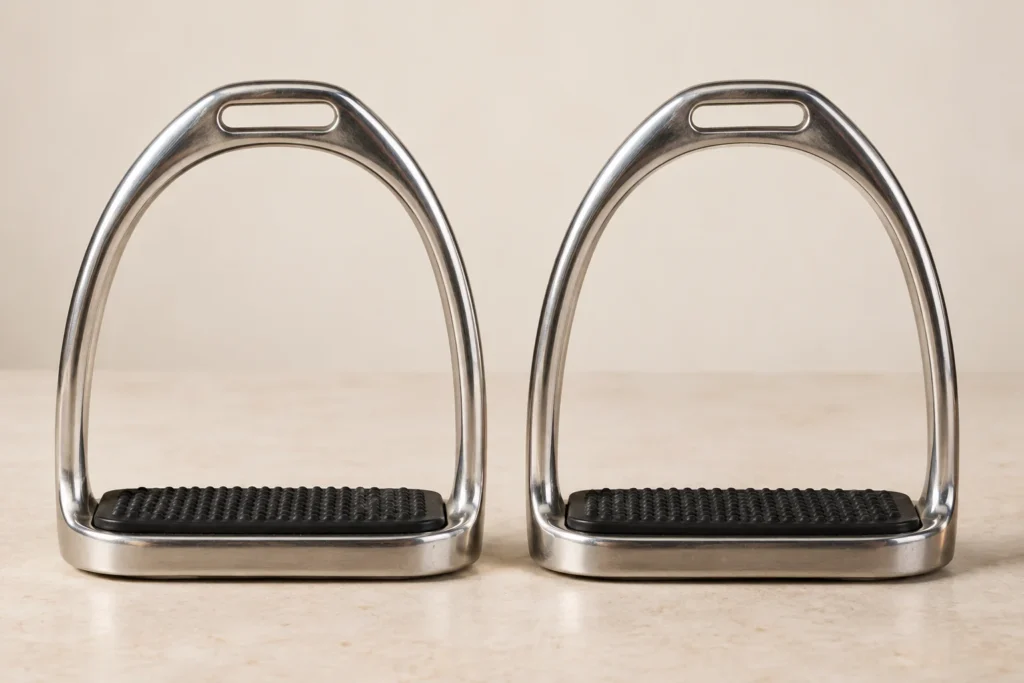
Traditional English irons
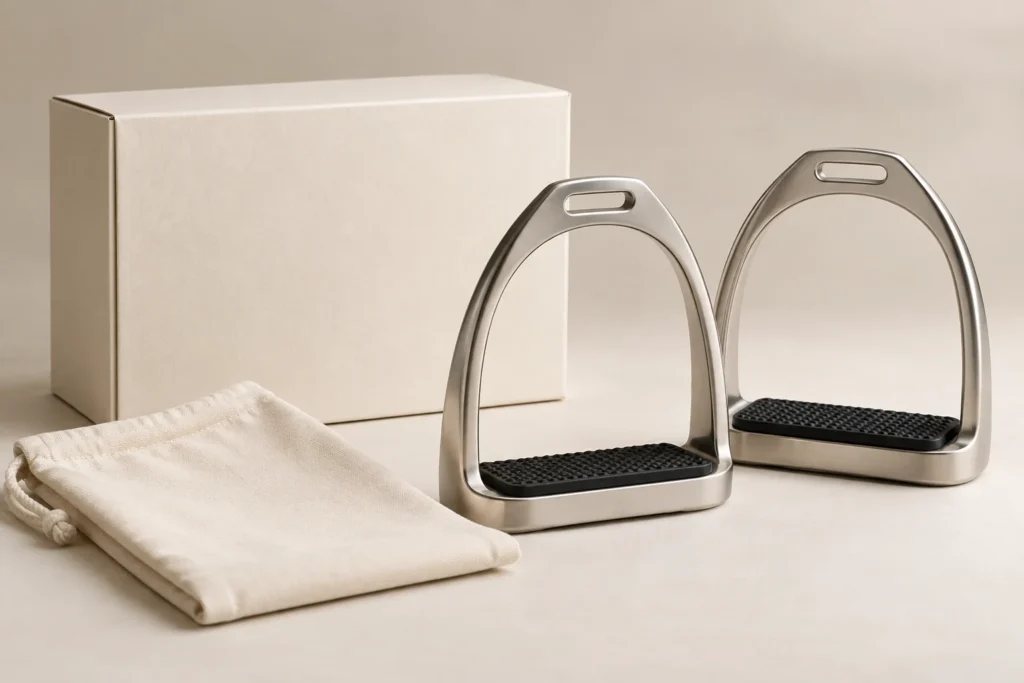
A Fillis-style iron is a familiar starting point for an English tack range. Specify its frame material and finish, the opening where the stirrup leather passes through, the internal foot opening and the tread insert. Ask whether the rubber or other tread component can be replaced and whether replacement pieces are supplied.
Do not select a size by a catalogue label alone. Request measured dimensions and check the sample with the intended footwear and leather combination. Your product page should state what was measured, so retailers can advise their customers accurately.
Wide-tread and flexible designs
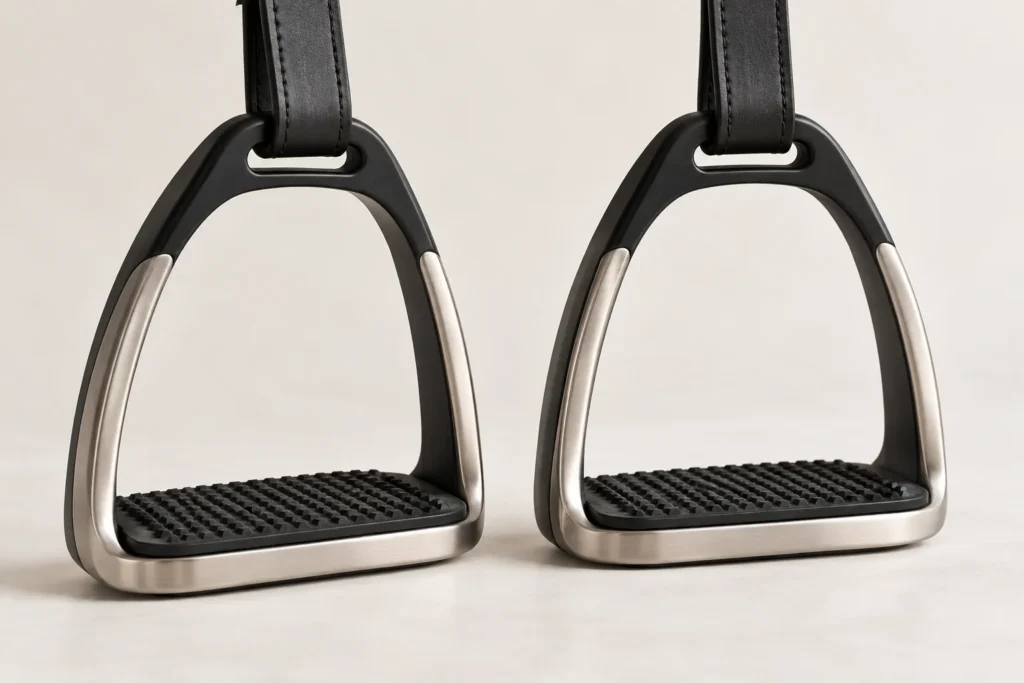
“Wide tread” describes a visible feature, but it does not give a dimension. Ask for the usable platform width and depth, its surface pattern, material and angle. Compare the sample with the stated specification and decide which sizes your shops actually need.
A flexible design requires a more precise explanation. Identify the component that moves and the movement the supplier intends. Ask how that part is assembled, inspected and replaced, if replacement is possible. Avoid promising comfort or performance outcomes solely because a design is described as flexible.
Safety-oriented designs
The word “safety” should not be treated as a complete technical specification. Different designs use different openings, flexible arms or release mechanisms. Ask for the exact mechanism, instructions, limitations and evidence supporting any proposed safety claim.
Competition rules may also vary by organization, discipline and date. If your customers intend to compete, confirm the current rules of the relevant governing body for the exact model. For example, US Equestrian maintains a stirrup resource page covering competition requirements; do not assume that a model accepted for one event is accepted everywhere.
Do not state that a stirrup prevents falls, always releases a foot or is approved for a competition unless those precise claims have been verified.
Western stirrups
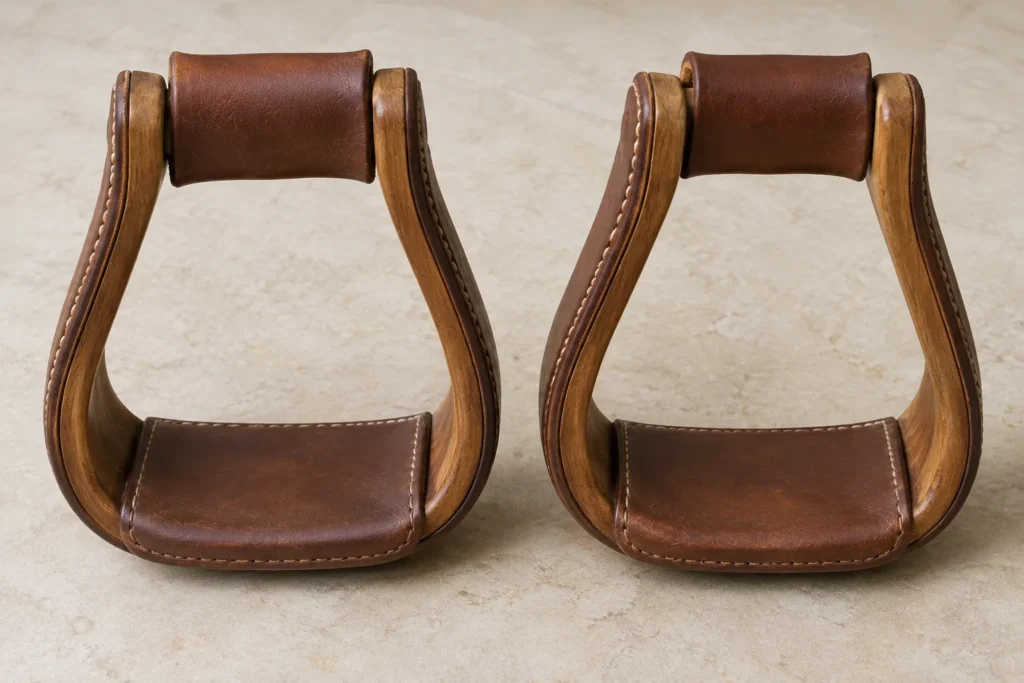
Western stirrups should be specified within the Western saddle system. Confirm the frame material, any wood or leather covering, the shape and width of the footbed, the hanger arrangement and the intended finish. A leather-covered appearance does not tell a buyer what the underlying frame is made from.
If the stirrups are being ordered with Western saddles, check their colour and finish against the approved saddle materials. Record the exact pairing on the purchase order so replacement pairs can be reordered consistently.
Specify dimensions without guessing a “standard” size
A stirrup size should be expressed through agreed measurements. Product names such as “adult,” “large” or “wide” are useful for merchandising but too vague on their own for production or purchasing.
Ask the supplier to provide a drawing that identifies:
- Internal opening width: The clear space available for the foot at the stated measuring point.
- Usable tread width and depth: The part of the platform on which the foot rests.
- Top opening: The size and shape through which the stirrup leather or hanger passes.
- Overall height and width: Useful for product records and packaging.
- Pair weight: State whether the figure is per stirrup or per pair.
- Measurement tolerance: The acceptable variation from the approved sample.
Use millimetres and, if helpful for your market, show inches as well. Keep the original unit and conversion consistent across the quotation, sample sheet and retail listing.
A footwear check should consider the actual boot used by the intended customer, including its sole and tread. Avoid publishing one universal clearance rule without confirming the specific design and the guidance relevant to its use.
Check the stirrup and leather as a system
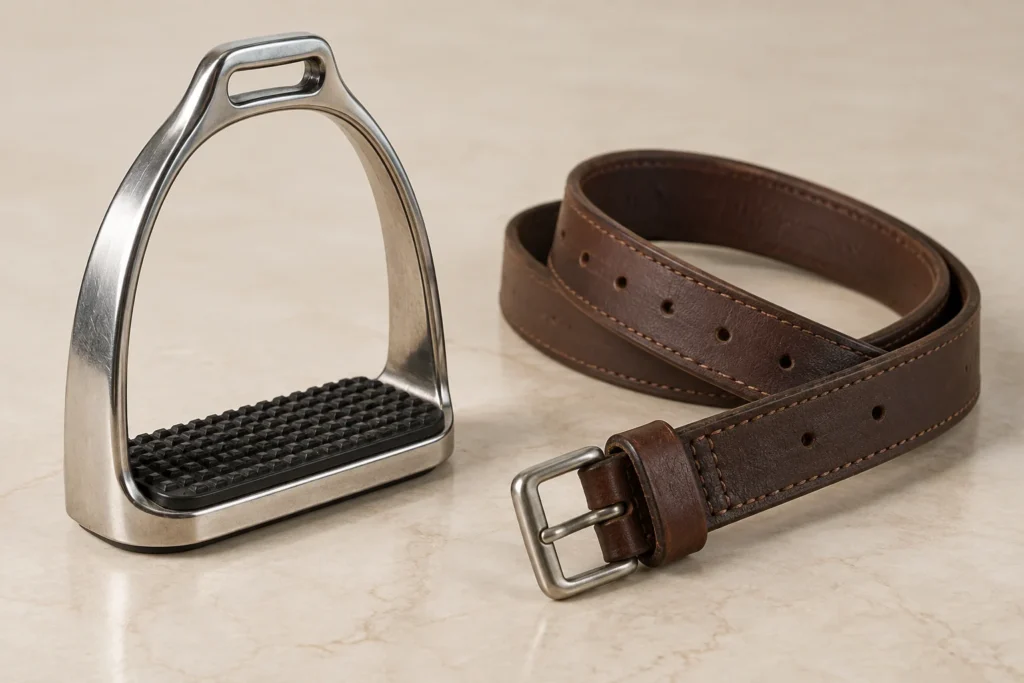
A correctly sized stirrup can still be a poor match for the leather or hanger specified with it. Compare the top opening with the width, thickness and construction of the stirrup leather. Check that it passes through and hangs as intended without bunching, twisting or excessive rubbing.
For a packaged saddle range, ask the supplier to show the exact stirrup and leather together on the approved saddle configuration. Confirm that the pair is matched in length, orientation and finish and that its components can be assembled as intended.
HideOrax also offers wholesale stirrup leathers in traditional, reinforced, mono and wide-comfort configurations. Specify the compatible combination rather than assuming that every stirrup fits every leather.
Define materials, tread and finish
A quotation is comparable only if suppliers price the same specification. List the frame material, any polymer or leather components, tread insert and finish separately. “Metal stirrup” or “premium finish” does not identify the supplied material.
Check the sample for:
- Consistent frame shape and a matched left-and-right pair
- Smooth surfaces and edges at contact points
- A securely seated tread insert or footbed
- Even finish and colour across the pair
- Sound attachment of any covering or moving component
- The agreed dimensions and weight
- Clear instructions for any removable or moving part
Ask how the supplier will check the same details on bulk units. If a product is offered in several finishes, approve a reference for each one; do not rely on a screen image to establish its colour or sheen.
Do not infer a metal grade, corrosion resistance or load rating from appearance. If those attributes matter to your range, request the exact material specification and appropriate supporting evidence for the model being purchased.
Approve a physical sample before bulk ordering
A sample should answer the questions left open by a photograph. Handle the stirrup, measure it, inspect both units in the pair and check it with the specified leather. If a mechanism is part of the design, assess it against the maker’s instructions and agree on any further evaluation required for your intended use.
Use a short approval record:
| Check | Record on the sample sheet |
|---|---|
| Identity | Model reference, design version, finish and sample date |
| Dimensions | Actual measurements and agreed tolerance |
| Components | Frame, tread, covering and any moving parts |
| Pair consistency | Matching shape, finish and assembly |
| Compatibility | Intended stirrup leather or hanger |
| Branding | Logo method, position and artwork version |
| Packaging | Units per pack, protection and labels |
| Corrections | Numbered issue, photograph and resolution |
If a correction changes a functional component, determine whether a revised physical sample is needed before signing off. Retain the approved sample or a documented control reference for bulk inspection and later reorders.
HideOrax’s stirrup page lists a standard minimum order of 10 pairs and a sample lead time of 5–7 working days after specification confirmation. Confirm timing, any revision costs and the treatment of mixed styles or finishes in your actual quotation.
Plan packaging and private-label presentation
Stirrups can mark one another or other items if packed without suitable separation. Ask how a pair is protected in its retail pack and how retail packs are arranged in an export carton. Verify the packaging on a sample, especially when a finish or leather covering needs protection.
For a private-label range, provide approved logo artwork and specify whether it belongs on the product, a label, a pouch or a carton. Check size and placement on a physical proof. Do not add unverified performance or safety language to the packaging.
HideOrax offers custom logos, labels and packaging for approved programs. Its broader private-label equestrian manufacturing page describes the review, quotation, sample and bulk stages.
Build a focused first wholesale order
List your proposed range by pair, not by individual stirrup. Separate each model, size, material and finish into its own line so the quantity is unambiguous. If you plan to sell stirrups with saddles, identify that package separately from the replacement pairs you will stock for retail.
For each line, record the approved sample reference, dimensions, compatible leather, packaging version and quantity. Ask whether several sizes or finishes can share the stated minimum; the published MOQ alone does not answer that question.
A practical first enquiry should include:
- Target market: USA, UK or specific European destination
- English or Western saddle program
- Stirrup type and reference images or drawing
- Dimensions and intended leather or hanger
- Frame, tread and finish requirements
- Quantity in pairs, broken down by variant
- Logo, labels and retail packaging
- Destination country and requested sample timing
This lets the supplier quote a defined product and identify choices that still need approval. It also gives your team a clear reference when the first shipment arrives.
Frequently asked questions
What types of horse stirrups does HideOrax offer?
Its published range includes Fillis irons, safety-oriented, flexible, wide-tread and Western configurations. Confirm the exact model, materials and dimensions during quotation.
What is HideOrax’s wholesale MOQ for stirrups?
The stirrup product page states 10 pairs as the standard minimum. Ask how that applies if you need different styles, sizes or finishes in one order.
Are stirrups and stirrup leathers the same product?
No. The stirrup is the foot-supporting component; the stirrup leather attaches an English stirrup to the saddle. Specify and check their compatibility when ordering them together.
Can I call a model a “safety stirrup” in my shop?
Use the supplier’s accurate model description, then verify the mechanism and evidence for any specific safety claim. Check current competition rules separately when those rules matter to your customers. Do not imply guaranteed release or injury prevention.
What should I check on a wholesale stirrup sample?
Measure the opening and tread, check both pieces of the pair, inspect material and finish, test the intended leather connection, and approve any branding and packaging. Record the exact sample version used for the bulk order.
Request a wholesale stirrup quotation
HideOrax supplies stirrups for equestrian wholesalers, importers, retailers and private-label saddle programs. Send the team your preferred type, target market, dimensions, material and finish, quantity in pairs, intended stirrup leather, branding, packaging and destination country.
Request a wholesale quotation from HideOrax so the team can review your specification and discuss a sample before bulk production.