
“Premium leather” is not a manufacturing specification.
Two suppliers can use that phrase while quoting different hides, treatments, thicknesses and finishes. Samples may look similar yet behave differently during cutting, stitching, tooling and use. For a trade buyer, vague leather language creates avoidable variation in price and bulk quality.
A useful specification defines grain, tanning, thickness, temper, finish, color and component use. This guide explains what buyers should confirm before approving a sample.
The Short Answer: What Is the Best Leather for Saddles?
There is no single best leather for every component. Full grain often suits premium visible areas. Vegetable-tanned leather is useful for structure, tooling or edge finishing. Softer leather may suit seats, while billets need controlled stretch.
Instead of asking only, “Is this saddle full-grain leather?”, ask:
- Which leather is used on each component?
- How was it tanned and finished?
- What thickness and tolerance will be supplied?
- What temper and stretch are acceptable?
- How will the bulk order be compared with the approved sample?
Record the answers in the quotation, sample sheet and purchase order.
What “Saddle Leather” Should Mean in a Buyer Specification
Saddle leather is a use category, not one grade. A hide suitable for a firm Western skirt may not suit a supple English seat. Define six variables:
- Grain type: full grain, corrected grain, split or another agreed construction.
- Tanning method: vegetable, chrome or combination tanning, where relevant.
- Substance: the required thickness, normally recorded in millimetres, ounces or both.
- Temper: the leather’s relative firmness or softness.
- Finish: the surface color, coating, sheen, wax or oil treatment and tactile feel.
- End use: the saddle component for which the leather is approved.
“Genuine leather” alone is insufficient because it does not define grain condition, performance, finish or suitability for a specific part.
Full-Grain, Corrected-Grain and Split Leather
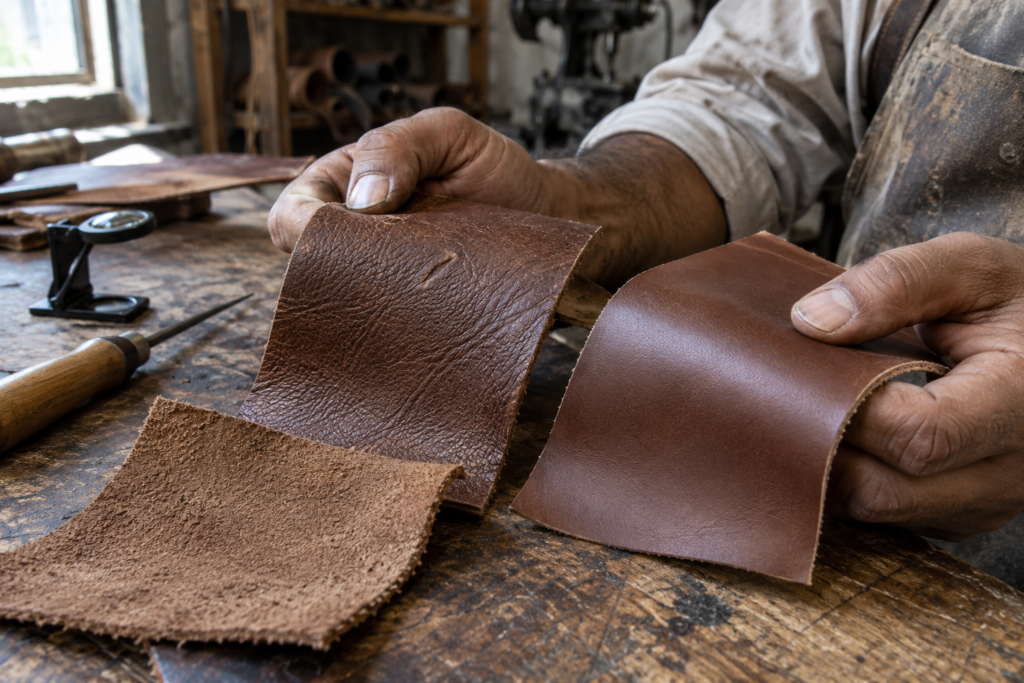
These terms describe the hide surface, not the complete quality of a finished saddle. The Leather Working Group’s terminology guide defines full grain as retaining the entire grain without corrective mechanical removal. Corrected grain has part of that surface mechanically removed and is enhanced through finishing.
Full-Grain Leather
Full-grain leather preserves the natural grain. Pores and small variations may remain visible. It is often chosen for premium ranges, but it is not identical or mark-free. Agree on acceptable markings, color variation, thickness, temper and finish.
Corrected-Grain Leather
Corrected-grain leather is mechanically corrected before a finish or embossed grain is applied. It can suit a uniform or price-sensitive collection. Check coating behavior during flexing and stitching and whether cut edges expose another base color.
Split Leather and Suede
Split leather is the lower layer after a hide is divided; it lacks the original outer grain. It may suit selected secondary areas but should not be presented as full grain or assumed suitable for high-stress parts.
Quick Buyer Comparison
| Leather description | Typical sourcing advantage | Point to verify before ordering |
|---|---|---|
| Full grain | Natural surface, premium appearance, visible material character | Acceptable markings, color variation, temper and finish |
| Corrected grain | More uniform surface and repeatable visual appearance | Depth of correction, coating flexibility and edge appearance |
| Split or suede | Soft texture and suitability for selected secondary areas | Exact component use, backing, thickness and abrasion requirement |
Vegetable-Tanned, Chrome-Tanned and Combination-Tanned Leather
Grain type and tanning method are separate decisions. State both when tanning affects performance, tooling or brand positioning.
Vegetable-Tanned Saddle Leather
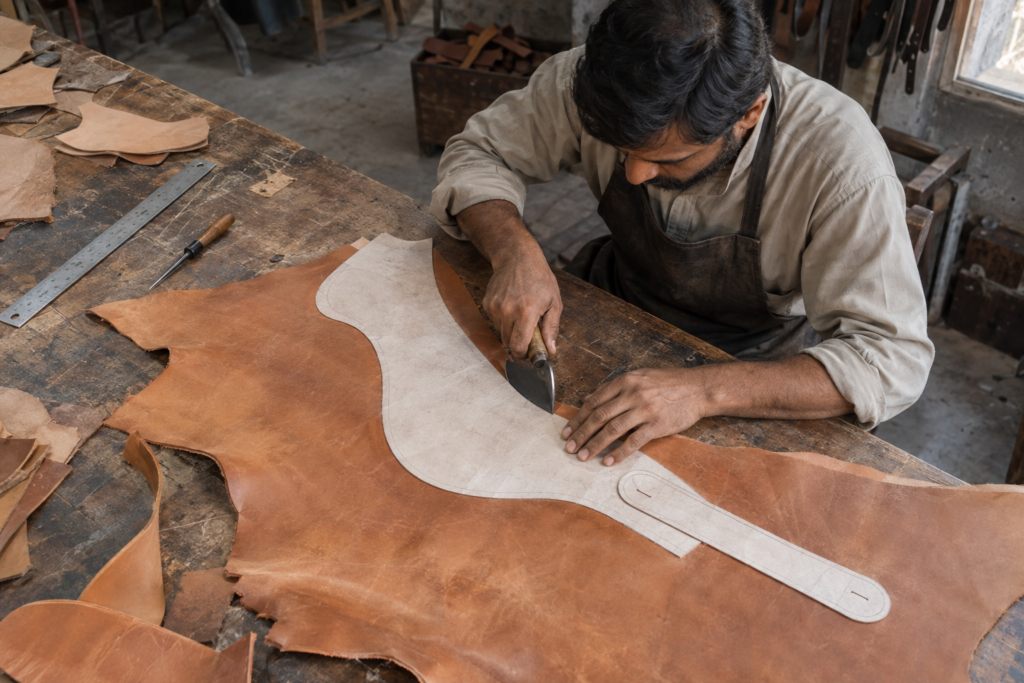
Vegetable tanning uses plant-derived tanning agents. It can produce firm, shapeable leather that accepts tooling, burnishing, oiling and traditional edge work. It is commonly considered for Western skirts, fenders, jockeys and tooling, and may be specified for structural English saddle parts. Review its color and oil response during sampling.
Chrome-Tanned Leather
Chrome tanning uses chromium salts and can produce softer, flexible leather in varied colors. Performance still depends on the hide, retannage, thickness and finish. A soft chrome-tanned leather might suit a seat but not a firm, load-bearing part, so approve it by component.
Combination-Tanned Leather
Combination tanning uses more than one approach to balance properties. Never assume a tanning method from appearance; request the material description and judge the finished leather against the approved physical sample.
Why Thickness and Temper Must Be Specified by Component
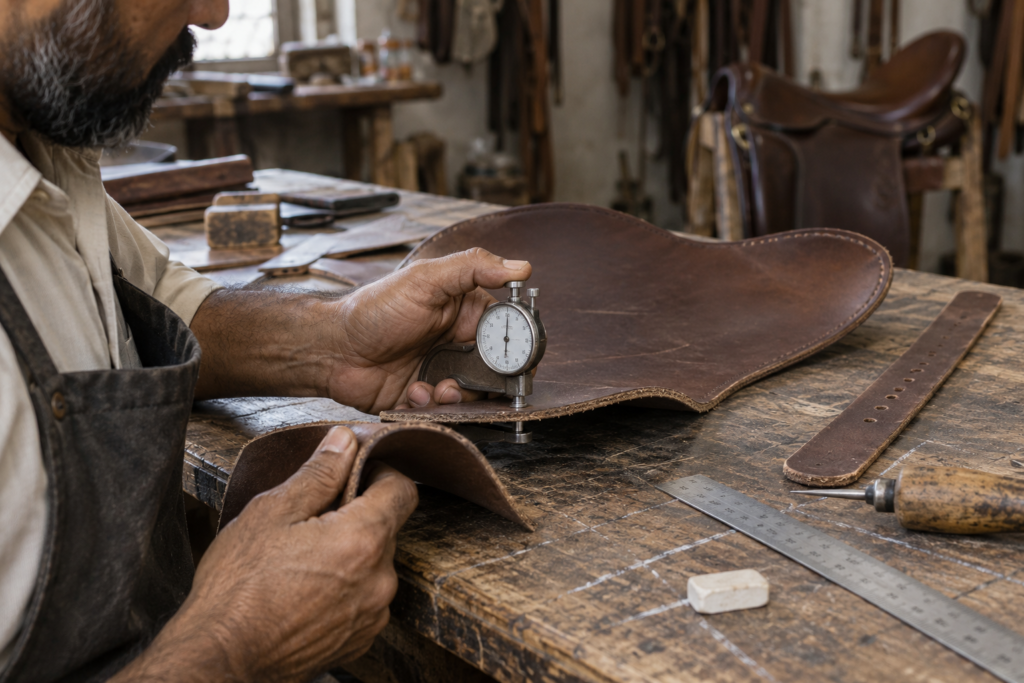
Thickness is not a shortcut for quality. Too much can make a flap rigid or add unnecessary weight; too little may allow a loaded part to stretch or lose shape. Temper, meaning relative firmness or softness, also matters. Two pieces with the same thickness can fold and form differently.
Use a component map in the technical specification:
| Saddle component | Material properties to define |
|---|---|
| Seat and padded areas | Supple handle, controlled stretch and finish comfort |
| English flaps and skirts | Balanced flexibility, stable shape and clean finish |
| Billets and girth straps | Dense structure, controlled elongation and consistent substance |
| Western skirts and jockeys | Body, shape retention and tooling or oil response |
| Fenders and stirrup leathers | Flexibility, abrasion resistance and matched thickness |
| Hidden structural parts | Strength and stability appropriate to the construction |
Record thickness in millimetres or ounces with a tolerance. Show both units if buyer and supplier use different systems.
English and Western Saddles Need Different Leather Planning
English and Western saddles can use high-quality leather, but their component needs differ.
English Saddle Leather Priorities
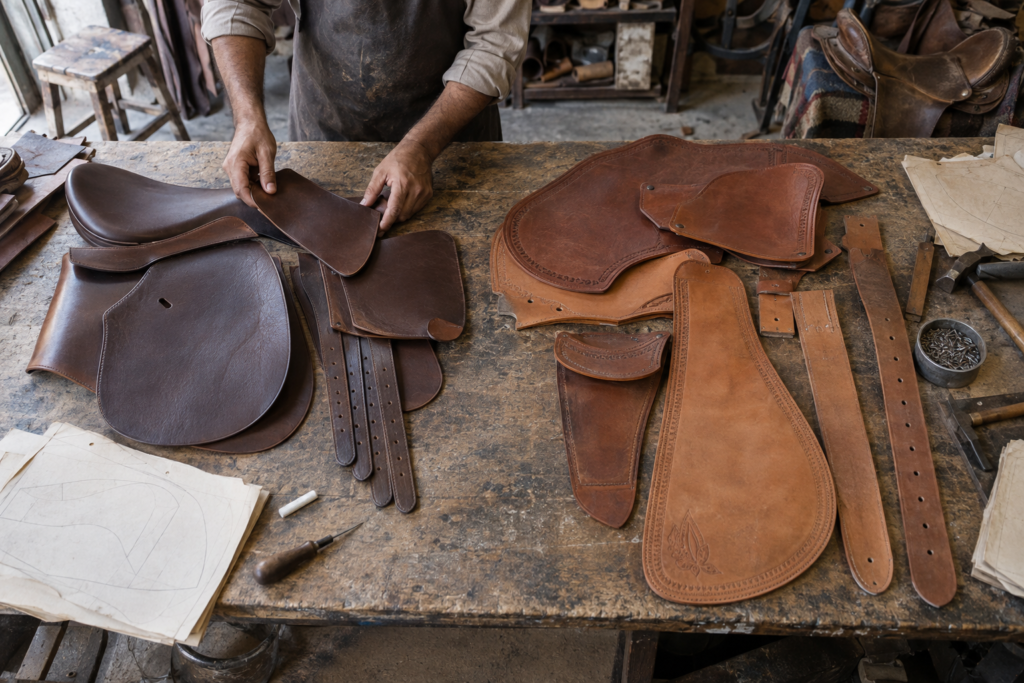
English saddles have highly visible seats and flaps where surface consistency, controlled flexibility and refined finishing matter. Seats, main flaps, sweat flaps, knee areas, piping and billets may require different leather properties.
Wholesale buyers should confirm:
- Seat and flap temper
- Finish, sheen and grain visibility
- Billet leather specification
- Color matching and edge finish
Western Saddle Leather Priorities
Western saddles use larger sections for skirts, fenders and jockeys. Matching those areas affects hide yield and cost, while tooling, carving, oiling and decorative finishing influence material selection.
Buyers should define:
- Tooling coverage and leather body
- Skirt and fender color matching
- Oil, wax or antique finish
- Latigo and other load-bearing leather specifications
Do not compare quotations using only finished weight or a general “leather saddle” description. Component size, yield, labor and finish differ. Buyers can review both categories in the HideOrax wholesale equestrian product range.
Surface Finish, Color and Batch Consistency
The finish changes appearance and grain visibility. Aniline-style finishes show more natural character; semi-aniline finishes add some protection and color control; heavier pigment creates greater uniformity. Ask to see the proposed finish on the actual leather and thickness intended for production.
For color approval:
- Use a physical leather swatch whenever possible.
- View the swatch and saddle sample in neutral daylight.
- Record the approved sheen as well as the color.
- Expect a defined tolerance rather than impossible absolute uniformity.
- Confirm whether visible components must come from the same color lot.
- Reapprove the material if the tannery, finish recipe or base leather changes.
Pantone can communicate a target, but a screen or print cannot reproduce dyed leather exactly. Keep the approved physical swatch and saddle sample as the control references.
How to Approve Saddle Leather During Sampling
A sample should answer production questions, not merely look attractive. Examine the leather by component before approval.
1. Confirm the Material Identity
Match the leather to the written grain, tanning and finish description. Record any change from the quotation.
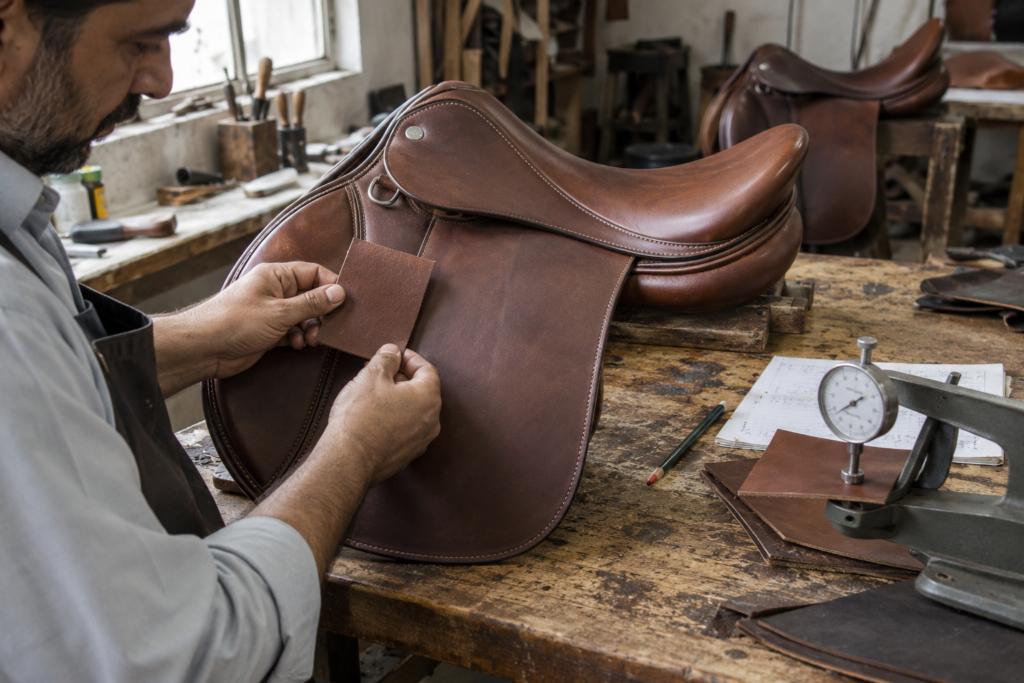
2. Measure Substance in Several Areas
Check important components in more than one place and compare readings with the stated tolerance.
3. Assess Temper, Flex and Recovery
Fold and flex relevant areas. Look for excessive stiffness, looseness, surface whitening or finish cracking.
4. Inspect Cut Edges and Stitching
Check coating depth, fibre density and color contrast at cut edges, plus puckering or tearing around stressed stitching.
5. Review Color and Record Corrections
Compare components with the approved swatch and record accepted variation. Mark changes on the sample sheet and support photographs with measurements. HideOrax’s private-label manufacturing workflow places sample approval before bulk production.
Controlling Leather Consistency in Bulk Production
The approved sample begins quality control. The manufacturer should explain how it will:
- Check incoming hides against the approved material
- Sort leather by color, finish, thickness and visible character
- Position patterns around unsuitable marks or weak areas
- Pair visible components for each saddle
- Measure critical high-stress pieces
- Control finish, oiling and edge treatment
- Compare completed saddles with the approved sample
- Retain the specification for repeat orders
The HideOrax equestrian manufacturing process covers material review through inspection and packing. Each stage should refer to the same approved material and product specification.
What to Put in a Saddle Leather RFQ
Send a structured request so every quotation describes the same product. Include:
- Saddle type and riding discipline
- Target market and intended retail positioning
- Required seat sizes and tree options
- Leather grain description
- Tanning method, if required
- Thickness and tolerance by component
- Temper by component
- Color and physical reference
- Surface finish, sheen, oil or wax treatment
- Acceptable natural markings and variation
- Tooling or embossing requirements
- Hardware and stitching details
- Brand logo, labels and packaging
- Sample quantity and bulk quantity
- Destination country and requested timeline
If some values are unknown, provide the intended product position and a physical reference. Ask for a component-based proposal instead of allowing unrecorded assumptions.
Common Buying Mistakes to Avoid
- Specifying only “genuine leather”: It does not define grain, tannage, thickness, temper or finish.
- Using one description for the entire saddle: Seats, flaps, billets, skirts and fenders perform different jobs.
- Approving color from a screen: Cameras, lighting and displays shift color; use a physical swatch.
- Leaving natural variation undefined: Agree on acceptable full-grain markings before bulk cutting.
- Comparing prices before aligning specifications: A lower quote may reflect a different grade, finish or component allocation.
The checklist in How to Choose a Private Label Saddle Manufacturer helps buyers assess production control, sampling and quality checks alongside material selection.
Frequently Asked Questions
What is the best leather for manufacturing saddles?
It depends on the component. Full grain often suits premium visible areas, while firm vegetable-tanned leather can suit tooling and structural applications. Specify each part by required feel, stretch and finish.
Is full-grain leather the same as top-grain leather?
Not exactly. “Top grain” can include full-grain or corrected-grain leather. State “full grain” when the natural grain must remain without corrective mechanical removal, then add tannage, thickness and finish.
Is vegetable-tanned leather always better for saddles?
No. It suits many firm, shapeable and toolable parts, but a softer leather or different tannage may suit seats and padded sections. Approve appearance and performance by component.
How should a wholesale buyer specify saddle leather thickness?
List thickness and tolerance for each important component in millimetres, ounces or both. Do not apply one number to the entire saddle. Measure critical pieces during sampling and incoming inspection.
Can English and Western saddles use the same leather?
They can share leather types, but component needs differ. English saddles often prioritize refined surfaces and flexibility; Western saddles may require larger, firmer sections for tooling and oil finishes.
Build a Clearer Saddle Material Specification
The strongest specification tells the factory which material belongs on each component and gives both parties a physical standard for sample and bulk approval.
HideOrax manufactures English, Western and synthetic saddles for importers, wholesalers and private-label equestrian brands. To discuss leather, sizes, hardware, branding, quantity and sampling, request a wholesale quotation and include your target market, saddle style and reference materials.