
A horse boot is a small product with a surprisingly detailed specification. Two pairs may share the same colour and size label yet differ in shape, lining, closure placement and the area they are designed to cover. For a wholesale buyer, those differences affect which products belong together and how clearly a retailer can describe them.
Before requesting a price, decide which boot types your customers need and what must remain consistent across sizes and repeat orders. A written specification and approved sample make that decision easier to communicate.
HideOrax manufactures horse boots for equestrian brands and wholesale suppliers in Sialkot, Pakistan. Its published range includes brushing, open-front, fetlock and overreach styles, with configurable materials, padding, closures, colours and private-label branding. This guide turns those options into a practical buying checklist. Wholesale & Private Label
Choose the boot type before the material
Begin with the product’s intended position in your range. A brushing boot, an open-front boot and an overreach boot are different constructions. Ordering them under one broad description such as “protective horse boots” creates confusion during quotation and sampling.
| Boot type | Typical range position | Details to define |
|---|---|---|
| Brushing | General protective boot range | Coverage shape, outer, lining, padding and straps |
| Open-front | Jumping-oriented front-leg range | Front opening, rear coverage, shell shape and closures |
| Fetlock | Compact hind-leg range | Coverage, size grading and coordination with front boots |
| Overreach | Bell-shaped hoof-area range | Flare, material, lower edge and closure |
These labels identify product families. They are not a substitute for checking fit on an actual horse or for substantiating a performance claim.
Brushing boots
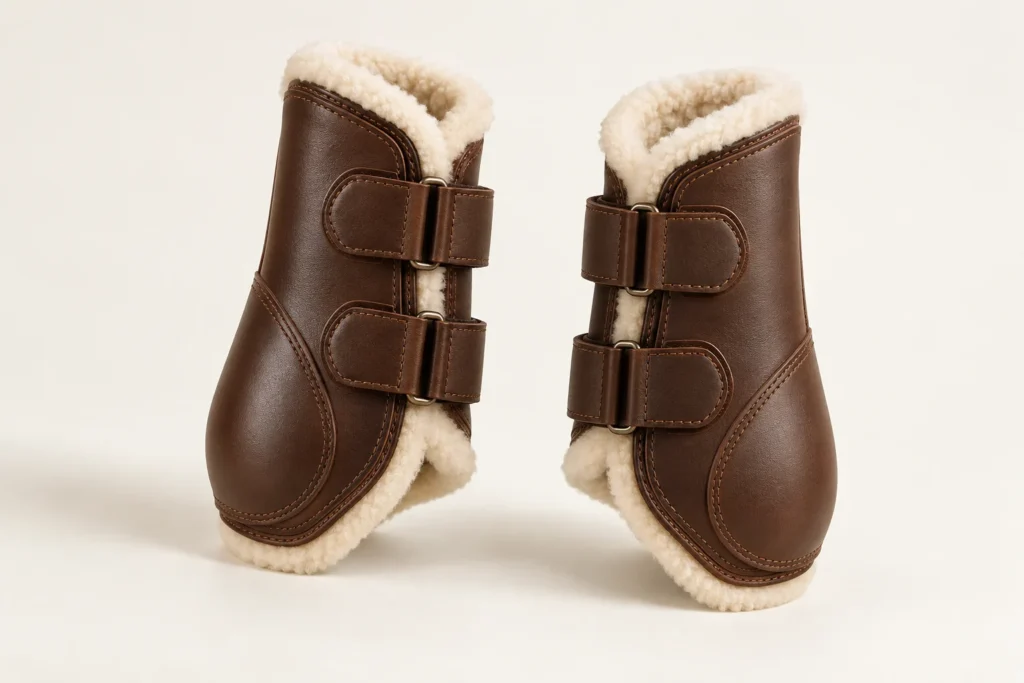
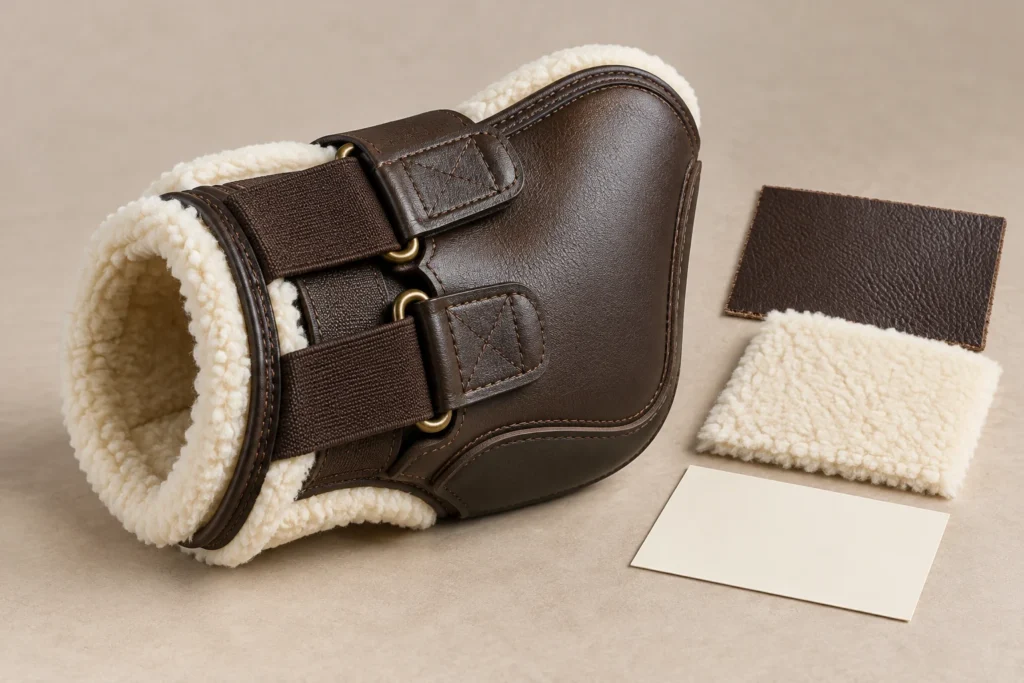
Brushing boots are a practical starting product for many tack retailers. For an enquiry, identify the outer material, padding, lining, shape, height and closure arrangement. Specify whether you want a leather appearance, a synthetic shell, a fleece-style lining or another approved construction.
Check the pair from both sides. The boots should match in shape and finish, and their straps should be placed consistently. On the sample, look at the edges that will sit against the leg and confirm the intended method for cleaning the materials.
Open-front boots
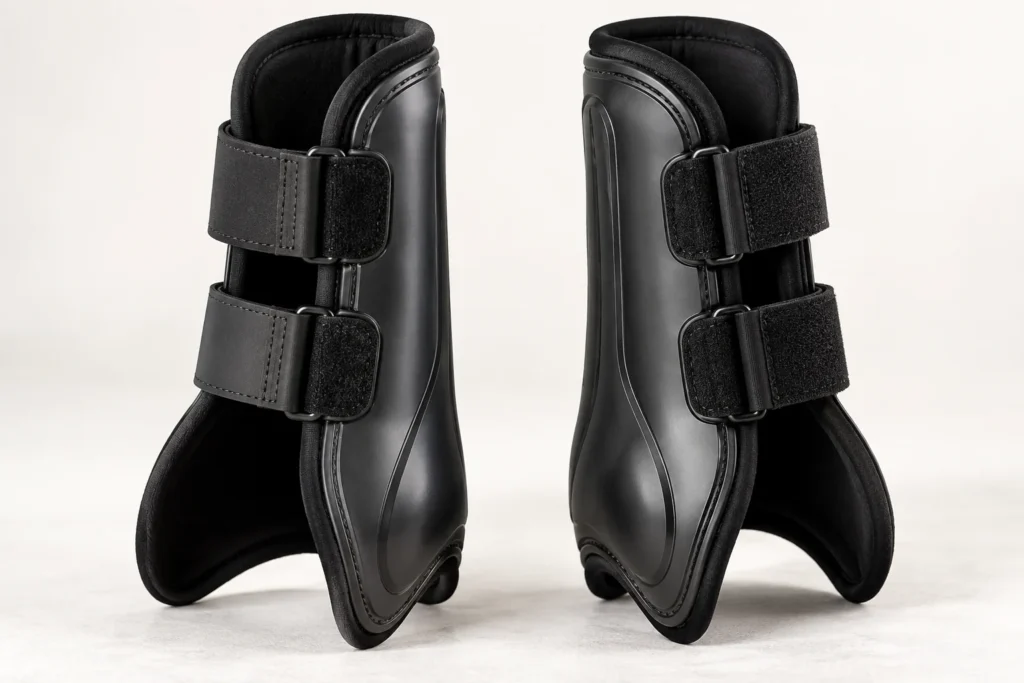
An open-front model should be identified with a drawing or reference that makes its front opening and protected areas clear. State the intended size range, outer shell, inner lining, padding and closure positions.
Ask the manufacturer to show the sample from the front, side and rear. A single catalogue view may hide important differences in shape or strap placement. If the boot has a rigid component, define its material and check how it joins the softer lining and edge binding.
Fetlock boots
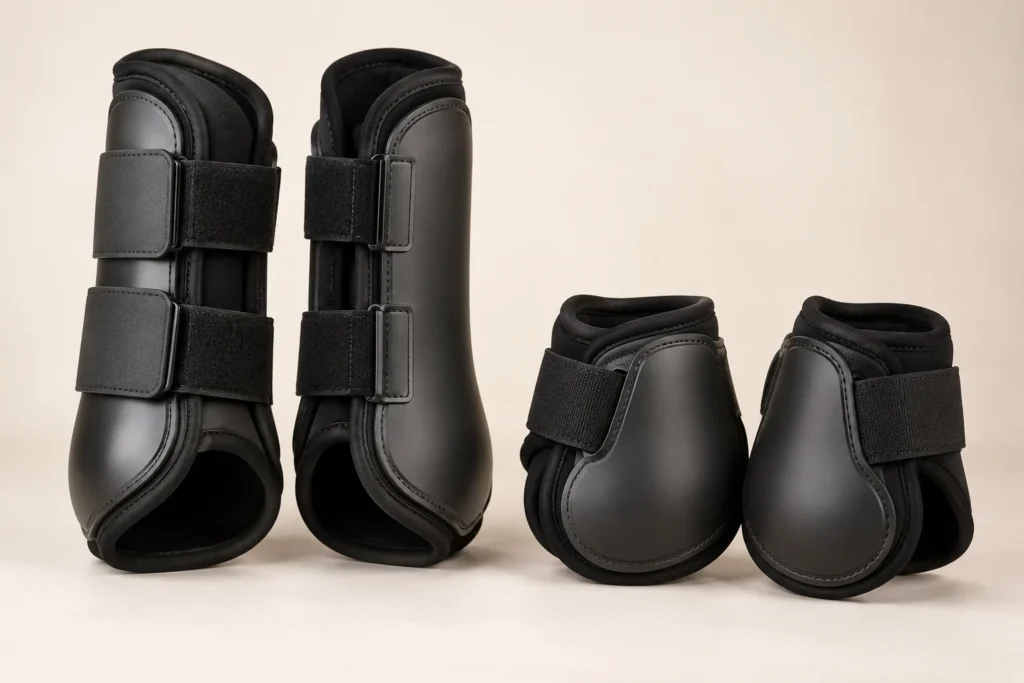
Fetlock boots are often planned as a shorter, coordinating product alongside open-front boots. They still need their own dimensions, construction and approved sample. Do not assume that a matching colour means the front and hind products use identical padding or closures.
If you will sell a coordinated set, define exactly what the customer receives. Record whether the retail unit contains two front boots and two hind boots, two separate pairs, or another agreed configuration. The product photographs, stock code and carton list should use the same description.
Overreach boots
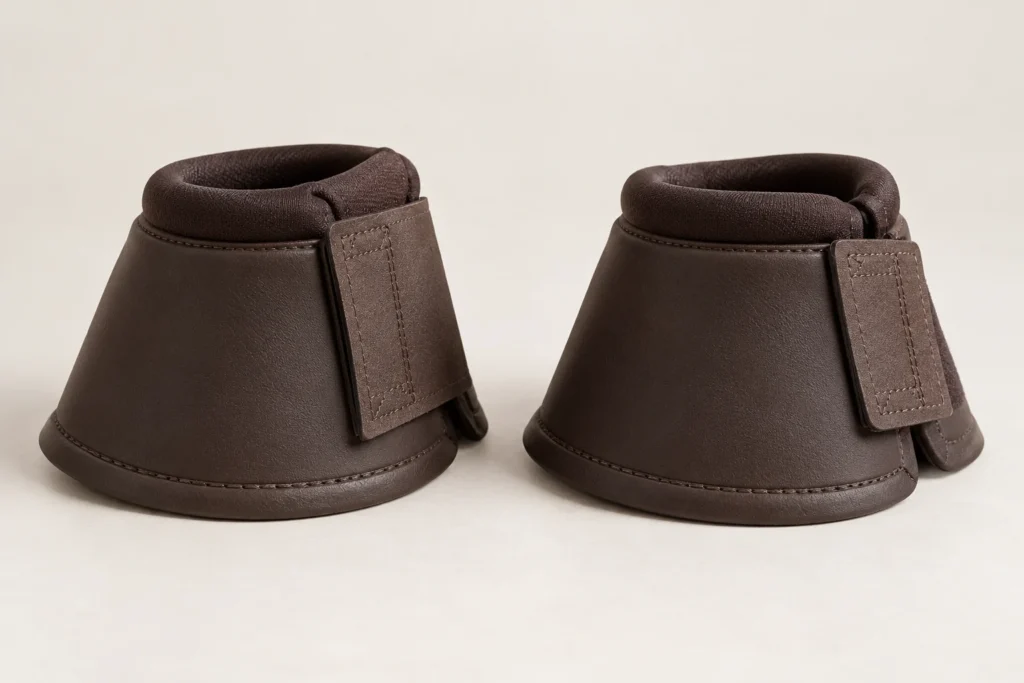
Overreach boots have a bell-shaped construction that should be reviewed separately from leg boots. State the intended material, shape, upper opening, lower flare, edge finish and closure. Check how the material flexes and how consistently the pair is made.
An overreach boot’s size label alone does not tell a buyer the dimensions of its top opening or lower edge. Request measured specifications and a documented grading method for additional sizes.
Make sizing measurable and repeatable
“Full,” “cob” or “medium” can help a shopper navigate a catalogue, but a wholesale production sheet needs measured reference points. Agree on the relevant dimensions for each boot type and show exactly where they are taken.
Depending on the design, record:
- Overall boot height
- Upper and lower opening or circumference
- Width or coverage of the protective area
- Strap length and usable adjustment range
- Distance between closure positions
- Size and shape of the lower edge
- Permitted measurement tolerance
Use the units your buyer and manufacturer can both read clearly. If you show centimetres and inches, convert consistently and identify the primary measurement.
Do not copy a size chart from another brand and assume it fits a new pattern. The sample should establish how this particular design is measured. A photograph with measurement points marked can help the manufacturer, retailer and repeat-order inspector use the same method.
Where possible, evaluate the sample on horses representative of the intended size range with appropriate professional input. That is more useful than judging fit only from a boot standing upright on a table.
Specify the outer, lining and padding separately
A material choice affects more than appearance. The outer must be described separately from any shell, padding, lining, binding and closure. “Leather horse boot” or “soft-lined boot” is too broad to reproduce reliably.
For each component, record what the buyer expects:
| Component | Buyer specification |
|---|---|
| Outer | Material, colour, surface finish and acceptable variation |
| Structure | Flexible or shaped components and their placement |
| Padding | Material, thickness or construction where required |
| Lining | Material, feel, attachment and care instructions |
| Binding | Material, colour and edge finish |
| Straps | Material, width, length and attachment method |
| Fastening | Type, position and adjustment range |
Review the actual sample in neutral light. A glossy product photograph cannot establish material feel, thickness or how a lining is attached. If a synthetic material, leather or fleece-like textile has a specific trade name or composition that matters to your retail description, confirm it in writing.
Ask how the boot should be cleaned and dried based on its approved materials. Do not use generic care instructions for every construction.
Check closures as part of the fit
Closures are a working component, not a decorative detail. On a sample, check the number of straps, their position, stitching or other attachment, usable adjustment and how securely they fasten. Compare the two boots in a pair.
If using hook-and-loop fastening, confirm the width, length and placement of both mating surfaces. If the design uses buckles or another system, check its material and operation on the sample. Ask how worn or defective components would be handled in a repeat order.
A closure should be assessed with the intended fit and use. A strap that appears long enough while the boot lies flat may behave differently when the boot is positioned on a leg. Record corrections with annotated photographs and measurements rather than an instruction such as “make straps better.”
Keep a first wholesale range focused
Each new boot type, size, colour and lining creates another stock-keeping unit. A first order should help you learn what your retailers can sell, rather than divide a small quantity across too many untested combinations.
You might begin with one brushing-boot construction in a controlled colour range, then add an open-front and fetlock combination if your customers request it. Overreach boots can be listed as a separate line because their pattern and sizing are different. That is a planning example, not a required assortment.
For every line in the quotation, specify:
- Boot type and model reference
- Intended front, hind or hoof-area use
- Size and colour
- Outer, structure, padding and lining
- Closure and strap arrangement
- Quantity in pairs or sets, clearly identified
- Branding and packaging version
HideOrax’s horse boots product page states a standard wholesale MOQ of 10 pairs. Ask whether the minimum applies separately to each model, size, colour or mixed order. The same page lists a typical sample lead time of 5–7 working days after specification confirmation; confirm the timing for your particular materials and revisions in the quotation. Wholesale & Private Label
Approve a sample for each distinct construction
A sample should answer the questions a product listing cannot. Inspect its dimensions, pair consistency, material identity, edges, closures, branding and packaging. Check the intended fit and ask for a revised sample when a significant change to shape or construction needs physical review.
Use a simple approval record:
| Item | What to record |
|---|---|
| Sample identity | Model, boot type, size, colour and version |
| Dimensions | Measured values and agreed tolerances |
| Components | Outer, padding, lining, straps and fastening |
| Pair check | Consistency of left and right pieces |
| Fit review | How and on what representative size it was evaluated |
| Branding | Artwork version, method and position |
| Packaging | Contents, pair or set description and protection |
| Corrections | Numbered issues, photographs and resolution |
Keep the approved reference and written decisions with the purchase order. If a later material, pattern or closure change is proposed, decide how it will be reapproved before it replaces the original specification.
HideOrax describes its broader private-label equestrian manufacturing workflow as specification review, quotation, sample approval and then bulk production.
Plan branding, packaging and related products
An effective private-label range should be recognizable without sacrificing clear product information. Agree on the logo method, position, labels, product code and packaging during sampling. If you plan matching front and hind boots, make the pair or set contents obvious on the retail label.
Decide how boots will be protected inside the retail pack and export carton. Ask for the carton count, dimensions and weight when comparing freight quotations. Avoid claims such as “impact-proof” or “prevents injuries” unless you have evidence for the exact product and wording.
Horse boots can sit beside saddle pads in a coordinated colour collection. HideOrax’s saddle pads product page is a starting point for a matching textile line. Approve colours against physical samples because different materials may take colour differently.
For a wider view of the available families, use the HideOrax product catalogue.
Frequently asked questions
Which horse boot types does HideOrax manufacture?
The published range includes brushing, open-front, fetlock and overreach boots. Materials, sizing, closures, colours and branding are finalized against the buyer’s approved specification.
What is the minimum wholesale order for horse boots?
HideOrax lists a standard minimum of 10 pairs. Confirm how this applies to a mixed order containing several designs, sizes or colours.
Can I order matching front and hind boots?
HideOrax says open-front and fetlock styles can be developed as coordinated sets. Give each product its own size and construction specification, and clarify whether the retail unit is a pair or a four-boot set.
Is one sample enough for every size?
Do not assume so. Agree on the size-grading method, measured tolerances and how additional sizes will be checked. A distinct pattern or material may need its own sample review.
What information should I send for a horse-boots quotation?
Send the boot type, target market, sizes, materials, lining, closure, quantity by variant, branding, packaging and destination country. Include reference photographs or drawings and mark any detail that is still open to the manufacturer’s proposal.
Request a horse-boots wholesale quotation
HideOrax manufactures horse boots for equestrian wholesalers and private-label brands in Sialkot, Pakistan. A clear enquiry lets the team review the design, propose a sample and quote the correct variants.
Request a quotation with your preferred boot type, target country, sizes, materials, closures, quantities in pairs or sets, logo and packaging requirements.