
A wholesale catalogue is most useful when a buyer can move from a product name to a clear sourcing decision. “Bridles,” for example, does not tell a manufacturer which style, sizes, leather, hardware or branding you need. “Saddle bags” does not explain how the bags will attach to the saddles in your range.
HideOrax works with importers, distributors, tack shops and private-label equestrian brands from Sialkot, Pakistan. Its published range covers saddles, leather tack, horse equipment and professional farrier aprons. This guide brings all 12 product families into one place and links directly to the relevant HideOrax page for each one. HideOrax
Use it to identify the products you want to discuss. Then send a specification and quantities for each product rather than requesting one general price for an undefined collection.
Saddles: choose the foundation of the range
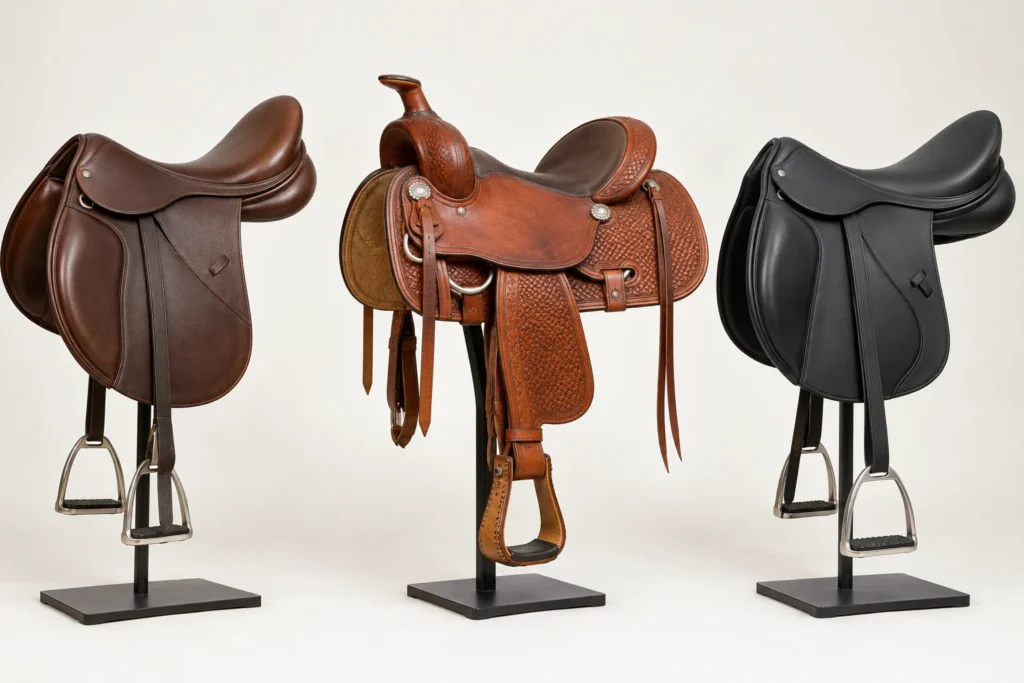
A saddle is often the most detailed product in an equestrian order. Style, size, construction and intended market should be established before discussing matching accessories. HideOrax has separate pages for three saddle families, making it easier to enquire about the one that fits your customer.
1. English saddles
The English range is relevant to buyers building dressage, jumping, all-purpose or other specified collections. Start your enquiry with the intended saddle style, seat sizes, tree or fit-related options, flap and panel requirements, leather and colour.
If you want several styles, list each separately. A jumping saddle and a dressage saddle should not be treated as one interchangeable product merely because both are English saddles. Identify the construction and approved sample for each model you intend to order.
2. Western saddles
For a Western range, identify the intended style and the details that define it: tree and seat specifications, skirts, rigging, fenders, stirrups, tooling and finish where applicable. Include clear reference views from both sides and from above.
Plan compatible Western accessories as part of the enquiry. Matching colour alone is insufficient if the attachment method, dimensions or hardware differ from the approved saddle.
3. Synthetic saddles
A synthetic saddle needs its own specification. Identify the outer material, reinforcement, padding, binding, hardware and cleaning expectations rather than asking for a “synthetic version” of a leather model.
When comparing leather and synthetic ranges, ask for samples built to the intended specification. Similar silhouettes do not establish that their construction, weight, finish or retail position is the same.
Head and control: coordinate styles, sizes and materials
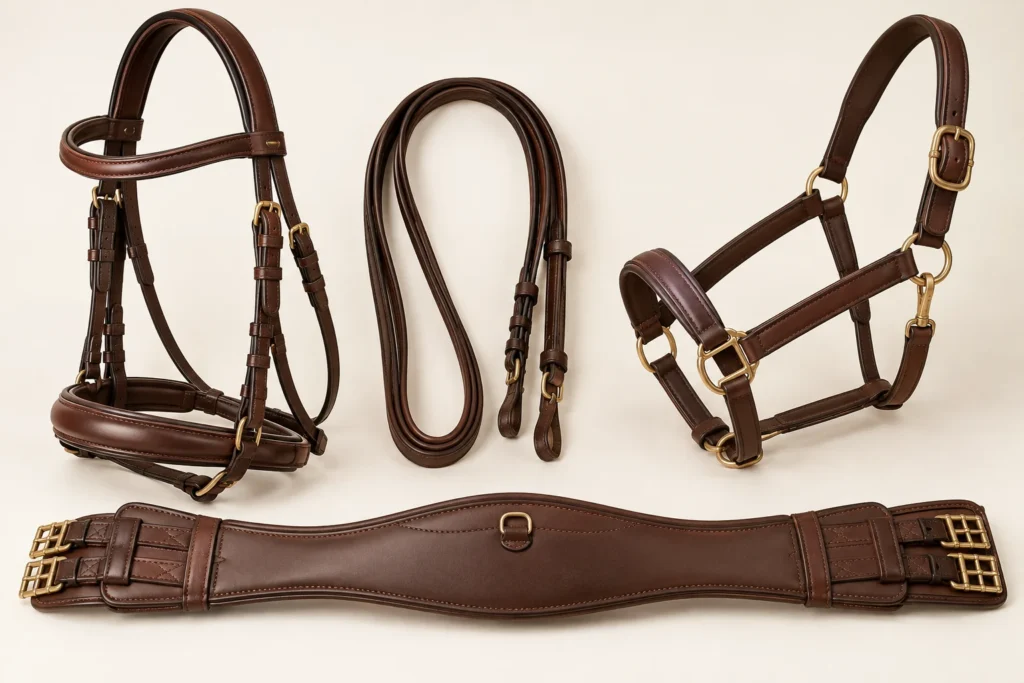
This group includes the products a retailer often presents alongside a saddle. A coherent appearance helps, but the buyer must also define sizing, strap layout, hardware and how separate products work together.
4. Bridles, halters and headcollars
Specify whether you need a riding bridle, a halter or headcollar, and the exact design within that family. Record the required sizes, leather or other materials, padding, noseband and cheekpiece details, buckles and finish.
For US and UK listings, halter and headcollar are familiar regional terms. Name both where useful, while keeping the technical specification consistent. Approve the size chart and the physical sample before building retail descriptions around a fit claim.
5. Horse reins
Define rein length, width, material, grip, attachment and hardware. If the reins are intended to match a particular bridle, identify that bridle model and compare the colour, finish and fittings on actual samples.
Record how the reins will be sold and packed. A separate retail pair and a bridle-and-reins set may need different labels, photographs and stock codes even if the reins themselves share a specification.
6. Horse girths
A girth enquiry should identify the intended saddle arrangement and girth type, then give the lengths, shape, padding, elastic or other components, buckle specifications and measurement method. HideOrax’s published catalogue includes long, dressage, anatomical and belly-guard configurations. HideOrax
Avoid ordering by a familiar size label alone. State where the girth is measured and confirm that the sizes in the sample and retail chart use the same method.
Saddle connection: check components together
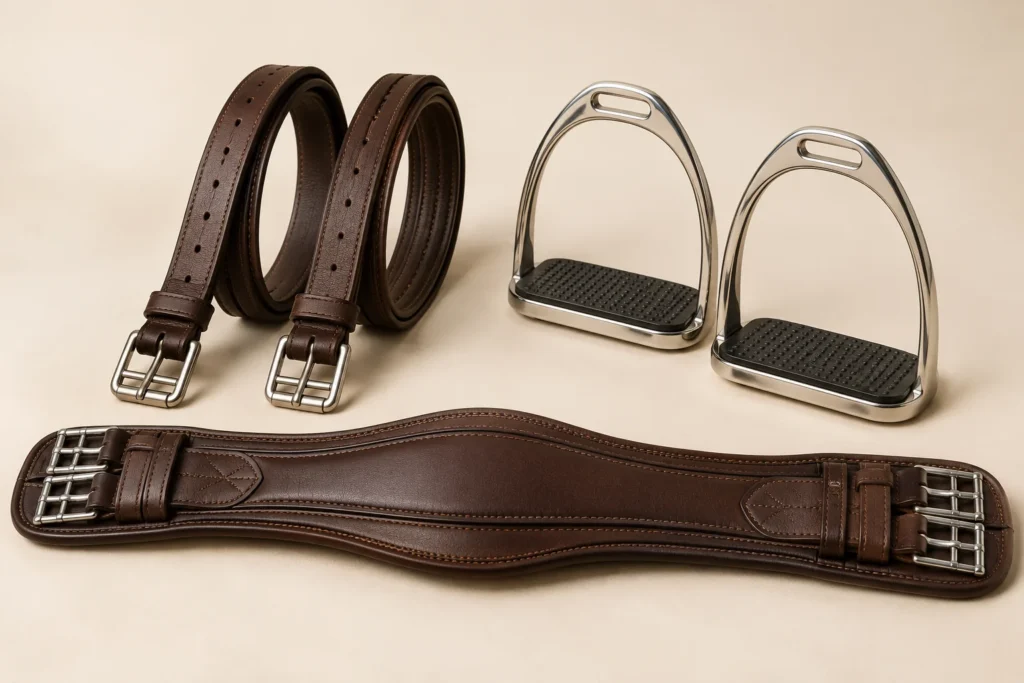
A stirrup, its leather and a saddle can each be correctly made while the selected combination still needs adjustment. When these products are intended as a package, check them together on the approved saddle arrangement.
7. Stirrup leathers
Specify length, width, hole spacing, leather and reinforcement where required, buckle material and finish. HideOrax lists traditional, reinforced, mono and wide-comfort configurations. Ask which construction suits your selected saddle and stirrup rather than assuming all variants attach in the same way. hideorax.com
Check both leathers as a pair. Compare their lengths, hole positions, edge finish and buckles with the approved reference.
8. Horse stirrups
HideOrax’s published range includes Fillis irons, safety-oriented, flexible, wide-tread and Western configurations. Specify the exact design, opening and tread dimensions, material, finish and intended stirrup-leather connection. hideorax.com
If a product is described as a safety stirrup, verify the precise design and evidence behind any safety or competition claim before putting that claim on your retail page. Approve a matched pair, not just one attractive catalogue image.
Pads and protective equipment: define fit and care
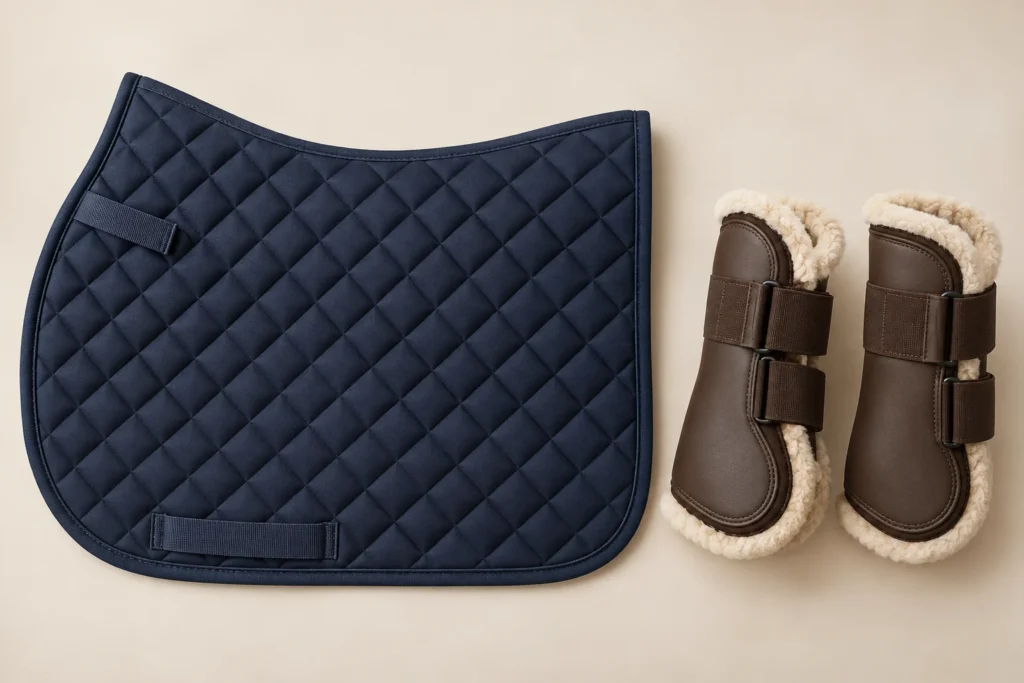
Textile and protective products need specifications that go beyond colour. Shape, filling, binding, straps, closures and care information can affect both sample approval and how retailers present the product.
9. Saddle pads
Identify whether the pad is intended for an all-purpose, dressage, jumping or another saddle outline. Provide its dimensions, fabric, quilting, filling, binding, attachment straps, colour and logo position.
When developing matching colours across leather and textiles, approve physical references. A brown leather saddle and a brown fabric binding may appear close in a digital image but differ in natural light.
10. Horse boots
State the boot type, intended use, size range, outer material, lining or padding, closures and shape. Ask the manufacturer to show the size-measurement method and confirm left-and-right or front-and-hind distinctions where the design requires them.
Check closure placement and consistency on the sample. If you plan several colours or sizes, record each variant and its quantity clearly before the bulk order.
Storage and professional equipment: serve distinct buyers
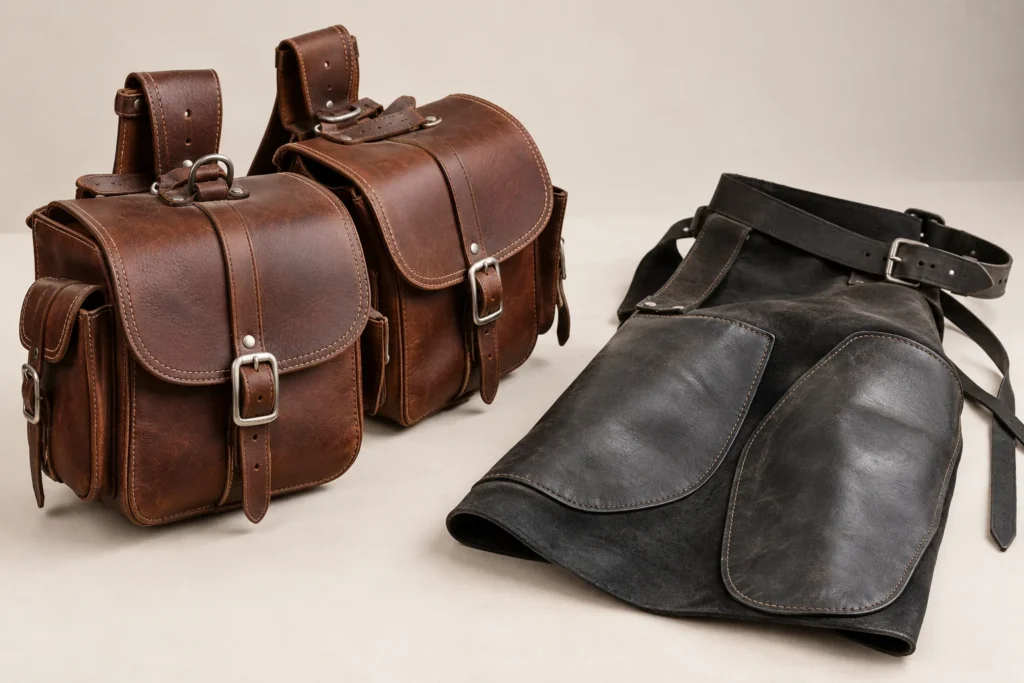
These final product families should have their own specifications and retail stories. Saddle bags serve a storage and carrying need within a riding range; farrier aprons serve a professional equipment buyer.
11. Saddle bags
HideOrax lists saddle bags for trail, endurance and Western collections. State the intended saddle, bag arrangement, dimensions, capacity requirements, attachment straps, closures, lining and material. HideOrax
Check a sample on the specific saddle configuration with which it will be sold. A bag can look well made in a studio and still need changes to its mounting position or strap length.
12. Farrier aprons
A farrier apron belongs in a separate professional-equipment range. Define apron size, leather specification, waist or leg adjustments, protective panel layout, pocket or tool-storage arrangement and finished weight as required by your buyer.
Review the sample with the intended professional use in mind. Describe its actual materials and construction accurately; do not add an unverified protective rating or certification to the listing.
Turn the catalogue into a clear quotation request
You do not need to order all 12 families at once. Select the products that match your buyers, then give HideOrax enough detail to quote each one accurately.
For every proposed product, provide:
| Information | What to send |
|---|---|
| Product | Family, style and reference image or drawing |
| Variants | Sizes, colours and materials |
| Construction | Dimensions, padding, hardware and other required details |
| Quantity | Units or pairs, clearly stated for each variant |
| Branding | Artwork, logo method, placement and labels |
| Packaging | Retail presentation and any required identifiers |
| Market | Destination country and intended sales channel |
| Sampling | Which models and variants require approval samples |
Separate confirmed requirements from the areas where you want a recommendation. This gives the manufacturer a clear starting point without treating an early suggestion as an approved production specification.
HideOrax publishes a general starting minimum of five saddles or ten pieces for most accessories, with product-specific terms shown on individual pages. Some categories, including stirrups and stirrup leathers, state minimums in pairs. Ask for the MOQ by product, model and variant in your quotation; do not assume one mixed order satisfies every minimum. HideOrax
Approve products as a collection and as individual items
A coordinated collection needs two checks. First, each item must match its own approved specification. Second, products intended to be sold or used together should be checked together.
For example, compare a bridle and reins for attachment and finish; check a stirrup with its leather; assess a saddle pad against the intended saddle outline; and test saddle-bag attachments on the stated saddle. Record which versions were checked so the pairing can be repeated on a later order.
Approve branding and packaging by product type. An embossed leather logo, a textile label and a mark on a metal component may need different methods. Keep artwork files, colour references, sample photographs and written decisions with the purchase order.
For a deeper explanation of how to choose a focused combination and control your first order, read HideOrax’s wholesale horse tack range-planning guide.
Frequently asked questions
Does HideOrax offer more than saddles?
Yes. Its live catalogue has 12 product families covering saddles, bridles and halters, reins, girths, stirrup leathers, stirrups, saddle pads, saddle bags, horse boots and farrier aprons.
Can I request several product families in one enquiry?
Yes. List each product and its variants separately, with the intended quantity. Ask how the MOQ, sample cost and timing apply to every product family.
Can these products carry my own brand?
HideOrax offers private-label customization, including agreed product specifications, logos, labels and packaging. Confirm the method and placement on the relevant sample before bulk production.
Should I request a sample for every size and colour?
Agree on a sampling plan with the manufacturer. Different constructions or materials may need separate review. For additional sizes and colours, document how those variants will be checked rather than assuming one sample represents every option.
Where should I start if my range is still undecided?
Send your target market, customer type and two or three priority products. State which sizes, materials and quantities you know, and ask HideOrax to identify the specifications that still need a decision.
Explore the range and request a quotation
HideOrax’s complete wholesale product catalogue provides a page for every published product family. Use the links above to review the products that fit your business.
When you are ready, request a quotation from HideOrax with your selected product types, target country, quantities, sizes or dimensions, materials, branding and packaging requirements. That information gives the team a practical basis for discussing samples and a wholesale order.