
A riding school buys equipment for repeated lessons, different riders and a changing group of horses. A saddle that suits one horse and one rider may not serve the rest of the program. A bridle that looks correct in a catalog may have an adjustment range that does not suit the school’s horses.
That makes a riding school order different from buying individual products for a tack shop shelf. The useful starting point is an inventory of horses, lesson types, current equipment and replacement needs. From there, a buyer can specify saddles and tack that work together, approve samples and place an order that staff can identify and maintain.
This guide is for riding schools, lesson barns, equestrian centers and trade suppliers serving them in the USA, UK and Europe. It explains what to include in a first wholesale inquiry, how to assess equipment for shared use and how to plan future replacements.
Start with the horses and the lessons you teach
Before asking for a price list, describe the program the equipment must support. A beginner English riding school may need a different assortment from a center offering jumping lessons or Western trail instruction.
Make a simple equipment plan for each horse:
| Record | Why it matters |
|---|---|
| Horse identification and relevant measurements | Helps staff match equipment to the intended horse |
| Lesson discipline | Guides the saddle and tack specification |
| Current saddle and fit assessment | Shows what works and where a replacement is needed |
| Rider range | Helps plan seat sizes and adjustment options |
| Bridle, girth and pad details | Identifies compatible items and useful spares |
| Condition and replacement priority | Prevents the order from being driven only by appearance |
Have a qualified saddle fitter assess saddle suitability for each horse. A manufacturer can make equipment to an approved specification, but a product name or a “medium” width label cannot establish fit for every horse.
If you supply several riding centers, ask each one for its own size and usage breakdown. Combining all requests into “20 school saddles” hides the details needed to make an accurate quotation.
Choose a saddle range for the actual program
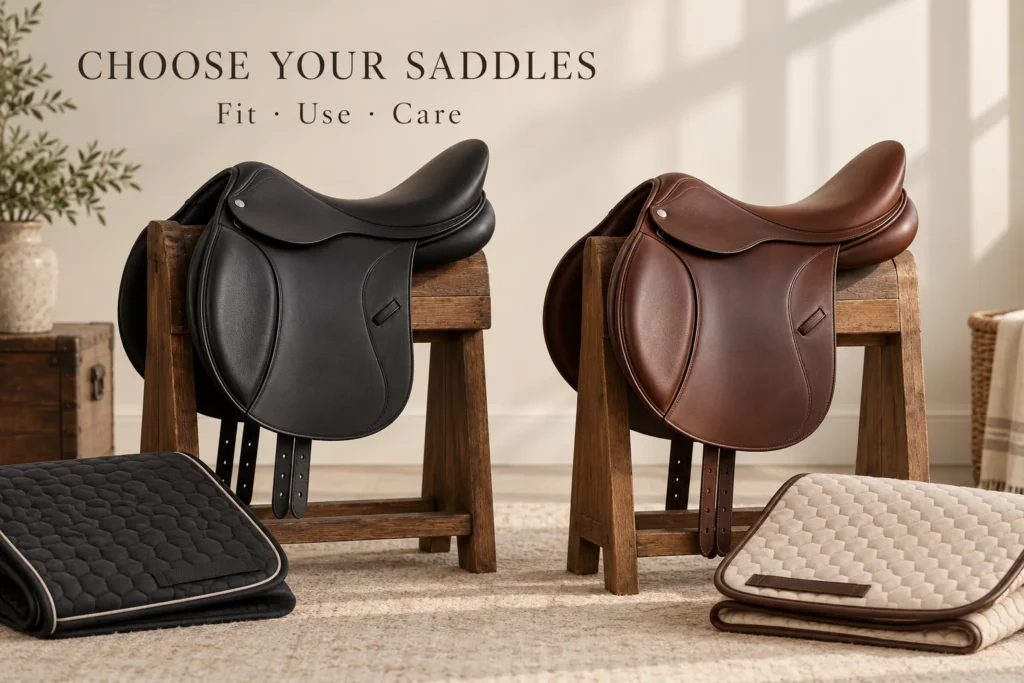
For an English lesson program, an all-purpose or general-purpose saddle may be a starting point. A jumping program may also need a separate style for its intended lessons. Western instruction requires its own saddle and tack specification.
HideOrax has separate manufacturing ranges for English saddles, Western saddles and synthetic saddles. The appropriate choice depends on the school’s horses, instruction and care routine.
Leather and synthetic: compare complete products
A leather saddle may suit a school that wants a traditional appearance and has a consistent cleaning and care routine. A synthetic model may appeal to a program that prioritizes a practical outer material and straightforward routine care.
Neither material determines fit or quality on its own. Ask for the actual tree or structure specification, panel design, seat sizes, finished weight, loaded attachments and care instructions. Compare samples of the complete saddles rather than choosing from the outer material name.
For a fuller material comparison, see HideOrax’s leather versus synthetic saddles guide.
Use clear measurements
For every proposed saddle model, confirm the seat measurement method, available fit options, relevant dimensions and the horse types on which the sample will be assessed. Keep those records with the school’s tack inventory.
In the UK, buyers may call a broad English schooling style a general-purpose or GP saddle. In the US, all-purpose saddle is familiar terminology. Use the terms your staff and suppliers understand, while keeping the underlying measurements explicit.
Build a coordinated tack list
A saddle order is easier to use when its accompanying items have also been specified. Review what the school already owns and list only the accessories that need to be supplied or replaced.
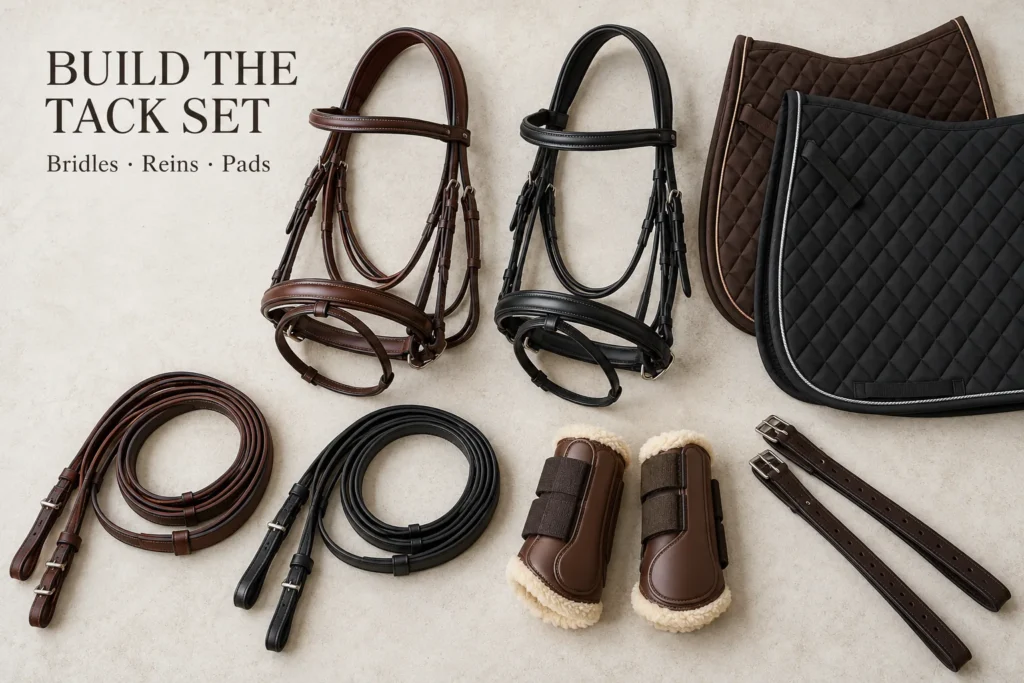
Bridles and halters
For bridles and halters, specify sizes using a measurement sheet or an approved reference. Check the usable adjustment range, buckle and ring placement, padding where requested and hardware finish.
A school may need several sizes for different horses. Ask for the quantity by size rather than ordering every bridle under one broad label. In UK inquiries, headcollar is common for a halter; US buyers commonly use halter. State the product and measurements so the terminology does not create confusion.
Reins
For horse reins, confirm length, material, grip, connection style and whether they are included with the bridle quote. A matched set makes it easier for staff to identify equipment, but the rein specification should still be approved separately.
Girths and saddle accessories
A horse girth must be specified for the relevant saddle and horse. Give the length measurement method and intended style. For stirrup leathers and stirrups, record the sizes, model and components included with each saddle.
Do not assume a saddle quotation includes stirrups, leathers or a girth. Ask the supplier to show every included item as a line in the quotation.
Pads and protective equipment
Plan saddle pads for the actual saddles in use. Confirm shape, size, lining, filling, attachments and washing instructions. A school may need enough pads for its cleaning and rotation routine, but the quantity should follow its lesson schedule and laundry capacity.
If your program uses horse boots, identify the specific style and horses for which they are intended. Check size, pairs, closures and care requirements on a sample.
Inspect equipment for repeated shared use
When several riders use the same tack, staff need to recognize its condition quickly. During sample review, pay attention to details they will handle every day.
For a saddle, examine the visible condition and construction of the seat, flaps, panels or underside, billets or rigging, stirrup-related attachments, stitching and hardware. For bridles and other straps, look at adjustment holes, loaded joins, buckles and edges. For pads, review the lining, quilting and attachments after the cleaning method proposed for that material.
Agree on the checks appropriate to each product before bulk production. Keep the approved sample and measurement sheet as the reference for delivery inspection and reorders. HideOrax describes sample approval and comparison with the approved specification as part of its manufacturing process. hideorax.com
Once equipment enters service, a school should have staff check it regularly for wear and remove damaged items from use until they are assessed or replaced. Purchasing an initial batch is only the beginning of equipment management.
Plan sizes and spares without ordering blindly
The best first order reflects the horses and equipment you already have. Sort the proposed purchases into three groups:
- Immediate replacements: Items that have been assessed and need replacing.
- Additional working equipment: Items needed for the school’s current lesson capacity.
- Spares: Selected items for which a suitable replacement would be hard to obtain quickly.
Keep the size breakdown beside each item. “Five bridles” is less useful than a list showing which approved size and model each horse needs.
A simple internal code can help staff identify sets. For example, a school could label a saddle, its pad and its storage location with the same horse or equipment reference. This is a record-keeping suggestion; agree on any physical labels or markings as part of the order.
For distributors supplying multiple schools, maintain the specification and approved sample for each model. That makes the next order easier to compare with the first.
Calculate the full cost of a usable set
A unit price for a saddle does not tell you the cost of putting that saddle into service. Ask for a quotation that shows the saddle and every required accessory separately.
Compare:
- Saddle model and approved specification
- Girth
- Stirrup leathers and stirrups
- Pad
- Bridle and reins
- Additional items the school has requested
- Sample charges and any custom labeling
- Packing, freight basis and destination charges
This allows you to decide what can be reused from existing stock and what should be included in the new order. Ask for finished weights and carton dimensions when comparing freight quotations.
HideOrax’s published starting quantities are five saddles or ten pieces for most accessories, with samples generally prepared before bulk production. Confirm how quantities are counted for mixed models, sizes and product families in your specific quote. HideOrax
What to send for a riding school equipment quote
A detailed inquiry gives the manufacturer a practical starting point. Send:
Our location: Country and delivery destination
Business: Riding school, lesson barn, equestrian center or distributor
Discipline: English, Western or both
Horses: Number of horses and relevant equipment size breakdown
Saddles: Style, seat sizes, fit requirements and quantity by variation
Material preference: Leather, synthetic or models to compare
Matching tack: Bridles, reins, girths, stirrup leathers, stirrups and pads needed
References: Current equipment photographs, measurements or an approved sample
Branding: School name, labels or packaging requirements, if any
Sampling: Which models need to be assessed before bulk production
Timing: Target order schedule
If your school is still deciding between materials or styles, say which choices you need quoted as alternatives. Do not collapse different saddle constructions into a request for one “best price.”
HideOrax’s private-label service can review a reference, measurements or a technical specification before confirming feasibility. A school that does not need custom branding can still describe its functional requirements in the wholesale inquiry form.
Frequently asked questions
Are synthetic saddles a good choice for riding schools?
They may suit some programs because of their practical care requirements. The final choice depends on the approved model’s fit, construction, lesson use and maintenance routine. Assess the sample for the horses and riders who will use it.
Can one saddle be shared by several horses?
Only where an appropriately qualified fitter has assessed its suitability for each horse and the rider requirements are met. A general size label does not establish that one saddle fits a whole school.
Can a school order saddles and tack together?
HideOrax lists saddles, bridles, reins, girths, stirrup leathers, stirrups, pads and other equestrian products in its wholesale catalog. Request a line-by-line quotation and confirm compatibility and quantities for each category. HideOrax
Do we need a private-label logo?
No. A riding school can inquire about equipment specifications without making logo customization the focus. If you do want school identification, agree on its method and position during sampling.
What should we approve before a bulk order?
Approve the relevant physical samples and written specifications, including sizes, materials, construction, finish, included accessories, labels and packing. Have saddle fit assessed for the intended horses.
Equip the program you actually run
A useful wholesale order begins with the horses, lessons and equipment already in service. Choose models for those needs, record sizes and compatibility, assess samples and keep the approved specifications for replacement orders.
HideOrax manufactures saddles and coordinated equestrian tack for trade buyers, including riding schools and riding suppliers. Send your equipment list, sizes, quantities and destination through the request a quote page to discuss suitable samples and a detailed quotation.