
A new equestrian brand often begins with a visual idea: a particular color, a quilted pattern, fine piping and a logo. Turning that idea into a saddle pad customers can use and your manufacturer can reproduce takes more detail.
The shape must work with the intended saddle. The outer fabric, lining and filling need to be specified separately. Attachments must sit where they are useful. Branding must remain readable on the finished pad. Then the approved sample has to become the reference for every color and reorder.
This guide is for tack retailers, wholesalers and emerging equestrian brands in the USA, UK and Europe planning a custom saddle pad collection. It explains how to create a focused first range, prepare a manufacturing brief, approve a sample and request a meaningful wholesale quote.
Begin with one customer and one clear product
Before choosing piping or sending a logo, define who will buy the pad.
Is it intended for everyday schooling, a refined general-purpose collection, jumping riders, trail use or a Western tack range? Which saddles will your customers place over it? What retail price position are you trying to serve?
A first collection could begin with one well-developed pad shape and two or three colors. Another brand may need separate general-purpose and jumping patterns because its customers use different saddles. The choice should follow your target rider and sales channel, not the number of options a manufacturer can show you.
HideOrax’s current saddle pad manufacturing range lists all-purpose, half, trail and Western pads as starting points. A different outline or construction can be discussed against your reference and assessed for feasibility during development. Confirm it in the quotation and sample before advertising it as an available product.
Choose the pad shape before choosing the color
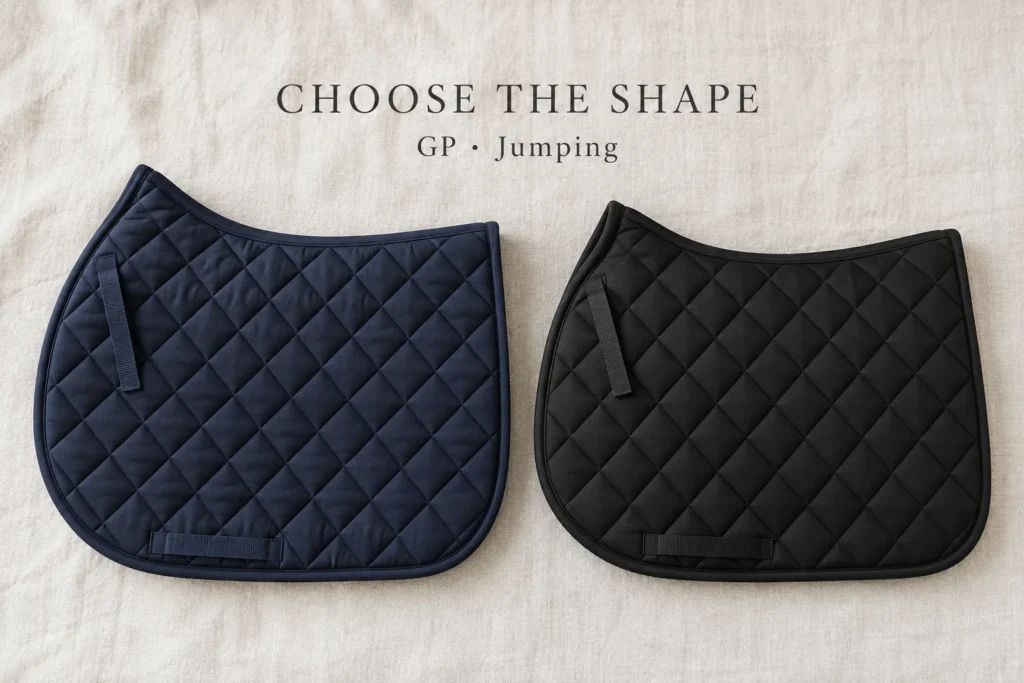
“English saddle pad” is too broad for a production brief. The outline and dimensions should relate to the saddle it will accompany.
General-purpose or all-purpose pad
A general-purpose (GP) saddle pad can be a starting point for a broad English riding collection. UK shoppers often use the term GP saddle pad, while US shoppers may be more familiar with all-purpose saddle pad. The names can help customers find the product, but your manufacturer still needs a measured shape.
Provide the intended English saddle or a reference pad. Show the desired spine length, side drop, front contour and amount of pad you want visible beyond the saddle.
Jumping pad
A jumping collection may need its own front outline and coverage. Compare the sample with the actual jumping saddle or a close reference. Record where the front and lower edges should sit and whether the proposed attachments work with that saddle’s flap and girthing arrangement.
A GP pad and jumping pad should be quoted as separate patterns when their shapes differ. A change in title alone will not create a different product.
Half, trail and Western pads
A half pad has a different footprint and intended layering arrangement from a full pad. Trail and Western saddle programs need their own shapes and construction. Define any pockets or reinforcement as specific requested features, then assess where they sit on the intended saddle.
Fit should be checked with the saddle and horse combination for which the pad is intended. A studio image cannot establish universal compatibility.
Build the specification layer by layer
“Premium fabric with soft padding” sounds appealing, but it does not tell a manufacturer what to purchase, cut or reproduce. Describe each layer of the finished pad.
| Component | What to specify |
|---|---|
| Outer fabric | Material, texture, finish, color reference and intended appearance |
| Lining | Material and surface that will face the horse |
| Filling | Material, amount, distribution and desired finished feel |
| Quilting | Pattern, spacing, stitching color and where it begins and ends |
| Edge | Binding width and color; piping type, color and placement |
| Attachments | Required straps or loops, exact positions and closure method |
| Wear areas | Material, size and placement if reinforcement is needed |
| Branding | Logo method, artwork, size and measured placement |
| Packaging | Fold, protective packing, labels and carton identification |
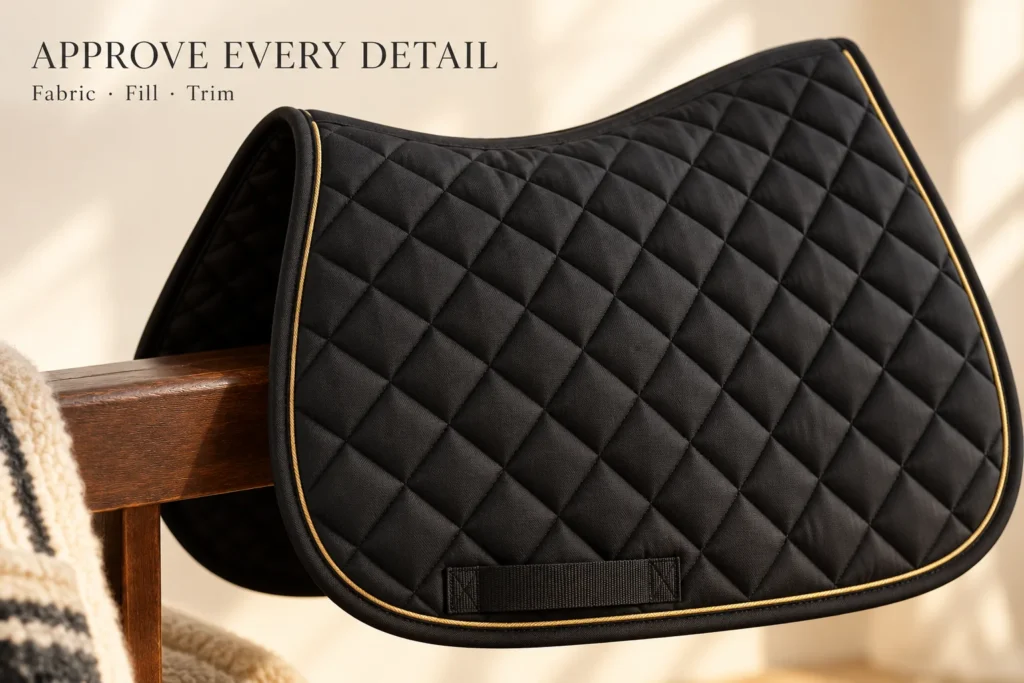
Ask to see fabric and trim samples when appearance is central to your brand. A black textile can look matte, glossy, blue-black or charcoal in different light. Likewise, “gold piping” can mean several shades and widths. A physical reference is easier to approve than an adjective.
Only use customer-facing claims such as breathable, moisture wicking or shock absorbing when the actual construction and appropriate evidence support them. Your product page should describe what was made and verified.
Get the measurements that make repeat orders possible
For an English pad, provide a drawing or annotated photograph showing where each measurement starts and ends. Depending on the design, this may include:
- Finished spine length
- Side drop at agreed points
- Front and rear outline
- Wither contour
- Position and size of attachment straps
- Quilting spacing
- Binding and piping width
- Logo position measured from a fixed edge
State whether measurements are in centimetres, inches or both. Ask the manufacturer to agree on practical production tolerances for the finished article.
Do not rely on “Full” or “Cob” alone. A size name is helpful on a retail label, but it does not define the exact pad outline. If you want two sizes, approve how the pattern changes between them.
Design the branding as part of the pad
A private-label pad should look like it belongs to your collection without interfering with the product’s use.
Options may include embroidery, a woven label, a badge, a distinctive trim combination, a hangtag or branded packaging. HideOrax lists these kinds of custom choices through its saddle pad page and private-label manufacturing service.
Send the original logo artwork and specify:
- The exact logo version and colors.
- Its intended application method.
- Its finished width and height.
- Its placement measured from a fixed edge.
- Whether the design should appear on one side or both.
- The label and packaging artwork.
Approve the logo on a physical sample, especially if it is embroidered onto quilting. Stitching can affect how a small letter or thin line appears. Keep your first branding treatment readable and easy to repeat.
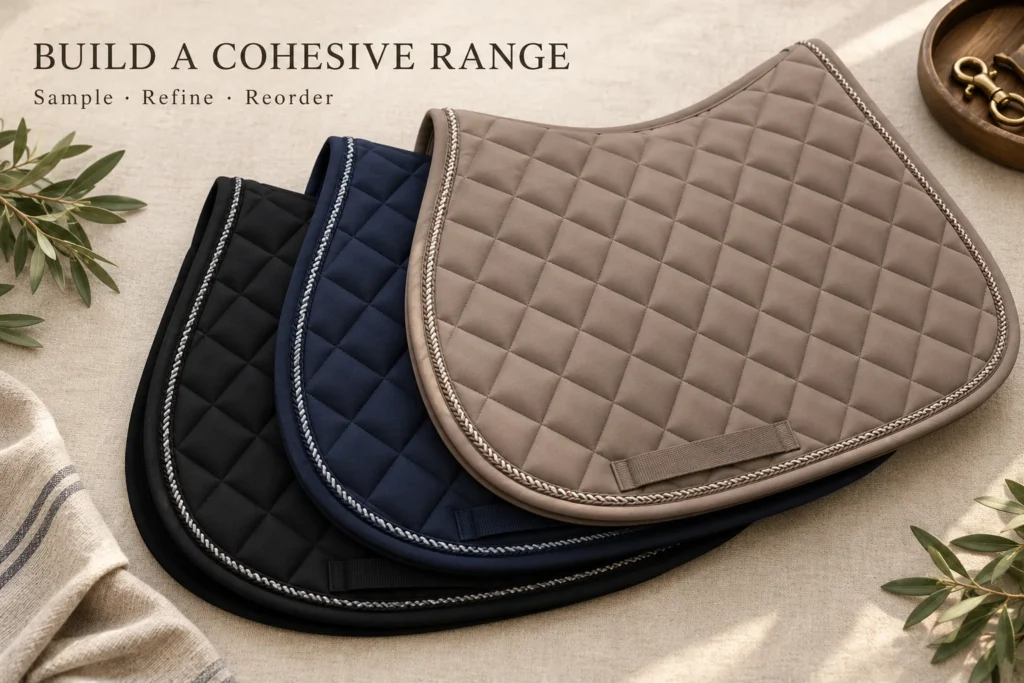
If you plan to sell matching accessories, compare the approved colors and finishes with relevant horse boots or bridles and halters. A coordinated collection needs physical color references; items photographed separately can appear to match when their delivered shades differ.
Keep the first collection easy to stock
Every added shape, size, color and logo version creates another variation to photograph, label, count and reorder.
Consider a starting matrix such as:
| Product decision | Focused first collection example |
|---|---|
| Shape | One approved GP shape |
| Sizes | The one or two sizes your intended retailers need |
| Colors | Two core colors |
| Quilting | One repeatable pattern |
| Branding | One logo method and position |
| Trim | One consistent binding specification |
| Later expansion | Add a jumping shape after its separate sample is approved |
This is an illustrative planning example, not a preset HideOrax package. A jumping-focused brand might reasonably begin with the jumping pad instead. Use your customer demand to choose the opening range.
When requesting a quote, list quantities by exact variation. Ten pads spread across several colors and sizes may not have the same production terms as ten identical pads. Confirm how the minimum quantity is counted for your order.
Approve a sample as a complete retail product
A sample should answer more than “Do I like the color?” Check it against your written brief and the saddle with which it will be sold.
Shape and measurements: Lay the pad flat and measure the agreed points. Check both sides, the wither contour and the finished outline.
Materials and construction: Compare the outer fabric, lining, filling, quilting, binding and piping with approved references. Check for uneven fill, shifting layers, puckered edges and loose threads.
Attachments: Place the sample beneath the intended saddle. Confirm that straps, loops or other attachments sit where expected and operate as intended.
Branding: Check logo size, position, legibility and color. Review hangtags, care instructions and labels as part of the sample.
Packing: Fold and pack the pad in the proposed way. Confirm that it arrives presentably and that labels identify the correct style, size and color.
Record corrections in writing with photographs and measurements. If a revision changes the shape or materials, update the product specification and quote. Keep a dated record of the sample that is finally approved for bulk production.
HideOrax describes a process in which the buyer’s reference and specification are reviewed, a pre-production sample is made, and bulk production starts after approval. HideOrax
What should a wholesale saddle pad quote include?
A useful quote allows you to calculate the real cost of your range. Ask the manufacturer to state:
- Price for each style and variation
- How the MOQ applies to colors, sizes and logo versions
- Sample cost and any artwork or setup charges
- Material and trim assumptions
- Branding method included in the price
- Packaging and labels included
- Expected sample and bulk lead times
- Packing dimensions and shipping basis
- What changes in price at a higher quantity
A lower unit price is only comparable when the materials, size, filling, trim and packaging are comparable. If two quotes describe different pads, ask for a common specification before deciding.
HideOrax currently publishes a 10-piece standard MOQ for saddle pads, a typical 5–7 working day sample time after specification confirmation, and 15–25 working days for bulk production after sample approval. These are starting figures; confirm the terms for your specific design, variations and destination. HideOrax
Copy this brief into your first inquiry
To help HideOrax respond with a relevant sample route and quotation, send the following information through the wholesale quote form:
Product: Custom saddle pad
My market: USA / UK / specific European country
My business: Equestrian brand / tack shop / wholesaler
Pad shape: GP, jumping or another described shape
Reference: Photos, measured drawing or physical sample
Intended saddle: Type or model used to check the pad
Sizes: Finished measurements and quantity per size
Materials: Preferred outer, lining, filling and trim, if known
Design: Quilting, colors, binding, piping and attachments
Branding: Logo artwork, method and placement
Packaging: Hangtag, care label and packing preference
Quantity: Units per exact color, size and design
Destination and timing: Delivery country and target schedule
You can send an initial brief even if some choices are still open. Mark them as decisions you want to make during sampling. That helps the manufacturer distinguish firm requirements from options to quote.
Frequently asked questions
Can HideOrax put my brand on a saddle pad?
HideOrax lists embroidery, woven labels and other approved branding options. Send your logo artwork and placement instructions so the exact method can be assessed and shown on a sample. HideOrax
Can I order both GP and jumping pads?
You can request a quotation for both shapes. If their outlines differ, treat them as separate product specifications and approve representative samples. Confirm the quantity terms for each design.
Do I need a finished technical drawing before contacting a manufacturer?
A measured drawing is helpful, but HideOrax says it can review a physical reference, photographs, measurements or a technical specification before confirming feasibility. Start with the information you have and clearly identify what still needs development. HideOrax
Is the minimum order ten pads in total or ten per color?
HideOrax’s published starting MOQ is ten pieces. The site does not settle how every mixed color, size or logo order will be counted. Ask for that detail in your exact quote. HideOrax
Can I add matching horse boots later?
HideOrax also has a horse boots manufacturing range. If you want a coordinated collection, keep physical fabric and color references from the approved saddle pad sample and quote the boots as their own product specification.
Turn your idea into an approved sample
A strong first saddle pad collection has a clear rider, an appropriate shape, specified layers, measured details and branding that can be repeated. Decide what matters most to your customer, then use the sample to confirm those decisions before placing a wholesale order.
HideOrax manufactures custom saddle pads for equestrian brands, wholesalers and riding suppliers. Share your reference, target market, variation quantities and branding requirements through the request a quote page to discuss your design and sample.