
A saddle bag that looks right in a studio photograph can still be a poor fit on the saddle it was intended for. The strap can land in the wrong place, the bag can crowd the rider, or a claimed capacity can mean little once the bag is closed.
For wholesale buyers serving the USA, UK and Europe, the useful question is: what exactly will this bag carry, and on which saddle will it attach? HideOrax lists endurance, horn, trail pannier and Western double saddle bags for buyer-specified programs. This guide shows how to compare those styles, define capacity and attachment, inspect a sample and prepare a private-label order.
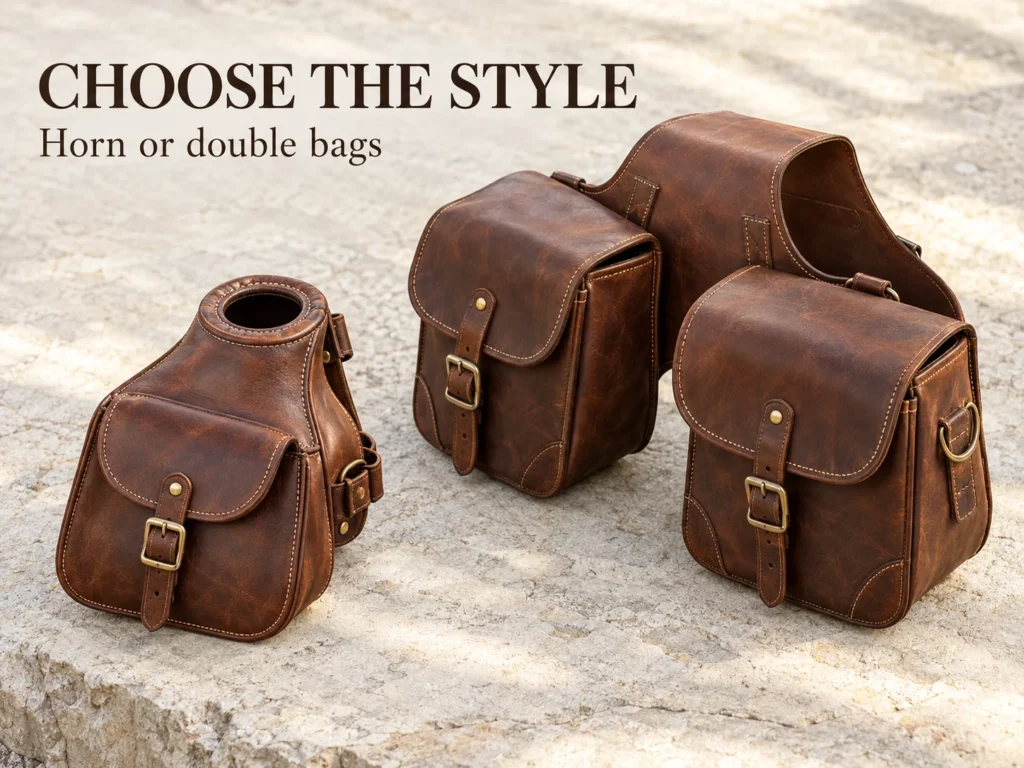
Select the format before choosing leather or color
“Horse saddle bag” is a broad term. Describe the saddle and use case first.
| Bag format listed by HideOrax | Intended range | Specification focus |
|---|---|---|
| Endurance saddle bags | Compact paired storage for longer rides | Attachment position, compact shape, access and balance |
| Horn saddle bags | Small storage designed around a Western saddle horn | Horn opening, anti-rotation straps and clearance |
| Trail panniers | Larger storage for trail and utility collections | Weight distribution, closure, reinforcement and saddle compatibility |
| Western double saddle bags | Paired bags for a Western saddle program | Capacity on each side, connector panel, tie-downs and symmetry |
A bag that fits one Western saddle may interfere with another model’s cantle, skirts, rigging or accessories. Evaluate an endurance bag with the specific saddle and rider setup chosen for the collection.
For an initial wholesale line, select a clear customer: a trail rider seeking paired storage, a Western customer seeking a horn bag, or an endurance customer seeking a compact format. Create a specific sample for that choice.
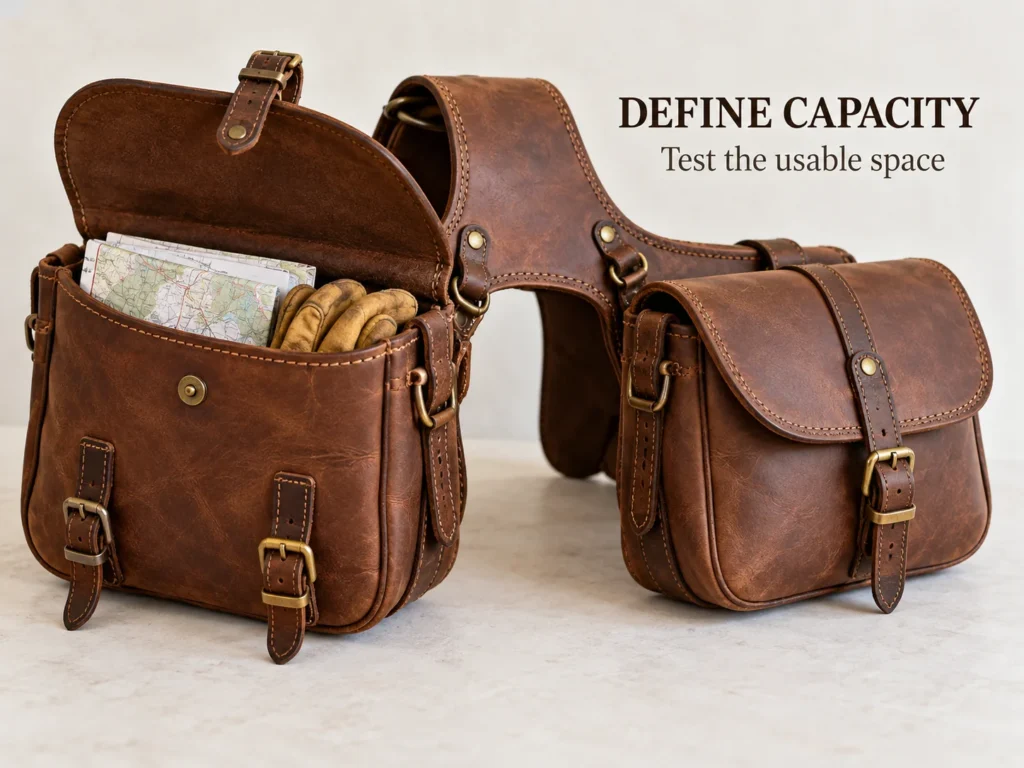
Measure usable capacity with a real packing test
External width multiplied by height and depth is not the same as usable internal volume. Curved panels, lining, pockets, flaps and closures all reduce the space available to a customer. If you claim a litre capacity, decide how it will be measured and verify the approved sample. If you do not have a measured value, publish the internal dimensions and a practical packing example instead.
Record the following for each bag:
- External dimensions: Width, height and depth at defined points.
- Internal dimensions: Clear space with the closure in its normal position.
- Pocket sizes: Dimensions and whether a phone, bottle or other intended item actually fits.
- Opening: How wide it opens and whether packed contents remain accessible when mounted.
- Packed weight: The bag alone and the contents used during the fit test.
- Unit of sale: One bag, a pair, or a connected double-bag set.
A simple sample test places the actual items inside, closes the bag and photographs it from the front, side and top. Repeat with both sides of a paired set. This makes product claims more useful than an unsupported “large capacity” label.
Show inches for US customers and centimetres for buyers who use metric units. Convert a single approved master measurement.
Draw the attachment points on the intended saddle
The most valuable image in the purchase order may be a photograph of the bag fitted to the exact saddle model. Mark each strap, loop, buckle and tie-down on that image. Identify where the bag sits when empty and when filled. Check clearance around the seat, rider’s leg, stirrup leather or fender, saddle rigging and horse. Secure loose strap ends away from moving equipment.
For a horn bag, measure the intended horn and check the bag’s opening, orientation and secondary restraint. For Western double bags, define how the two sides connect over or behind the saddle, plus any separate anchor points. For endurance bags, consider how a compact bag will stay stable during its intended use. For trail panniers, evaluate bulk and load distribution with real contents.
The buyer should evaluate the finished sample with the intended saddle and give customers clear fitting instructions.
Specify materials, closures and reinforcement
HideOrax’s saddle bag manufacturer page lists full-grain leather and selected performance textiles as primary options. Choose the material based on the range’s positioning and the conditions in which customers will use it. Record the body material, lining, strap material, thickness, edge finish, stitching and any reinforced wear points.
A leather bag can be sold on its traditional look and finish. A textile design may suit buyers who want a different weight, appearance or care routine. Mixed materials need a consistent color and a clear bill of materials so repeat orders match the approved sample.
The closure is part of the specification. Buckles, flaps, zippers and other agreed fasteners should be tested while the bag is empty and filled. Check whether opening the bag on the saddle is practical, whether contents can slip out, and whether a closure presses into the saddle or horse. Inspect stitching at strap anchors, flap hinges and pocket openings.
If you market a bag as water resistant or waterproof, define and verify that claim for the complete bag, including seams and closures. A material alone does not prove the finished bag keeps contents dry. Give care instructions for the approved construction and destination market.
Balance the two sides of a paired bag
For double bags and panniers, compare the left and right sides as a set. Check dimensions, strap length, closure direction, leather shade, pocket layout and packed fit. Specify how the logo or label should appear on each side.
Load the sample with the intended contents and assess whether one side is noticeably heavier. Advise customers to distribute their load sensibly and follow the saddle maker’s guidance. Only publish a maximum load rating when it can be supported for that design.
Record a written pair tolerance for measurable dimensions. Photograph the filled and empty set on the selected saddle. A tabletop sample alone cannot show balance, rider clearance or movement.
Tailor the retail page for US and European customers
Use accurate terms and a clear fit guide. US Western buyers may search for “horn saddle bag,” “trail saddle bags” or “Western saddle bags”; an endurance retailer may use “endurance saddle bags.” European product pages may need translated product names, centimetre dimensions and local-language care information. Verify which terms your target customers use.
Every listing should answer:
- Which saddle type and tested model was used for the product photographs?
- What attachment hardware and straps are included?
- Is the sale for one bag, two separate bags or a connected pair?
- What are the internal and external dimensions?
- What does the material and closure do under normal care?
- Can a shopper see the bag both empty and mounted with typical contents?
You can link from a Western bag listing to the matching Western saddle range and from an endurance collection to the relevant English saddle range where that pairing has been checked. Internal links should help buyers solve compatibility questions.
Develop a private-label range that can be reordered
HideOrax lists custom dimensions, capacity, attachment layout, pockets, reinforcement, embossing, labels and packaging as configurable options. Its private-label service provides a route for agreed materials and branding.
Create a model code for each construction, then a short variation code for color and material. Keep the attachment drawing, approved saddle photograph, physical sample, swatches and packing instructions with that code. Approve the actual logo size and position on a finished sample.
If a retailer also stocks saddle pads, align the color and intended riding range while preserving each product’s fit information.
Inspect a sample and confirm wholesale terms
HideOrax’s product page states a standard MOQ of 10 pieces, with samples typically taking 5–7 working days after specification confirmation and bulk production normally 15–25 working days after sample approval. Confirm the current quote for your exact style, material, variation mix and retail unit.
Use the sample review as a practical test:
- Measure the bag and its usable compartments.
- Fill it with the intended items and operate every closure.
- Mount it on the actual saddle and photograph all attachment points.
- Assess empty and filled stability, clearance and paired balance.
- Inspect stitching, strap anchors, edges, hardware and lining.
- Review branding, labels, care information and the packed unit.
Ask the supplier how changes after approval will be recorded. For bulk inspection, define the dimensions and details to check, and whether the order is counted as individual bags or pairs. Keep a reference sample and a dated specification for reorders.
Saddle bag quotation checklist
Send HideOrax a brief with:
- Target market, sales channel, riding use and desired bag format.
- Intended saddle brand or model, dimensional reference and mounting photographs.
- External and internal dimensions, pocket plan and proposed contents.
- Body, lining, strap and reinforcement materials.
- Closure type, attachment layout, hardware finish and color.
- Unit of sale, quantity by model and color, and paired-set requirements.
- Logo position, label, care information and retail packaging.
- Sample evaluation plan, destination, requested timing and quote basis.
If the saddle is not yet selected, explain that in the enquiry. Ask for a proposed attachment layout, then approve it after a physical fit test.
Frequently asked questions
Which saddle bag styles does HideOrax offer?
The current manufacturer page lists endurance bags, horn bags, trail panniers and Western double saddle bags. Exact dimensions and fittings are developed from the approved specification.
Can a saddle bag fit every Western saddle?
Fit depends on the saddle’s construction and the bag’s straps, shape and contents. Test a physical sample on the intended saddle and describe that fit accurately.
Can I order custom capacity and compartments?
Yes. HideOrax lists dimensions, capacity, pockets and attachment positions as buyer-specified options. Verify usable space in a packed sample.
What is the minimum order for private-label saddle bags?
The page states 10 pieces. Confirm whether that means individual bags or sets and how the minimum applies across colors and designs in your quotation.
Can I claim the bag is waterproof?
Only when the completed design, including stitching and closures, has been evaluated to support that claim. Describe the actual material and care more precisely when no test exists.
Build the product around a real saddle and a real load
A strong saddle bag specification connects three things: the contents, the attachment and the intended saddle. Approve the design loaded and mounted, then use those measurements and photographs for both the purchase order and the retail listing.
Explore HideOrax’s wholesale equestrian products and request a saddle bag quotation with your format, target saddle, materials and opening quantity.