
A farrier apron can look substantial in a catalogue photograph, yet prove awkward when its waist shifts, a leg panel rides up or a pocket blocks a common movement. For professional-equipment wholesalers, the useful specification is built around how the apron fits and works, as well as how it looks.
HideOrax lists full leather farrier aprons, split-leg farrier chaps and custom reinforced designs. Its product page describes selected full-grain cowhide, with buyer-specified sizing, reinforcement, pockets, straps, hardware and branding. This guide helps buyers in the USA, UK and Europe plan a clear first order, approve a practical sample and describe the final product accurately. HideOrax
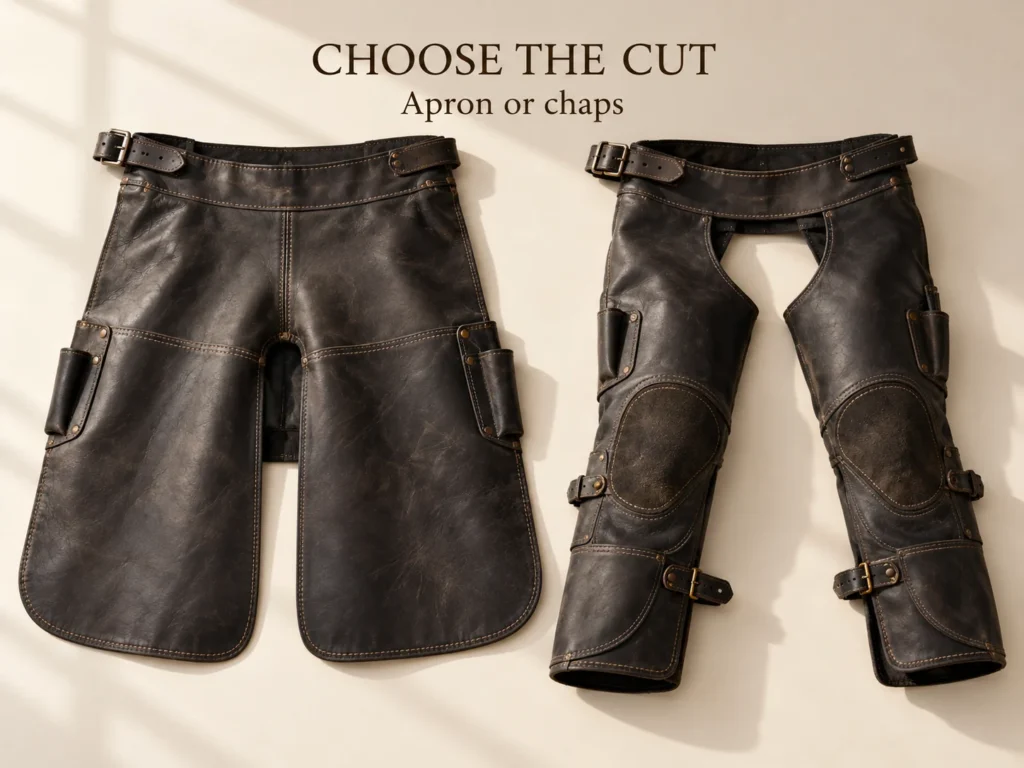
Choose the cut for the customer and the task
Begin with the intended user. Is the product for a professional farrier, a training program, a retailer’s core range or a specialist private-label collection? Each audience may value a different balance of coverage, mobility, weight, tool access and price.
| Style | Main design decision | Ask during sampling |
|---|---|---|
| Full farrier apron | Coverage and panel shape | Where does the hem fall when standing, bending and working? |
| Split-leg farrier chaps | Independent leg movement and fastening | Do the leg straps stay in position without restricting movement? |
| Custom reinforced apron | Buyer-defined reinforcement and pocket layout | Which areas are reinforced, and does the added material change fit or weight? |
These style names do not establish a protection rating. The appropriate construction depends on the actual material, design and intended use. If your brand intends to make a specific protective-performance claim or sell under a regulated PPE category, arrange the relevant assessment and documentation for that finished product and destination market before publishing the claim.
For an opening range, one well-defined core design plus one distinct alternative can be easier to sample and stock than many similar variations.
Build the size chart from the apron
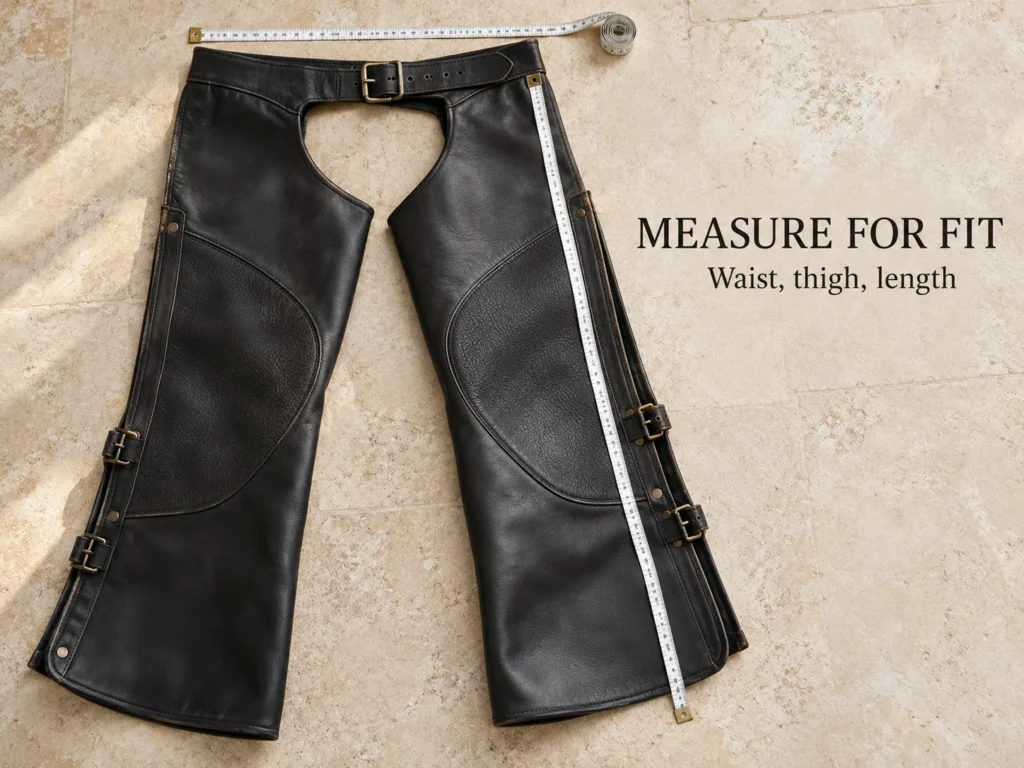
“Medium” and “large” tell a buyer little unless the measurements and adjustment range are shown. A product sheet should state the waist range, panel length, panel width at thigh and knee, leg strap range, and how much of the front and side of the leg the design covers. State exactly where each dimension is taken.
For a fit trial, measure a person wearing the clothing and footwear normally used for the intended work. Then check the apron or chaps while standing, walking, bending and adopting typical working postures in a controlled setting. Note where straps pull, hardware presses or panels shift. The fit trial evaluates comfort and movement; it does not establish a protection rating.
Include an annotated photograph of the approved sample. If the same design will be sold in US and European markets, show inches and centimetres consistently from one master measurement. Decide whether the chart refers to body measurements, garment measurements or both. A “34-inch waist” label without that distinction can create avoidable returns.
Specify leather and reinforcement by zone
HideOrax identifies selected full-grain cowhide as the primary material for its leather farrier apron program. For a wholesale order, record the approved leather grade, thickness range, surface finish, color, expected natural variation and whether separate zones use different layers.
Mark reinforcement on a front-and-back drawing: left and right thighs, knees, outer edges or other buyer-defined areas. State its material, shape, thickness, attachment and stitching. Add a photograph of the physical sample. A heavier-looking panel is not automatically the best choice; extra bulk can affect drape, movement and packed weight.
Inspect the sample after repeated ordinary bending and fastening. Look at stitching, corners, rivet areas and layer transitions. Agree on acceptable appearance changes and manufacturing tolerances. If the product is presented as resistant to a particular hazard, support that statement with suitable evaluation of the finished design.
Put pockets and tool loops where the user can reach them
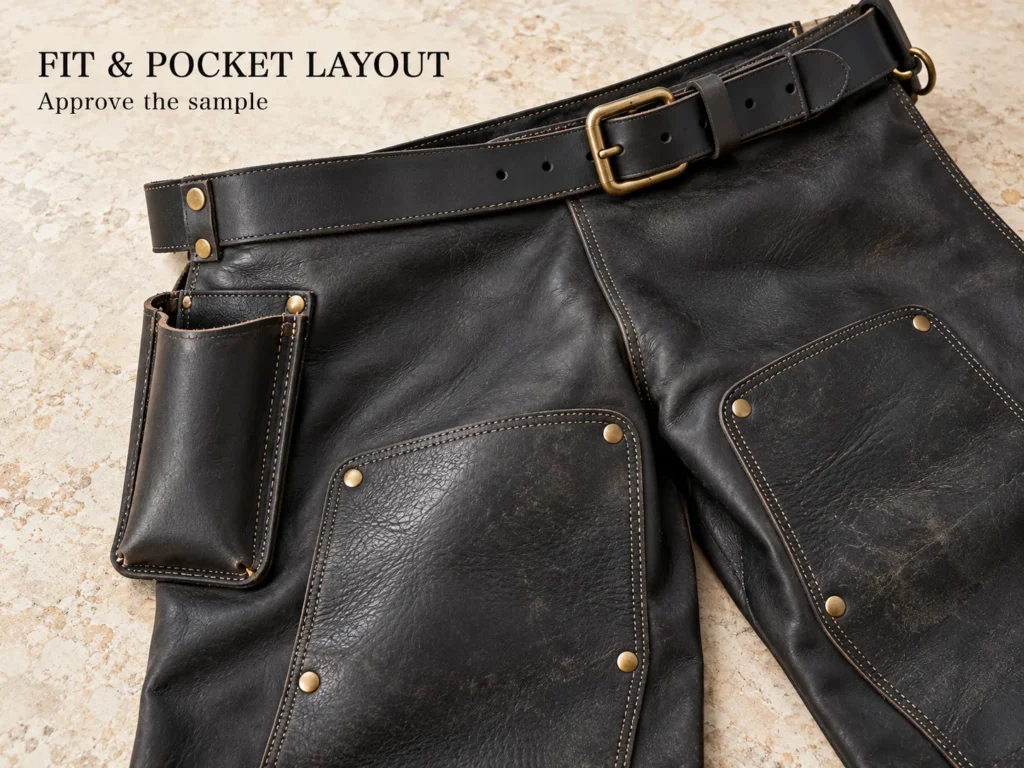
A tool pocket is useful only if its location, opening and depth suit the intended item. Draw each pocket and loop on the technical sheet. Give its internal dimensions, placement relative to the waist and panel edge, reinforcement at its attachment, and whether its contents could press into the worker while bending.
HideOrax lists buyer-specified pocket and tool-loop configurations. For the sample, use the actual tools or representative objects that the target user would carry, then test access and retention in normal positions. Describe precisely what has been checked.
Consider the left and right layout deliberately. The preferred arrangement may depend on the customer’s workflow. Specify whether tools are included in the sale; photographs containing props can otherwise confuse buyers about the pack contents.
Inspect straps, buckles and edge finishing
The waist and leg fastenings control how the apron stays positioned. Specify strap width, adjustment range, hole spacing, buckle material and finish, and the attachment method. A split-leg design needs each leg strap reviewed separately, including the ends of its usable adjustment range.
Fasten and release every buckle several times on the approved sample. Check whether the holes are clean, strap ends are finished, hardware edges are smooth and the fittings remain accessible while worn. Inspect both sides of each anchor point and confirm that the leather does not fold awkwardly under the fitting.
Edges also deserve attention. Record whether they are turned, bound, burnished or otherwise finished, and inspect them after ordinary flexing. A useful visual specification includes close photographs of the waistband, pocket edge, knee reinforcement and lower hem.
Prepare clear US and European listings
For US customers, a title such as “leather farrier apron” or “farrier chaps” should be paired with exact dimensions in inches and photographs of the front and back. UK customers may use similar terms. For buyers in European countries, a translated product name and metric size chart can help, while the technical details must remain consistent with the approved design.
A retailer should be able to answer:
- Is this a full apron or split-leg chaps?
- What is the adjustable waist and leg range?
- What leather and reinforcement are specified?
- Which pockets, tool loops and straps are included?
- What is the item’s finished weight and care method?
- Which claims about protection have been verified for the finished product?
Confirm country-of-origin, care, importer and applicable product information for the destination. Add a CE mark, certification or specific safety rating only when it is supported for the finished product and the intended market.
Develop the private-label sample and packaging
HideOrax’s private-label manufacturing page describes customization of dimensions, materials, colors, stitching, hardware, embossing, labels and packaging. Build one dated product specification for each construction and size range. Identify the approved sample with a model code, revision date and photographs.
Approve logo embossing on the actual leather. Position it so it remains readable without interfering with a flexible or high-wear zone. Define whether the retail unit is one apron or one set of chaps, what accessories are included, and how the straps are protected in packaging. Include care and size information on the agreed label or insert.
Buyers sourcing other products can review HideOrax’s full equestrian product range. A farrier apron may be sold through a different professional-equipment channel from saddles and riding tack, so its specifications and buyer language should remain focused on the farrier.
Approve a physical sample before bulk production
The HideOrax farrier apron page currently states a standard MOQ of 10 pieces, a sample lead time of 5–7 working days after specification confirmation, and bulk production normally 15–25 working days after sample approval. Confirm current terms, sample cost, size mix and whether the MOQ applies per design or across variations in the quotation. HideOrax
Use a sample approval record that covers:
- Measurements and adjustment ranges against the technical sheet.
- Fit and panel position in several ordinary working postures.
- Leather, any specified lining, reinforcement and finished weight.
- Pocket and tool-loop dimensions and positions.
- Buckle operation, straps, stitching, rivets and edges.
- Logo placement, labeling, packaging and unit of sale.
Ask how the approved sample will be used during production inspection. For repeat orders, keep the physical sample or a detailed reference, and document every design change. If testing or certification is needed for a market claim, agree on responsibility and acceptance requirements before bulk production.
Farrier apron wholesale quotation checklist
Send the supplier a brief with:
- Intended user, target country and sales channel.
- Full apron, split-leg chaps or custom reinforced format.
- Body size range, garment dimensions and adjustment range.
- Leather type, thickness, color and any lining.
- Reinforcement map and stitching requirements.
- Pocket and tool-loop drawing, with intended contents.
- Waist and leg strap layout, buckle finish and edge treatment.
- Logo, label, care insert and packed retail unit.
- Quantities by style and size, sample requirements and delivery destination.
- Any performance claim or documentation needed for the intended market.
A reference photograph helps, while dimensioned drawings and a physical approval sample make repeat production easier to assess.
Frequently asked questions
What is the difference between a farrier apron and farrier chaps?
In this guide, “full apron” describes a broad front-covering configuration, while “chaps” refers to separate leg panels with adjustable fittings. Product terminology varies, so use photographs and exact dimensions in the listing.
What leather does HideOrax list for farrier aprons?
HideOrax lists selected full-grain cowhide leather. Confirm the finished leather specification and any additional layers in the approved sample.
Can pockets and reinforcement be customized?
Yes. HideOrax lists buyer-specified pocket positions, reinforcement zones, straps and hardware. Provide a drawing and test a sample for the intended use.
What is the minimum order?
The product page currently states 10 pieces. Ask how that quantity applies to sizes, colors and design variations in your quotation.
Is a leather farrier apron automatically certified protective equipment?
A leather material description does not establish certification. Any regulated or measurable protective claim must be supported for the finished design in the destination market.
Build a product the buyer can measure and reorder
A dependable wholesale farrier apron starts with an intended user, a clear size range and a physical sample that can be inspected from waist to hem. Define each reinforcement, pocket and fastening in writing, then carry those details into the retailer’s product page.
To discuss a leather apron or chap program, request a wholesale quotation from HideOrax with your target market, reference design, size range and expected quantity.