
An attractive product photograph cannot tell a wholesale buyer whether every saddle has the agreed dimensions, every bridle has the correct hardware or every carton contains the right sizes. Those details become visible when an order reaches a warehouse—or, worse, when a customer opens it.
Horse tack quality control starts before bulk production. The buyer and manufacturer need a clear specification and an approved sample. Inspection then becomes a comparison with something concrete, instead of a general judgment that the products “look good.”
This checklist is for equestrian importers, tack shops, distributors and private-label brands sourcing for the US, UK and European markets. It covers what to agree during sampling, what to examine across product categories and what to record before shipment.
1. Establish the standard before inspecting the order
A quality check is useful only when both sides know what “correct” means. Before approving production, prepare a product specification for each model. It should identify:
- Product name and model code
- Intended use and target customer
- Materials by component, including lining and reinforcement where relevant
- Finished measurements and agreed tolerances
- Color, stitching, edge finish and hardware
- Size labels and measurement method
- Logo position and packaging
- Included and excluded accessories
- Any testing or documentation specifically required for the order
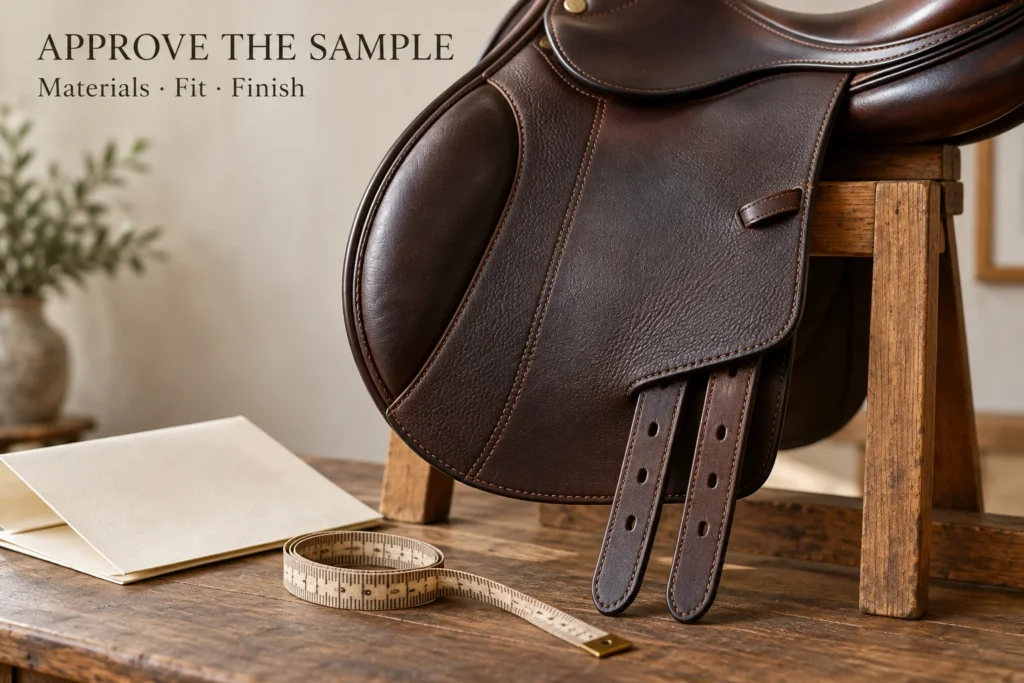
Approve a physical sample against that specification. Photograph its important details and record any changes in writing. Keep the final approved version as the reference for the bulk order and future reorders.
HideOrax describes this sequence on its equestrian manufacturing process page: materials and construction are checked against the buyer specification, and finished products are compared with the approved sample before packing.
Make measurements unambiguous
A label such as “Full,” “Medium,” or “17 inches” is not a complete measurement instruction. State where the measurement begins and ends, whether it is taken on a finished product, and which variation is acceptable.
For example, a bridle size sheet should show its adjustment range at named straps. A saddle pad drawing should identify the spine length, side drop and attachment positions. A saddle brief needs the seat measurement method and relevant fit dimensions.
Agree on one set of units or show both inches and centimetres clearly. This is especially helpful when a Pakistan-based manufacturer is supplying retailers in several markets.
2. Inspect the materials you actually ordered
“Leather,” “synthetic” and “metal hardware” are broad descriptions. A buyer should check each important component against the sample and specification.
For leather tack, examine the visible grain, thickness where specified, flexibility, surface finish and color. Check the cut edges and the reverse sides of straps. A finished front surface should not distract from a weak, uneven or poorly finished loaded area.
For synthetic products, check texture, coating consistency, backing, padding and binding. Avoid assuming that every synthetic material has the same cleaning behavior or durability. If your retail copy will make a specific performance claim, support it with appropriate evidence for the actual product.
For hardware, compare the type, dimensions, finish and placement with the approved sample. Open and close buckles and clips. Check that paired components match and that moving parts operate as intended.
If you are developing a branded collection, HideOrax’s private-label equestrian program allows materials, colors, stitching, hardware and branding to be agreed during quotation and sampling.
3. Check construction where the product takes load
Cosmetic finishing matters to a retailer, but inspection should give extra attention to parts that experience tension or repeated movement.
Look for consistent stitching, secure thread ends, aligned holes, tidy edge finishing and properly seated hardware. Examine how straps join the main product. If reinforcement is part of the specification, confirm its location and construction on the sample and during bulk inspection.
Check matching pieces together: a pair of stirrup leathers should match in length and hole position; a pair of horse boots should match in shape and closure placement. Do not assume that a sound-looking single piece represents its pair.
A visual inspection cannot establish every aspect of structural performance. Agree on any necessary tests for the specific design and market before production, and document their methods and results. Avoid inventing a “passed safety test” claim from a visual check alone.
4. Use a category-specific checklist
One inspection form cannot capture every issue equally well. Use shared checks for color, finish, size and branding, then add the details that matter to each product.
Saddles
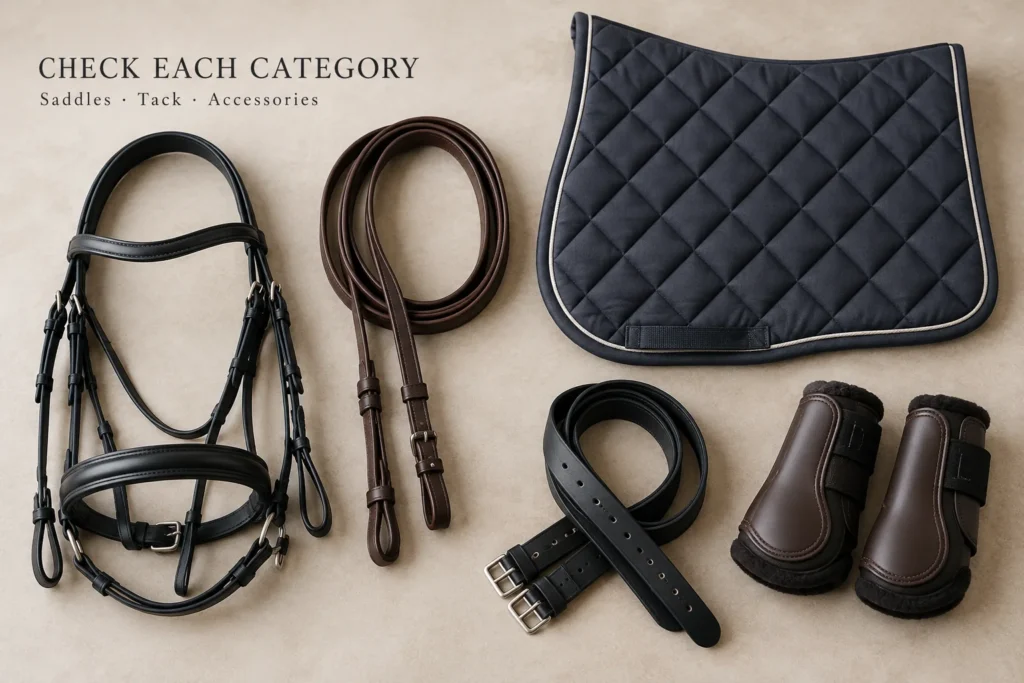
For English saddles, Western saddles or synthetic saddles, compare the finished model with its approved sample. Check seat and flap measurements, agreed fit options, visible balance and symmetry, panels or underside, hardware, billets or rigging, and the condition of surfaces and seams.
Have the sample assessed for its intended use by an appropriately qualified fitter. An inspection on a stand cannot establish that a saddle fits every horse. Record the fit information you can accurately pass on to retailers and customers.
Bridles, halters and reins
For bridles and halters, verify the size range, strap measurements, adjustment holes, buckles, padding and any noseband details against the specification. Compare left and right sides. Check that the approved hardware finish is consistent.
For horse reins, check finished length using the agreed measurement method, matched sides, grip or texture, joins, stops where specified and connection hardware. Confirm whether reins are included with a bridle or sold separately.
Girths, stirrup leathers and stirrups
For horse girths, confirm the specified style, length measurement method, buckle placement, elastic or other materials if specified, padding, edges and both ends of the product.
For stirrup leathers, compare the pair for length, width, hole spacing, buckle position and finish. Check the reinforcement and construction stated in the approved brief.
For horse stirrups, verify the ordered model and pair, tread, finish, dimensions and moving parts if the selected design has them. Do not describe a stirrup as having a particular safety function unless that function has been verified for the actual model.
Pads, boots and saddle bags
For saddle pads, examine the outline, finished dimensions, quilting, lining, attachment straps, trim and color. Assess the approved sample with the saddle it is intended to accompany.
For horse boots, check the pair, size, left/right designation where applicable, lining, padding, edge finish and closures. Ensure the product label agrees with the actual contents.
For saddle bags, verify dimensions, compartment layout, closure operation and attachment points against the intended saddle and approved reference. Do not make a waterproof claim merely because the bag has a closed flap.
5. Separate appearance issues from specification failures
An inspection is easier to resolve when the report explains what happened. Use three practical groups:
| Finding | Example | Next step |
|---|---|---|
| Specification or function failure | Wrong size, wrong hardware, missing attachment or a construction issue | Hold affected goods and agree on correction or replacement |
| Visible finish issue | Uneven edge, obvious mark or inconsistent stitching | Compare with the approved finish standard and document the affected units |
| Packing or identification issue | Incorrect label, quantity, model code or carton content | Correct the identification or packing before dispatch |
Define acceptable appearance variation during sample approval. Natural leather can vary in grain and shade; that does not mean every difference is acceptable for your brand. A written color reference and approved sample provide a clearer decision point than a complaint after shipping.
Photograph each finding alongside its model code and measured result. A close-up without a product identifier can be difficult to trace back to the affected units.
6. Check the order across sizes and variations
A good sample of one color and size cannot prove that every variation is correct. Build an order matrix showing the quantity for each model, size, color and hardware finish.
During inspection, select units across those variations according to a sampling approach agreed with your supplier or inspection provider. If you need a formal acceptance sampling plan, set its method and pass/fail criteria in the purchase terms before production. Do not apply a generic number after the order is finished and call it an agreed standard.
Give particular attention to newly introduced variations. A different leather color, alternate buckle or smaller size may require its own approved reference.
For a first order, also establish how corrections will be handled: who documents them, who approves reworked units, and which issues require another check. This keeps the final shipping decision clear.
7. Inspect labels and packing before shipment
A correctly made product can still cause returns if its size label is wrong or its carton is poorly prepared. Review the packing as a customer and a warehouse team would.
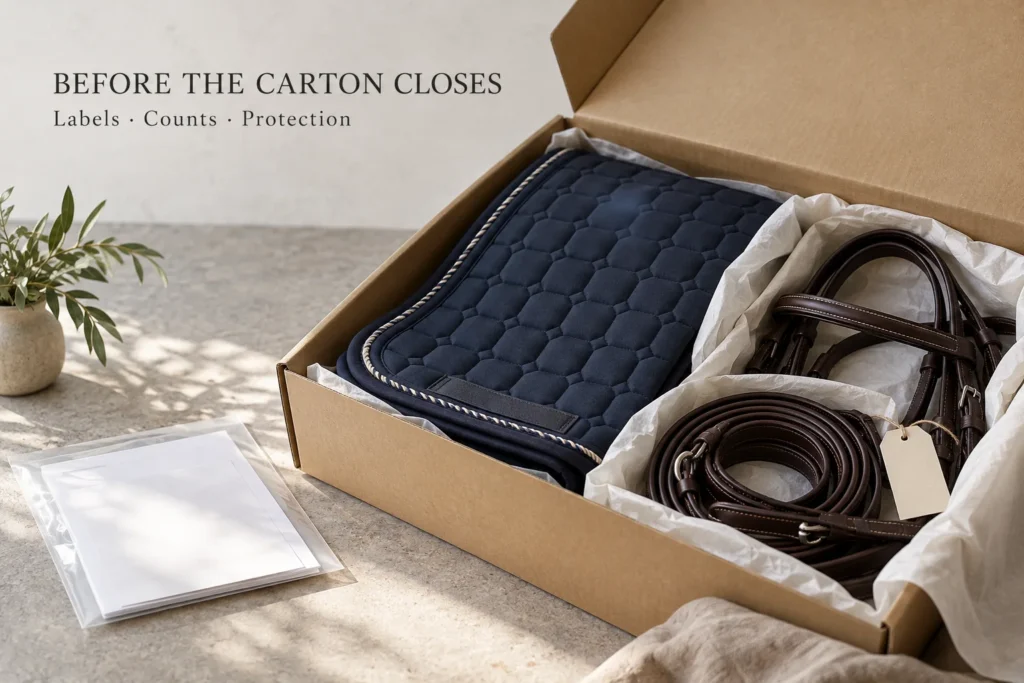
Check that:
- Product and carton codes match the order matrix
- Sizes and colors on labels match the items inside
- Pairs and included accessories are complete
- Care information reflects the actual materials
- The buyer-approved logo appears in the agreed position
- Hardware and finished surfaces are protected during transit
- Carton quantities and dimensions are recorded accurately
- Any destination-specific labeling or documents required by your importer are agreed before dispatch
US and European buyers should determine the requirements of their own product, destination and sales channel, then provide the approved label and document instructions. A supplier should not have to guess what a particular importer needs.
HideOrax lists protective packing and export documentation as part of its wholesale process; confirm the exact carton and documentation requirements for your order through the quote form. HideOrax
A simple record to keep for every product
For each approved model, keep one current record containing:
- The signed-off specification and version date.
- Photographs of the approved sample from relevant angles.
- Material and hardware references.
- A drawing or sheet showing measurement points and tolerances.
- Logo, label and packaging artwork.
- The order matrix and carton instructions.
- Inspection findings, corrections and final approval.
When you reorder, identify any requested change by version. Otherwise, a new color or revised buckle can be confused with the earlier approved product.
Questions to ask a horse tack manufacturer
Before starting a new wholesale program, ask the supplier:
- Which details will be confirmed in the sample?
- How will finished measurements be recorded?
- Can I review material and hardware options before approval?
- What reference will the team use during bulk inspection?
- How will an out-of-specification item be documented and corrected?
- Can branding and carton contents be approved before production?
- What will be included in the final packing list?
A supplier’s answers should refer to your actual product and order—not only offer a general assurance that “quality is good.”
Frequently asked questions
Is a pre-production sample enough to approve a wholesale order?
It establishes the reference, but bulk units still need to be checked against it. Include variations and packing in the inspection plan.
What should I inspect first in a leather bridle or halter?
Start with the agreed size and adjustment range, then inspect material, loaded strap joins, stitching, buckles, padding and matched sides. Use the approved bridle or halter specification rather than a generic checklist alone.
Should every saddle be sold with a “universal fit” claim?
No. A saddle’s dimensions and fit options should be stated accurately, and suitability should be assessed for the individual horse and rider. Avoid promising that one model fits every horse.
Who should prepare the labels for a private-label order?
The buyer should approve the final brand artwork and the information required for the intended market. The manufacturer should confirm that the approved placement and content can be reproduced on the product and packaging.
Can I inspect an order using photographs?
Photographs are useful for documenting appearance and progress. Physical assessment may still be needed for measurements, material feel, operation, construction and fit. Agree on the inspection method before the order is made.
Turn inspection into a repeatable buying process
The aim of quality control is a clear, repeatable product. Begin with a written specification, approve a representative sample, inspect the details that matter for each product category and record the condition of the packed order.
HideOrax manufactures saddles, leather tack and equestrian accessories for wholesale and private-label buyers. If you have a product reference or specification, send your target market, models, quantities, materials and branding requirements through the wholesale inquiry form to discuss sampling and production.