
A synthetic saddle can fill an important place in an equestrian collection: a practical option for new riders, lesson programs and customers who prefer straightforward care. But “synthetic” tells a wholesale buyer very little about the finished saddle. The outer material, underlying structure, padding, fit, attachment points and finishing all affect the product a customer receives.
For tack shops, importers and private-label brands in the United States, the United Kingdom and Europe, the useful question is not simply “Can you make a synthetic saddle?” It is “Can you make the same approved saddle consistently, in the sizes and presentation our customers expect?”
This guide explains how to choose a synthetic saddle range, prepare a manufacturing specification, assess a sample and build an order that is ready for your market. If you are still deciding which material belongs in your collection, read our separate leather versus synthetic saddles guide.
Start with the customer, not the material
Before requesting a quotation, decide who will ride the saddle and where it will be sold. A riding-school collection, an online beginner range and a specialist jumping assortment have different needs, even when each uses synthetic outer materials.
Write down five decisions first:
- Riding use: General schooling, recreational riding, jumping or trail riding?
- Customer: Beginner riders, lesson barns, established riders or retailers buying for several groups?
- Retail position: Accessible opening price, a more refined mid-range offer or a particular specialist style?
- Fit range: Which seat sizes and horse fit options does your customer base actually need?
- Selling channel: Tack shop, distributor, online store or private-label brand?
This gives the manufacturer a meaningful brief. It also keeps your first order focused. A small collection of clearly different models is easier to explain, stock and improve than a long list of nearly identical saddles.
Which synthetic saddle styles should you consider?
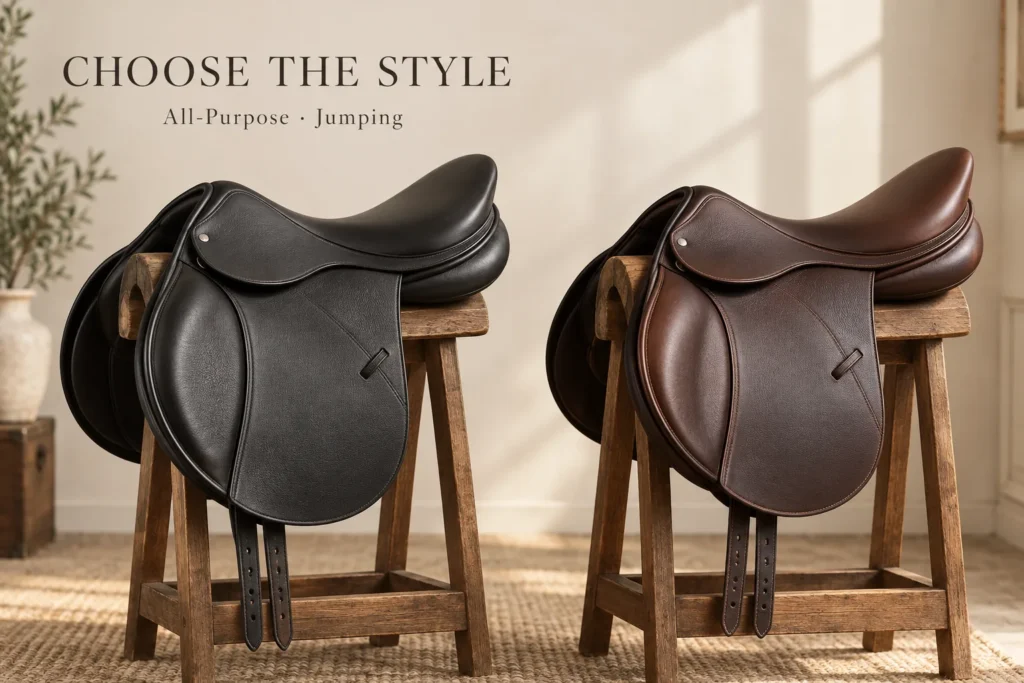
HideOrax’s synthetic saddle range includes all-purpose English, close-contact jumping and Western trail configurations. These are starting points; the final dimensions, materials and finish should be agreed through a sample.
Synthetic all-purpose saddles
An all-purpose saddle is a logical starting point for a general riding or schooling assortment. It can appeal to customers who want one saddle for varied everyday use rather than a specialized discipline.
If you sell in the UK, buyers may search for a synthetic general purpose saddle or synthetic GP saddle. In the US, synthetic all-purpose saddle is familiar wording. Use the term your customers recognize in your product title, while explaining the intended use clearly in the description.
Ask the manufacturer to confirm the seat profile, flap shape, available sizes, fit options, panel design and finished weight. An “all-purpose” label alone does not establish that a saddle fits a particular horse or rider.
Synthetic jumping saddles
A synthetic jumping saddle suits a collection aimed at jumping-oriented riders. The sample deserves close attention to flap position, seat balance, knee support where specified and the way the saddle sits on its intended horse type.
Do not rely on a photograph to approve the shape. Request measured dimensions and evaluate a physical sample with appropriate fitting expertise before presenting it to customers as a jumping model.
Brands also considering leather jumping or other English styles can review HideOrax’s English saddle range.
Synthetic Western trail saddles
A synthetic Western trail saddle serves a different customer and should have its own specification. Confirm the intended riding use, tree and fit requirements, seat and rigging details, attachment points, hardware and accessories included in the quoted price.
A Western trail product should not be treated as an English saddle with a different outer covering. For a collection spanning both materials, compare the synthetic option with the Western saddle range and define the purpose of each model.
What should a synthetic saddle specification include?
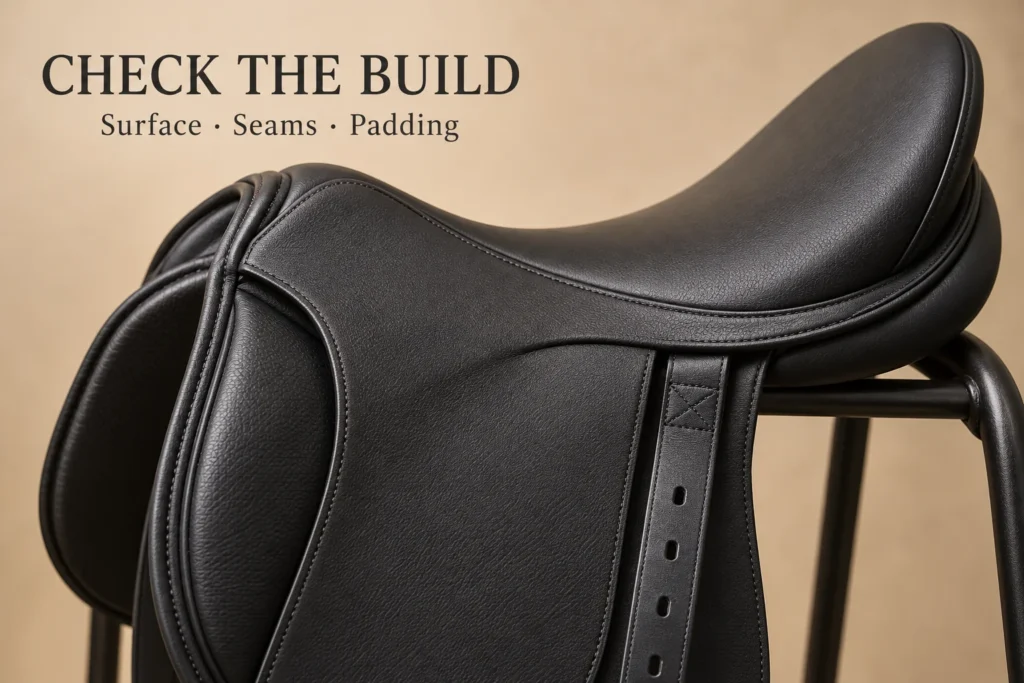
Synthetic saddles can use different coated textiles, engineered surfaces, backing materials, padding and reinforcement. Two products described as “black synthetic saddles” can therefore look and perform quite differently.
A useful purchasing specification identifies the important components separately.
| Area | What to agree before sampling |
|---|---|
| Outer surface | Material, texture, color, sheen and cleaning method |
| Structure and fit | Intended tree or structural design, width options and key measurements |
| Seat and flaps | Shape, dimensions, padding and finish |
| Panels or underside | Shape, padding, contact surface and channel measurements |
| Loaded areas | Billets or rigging, webbing, reinforcement and attachment construction |
| Edges and seams | Binding style, stitch appearance and finish |
| Hardware | Type, finish, placement and any included fittings |
| Retail presentation | Size labels, care information, logo placement and packaging |
Ask for a component-level description, not just a general material name. If a particular performance claim matters to your brand—such as abrasion resistance, color stability or water resistance—agree on a suitable test and acceptable result. A synthetic surface should not automatically be described as waterproof or maintenance-free.
Pay particular attention to loaded areas
A polished seat and tidy outer flap make a good first impression, but a buyer should also inspect the parts that take repeated load. Check billet or rigging attachments, stirrup-related components, webbing, reinforcement, seams and hardware against the agreed construction.
Request clear photographs of these areas during development. Then inspect the physical sample. A visually attractive saddle is not a substitute for a sound structural specification.
Fit information needs more than “medium” or “wide”
A size label is useful for shopping, but it cannot describe every relevant dimension. Fit terminology also differs between suppliers and product lines.
For each proposed model, ask for:
- Seat size and the method used to measure it
- Available tree or fit options
- Relevant width and channel measurements
- Panel or underside shape
- Flap length and position
- Finished saddle weight
- Measurements and tolerances that will be checked on repeat orders
Have an appropriately qualified saddle fitter assess the sample for its intended horses and use. A retailer should avoid describing one model as suitable for every horse. Good product information tells the customer what has been measured and when individual fitting advice is needed.
Build a range for the US, UK and Europe
The same product may need different wording and assortment decisions across markets. Start with your own sales evidence, customer questions and local riding disciplines.
For US retailers: Use familiar descriptions such as synthetic all-purpose saddle, synthetic jumping saddle and, where relevant, synthetic Western trail saddle. Specify what comes in the box; customers should not have to guess whether stirrups, leathers, a pad or other accessories are included.
For UK retailers: Consider general purpose or GP in appropriate English-saddle listings. Keep seat measurements and fit descriptions consistent across your store. Explain the difference between a general-purpose model and a jumping model in ordinary customer language.
For European importers: Prepare accurate product and care information for each destination market and agree with the supplier which labels, languages, packaging details and documents your business requires. Europe is not one uniform retail audience; assortment and terminology should follow the countries and channels you serve.
Across all three markets, avoid making unverified claims about fit, durability, testing or compliance. Approve the product first, then write the retail copy from its actual specification.
How to assess a synthetic saddle sample
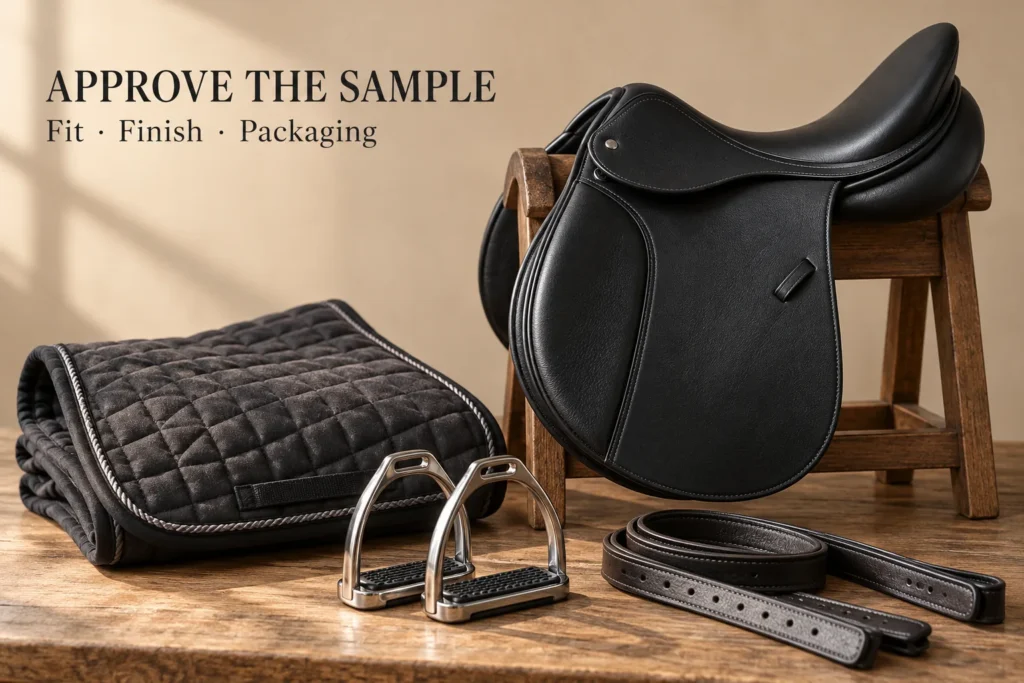
A pre-production sample is the bridge between an attractive idea and a repeatable wholesale product. Inspect it against a written checklist, record changes and approve a final reference before bulk manufacturing begins.
1. Compare it with the order specification
Measure the seat, flap and agreed fit points. Confirm materials, color, hardware, included accessories, logo placement and packed weight. List any differences in writing instead of relying on a conversation or annotated photograph alone.
2. Inspect the outer material
Look at the saddle in daylight. Check whether the texture and sheen match your target retail position. Examine bends and edges for unwanted creasing, uneven coating or loose binding.
If cleaning performance matters, try the proposed care method on the sample and record the result. Use material-specific evidence before making public performance claims.
3. Inspect the construction
Check seam regularity, reinforcement, loaded attachment areas, underside finish and hardware security. Compare both sides of the saddle for visible symmetry. Examine whether padding feels even and recovers after ordinary handling.
4. Assess fit and use
Have the sample assessed on suitable horses by a qualified fitter. Note the horse types and fit options actually evaluated. A product photograph or stand assessment cannot establish how the saddle fits a living horse.
5. Review the retail package
Open and repack the sample as a customer or warehouse team would. Check the carton, product protection, labels, care information and any branded inserts. Make sure the contents match the proposed product listing.
Keep the signed-off specification and approved sample available for comparison with the bulk order and future reorders.
Private-label details that customers will notice
Private-label work is more than placing a logo on the flap. The brand should appear consistently across the saddle, product information and packaging.
Agree on:
- Logo artwork, size, position and application method
- Approved color and surface texture
- Size and model identification
- Care instructions based on the actual materials
- Product labels and required market information
- Individual packaging and carton markings
- A reference code for future reorders
HideOrax offers customization of materials, color combinations, padding and reinforcement, branding and packaging through its OEM and private-label equestrian program. Confirm every selected option in the sample and quotation before it appears in your retail listing.
Calculate the complete landed product cost
A low saddle unit price may look appealing until accessories, packaging, freight and import expenses are added. Compare suppliers and models on the same basis.
Ask what the quotation includes: the saddle alone; stirrups and leathers; the saddle pad; branding; retail packaging; sample charges; inspection; and export packing. Obtain the finished product weight and packed carton dimensions for each model. Freight costs can depend on carton volume as well as weight.
A coordinated assortment can make buying easier for your customer. Depending on your range, compare matching saddle pads, stirrup leathers and horse stirrups. Specify whether these are sold separately or included with the saddle so your margin and product pages remain accurate.
You can also browse the full HideOrax equestrian product range when planning a collection across several tack categories.
What to send when requesting a wholesale quotation
A detailed first inquiry makes it easier to compare the quote with your intended product. Send:
- Your destination country and selling channel.
- The saddle style and intended rider or discipline.
- Target seat sizes and fit options.
- Preferred outer material, color and finish, if known.
- Reference images or a technical specification.
- Expected quantity by style, size and color.
- Logo, label and packaging requirements.
- Accessories to include or quote separately.
- Any specific tests, documents or delivery requirements you need.
If some details are undecided, say so. The manufacturer can identify the choices that need a sample rather than guessing at your requirements.
HideOrax currently lists a five-saddle minimum order for its synthetic range, with a typical 5–7 working day sample lead time after specifications are confirmed and 15–25 working days for bulk production after sample approval. Confirm the current schedule, options and price for your exact order when you request a wholesale quotation. HideOrax
Frequently asked questions
Are synthetic saddles always lighter than leather saddles?
No. Some synthetic constructions may weigh less, but the complete saddle determines the final weight. Request the measured weight of the approved model and its packed shipping weight.
Can a synthetic saddle be sold under my own brand?
Yes, subject to the agreed specification and sample. Confirm logo placement, labeling, colors and packaging through the private-label manufacturing process before placing a bulk order.
Is an all-purpose saddle the same as a GP saddle?
General purpose and GP are commonly used UK descriptions for the broad category that US buyers often call all-purpose. The names alone do not guarantee identical design or fit. Compare the actual dimensions and intended use of the model you are buying.
How many models should I order first?
Start with the smallest assortment that serves clearly different customers. For example, a general-purpose model and a jumping model may give an English tack retailer two distinct offers. Let sales, fit feedback and returns guide later additions.
Can I approve a bulk order from photographs?
Photographs help with early decisions, but they cannot fully show fit, material feel or construction. Approve a physical sample and written specification before treating the design as ready for repeat production.
Make the approved sample your standard
The strongest synthetic saddle range begins with a specific customer and ends with a product you can describe accurately and reorder consistently. Define the style and fit, inspect the complete construction, assess the physical sample and record exactly what was approved.
HideOrax manufactures synthetic saddles for wholesale buyers and supports customized equestrian collections. Share your target market, proposed models, quantities and branding requirements through the wholesale quote form to begin a sample-based discussion.