
A Western saddle is more than a seat with a horn. Its intended discipline affects the shape, construction, hardware and details that a buyer should approve before placing a wholesale order. Two saddles may look similar in a catalogue but serve different riders and be built to different specifications.
HideOrax lists roping, barrel, cutting and trail Western saddles for wholesale and private-label development. Its product page says leather, tooling, seat, hardware and finish are agreed against the buyer’s approved sample. This guide explains how an importer, tack shop or equestrian brand can choose a useful range for customers in the USA, UK and Europe, then turn that choice into a clear manufacturing brief. HideOrax
Start with the rider and discipline
A wholesale collection should answer a simple question: who is buying each saddle, and what will they use it for? The discipline name provides a starting point, but it does not replace a detailed design or a fit assessment.
| Saddle category | Intended collection | Questions for the buyer |
|---|---|---|
| Roping | Roping and ranch-oriented ranges | What horn, tree, rigging and construction does the intended activity require? |
| Barrel | Barrel and performance ranges | What seat, cantle, weight and rider position are specified? |
| Cutting | Cutting-oriented ranges | What seat profile and freedom of rider movement are intended? |
| Trail | Trail and general riding ranges | What balance of comfort, weight and attachment points does the customer need? |
These are the four Western styles listed by HideOrax. The table is a planning guide, not a claim that every saddle within a category has the same construction. Confirm the intended use and final specification with an experienced buyer and evaluate the physical sample.
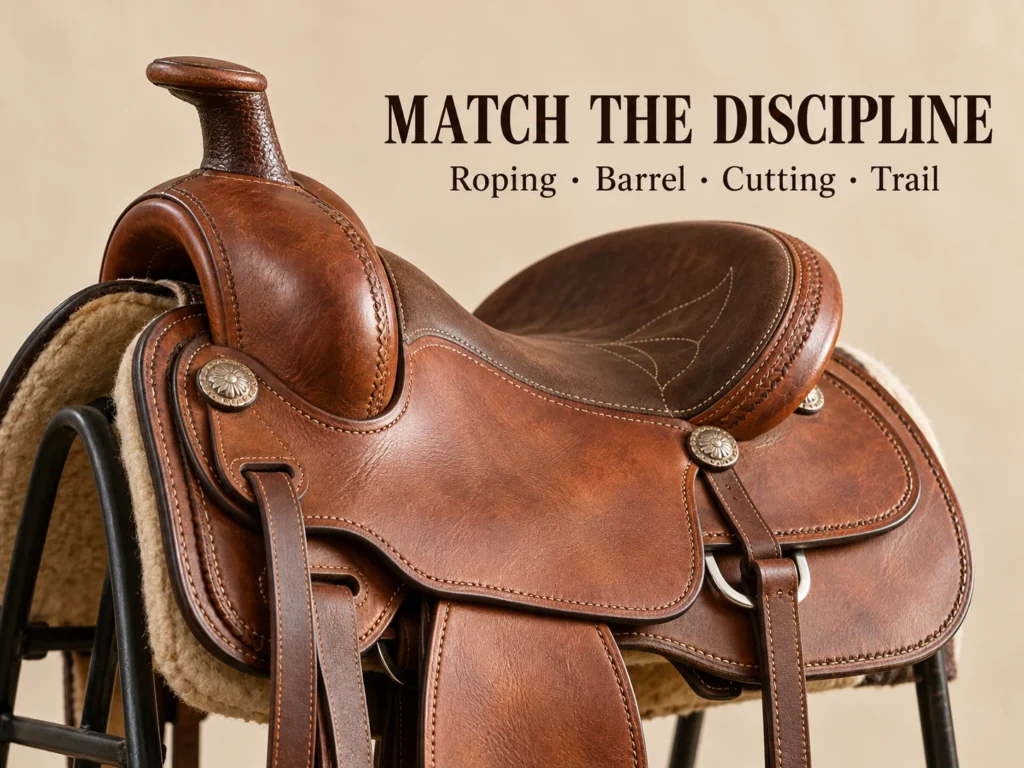
Roping saddles: define the working specification
A roping saddle should be specified around the particular activity and customer, rather than selected because it has a prominent horn. Ask the buyer for a reference saddle or technical brief covering the tree, horn, rigging, seat, fenders, stirrups and hardware.
Record dimensions and materials for each part. If a retailer plans to make a claim about suitability for a particular roping activity, that claim needs to be supported by the completed construction and appropriate evaluation. A photograph of a robust-looking saddle cannot establish what loads its components can withstand.
The approval sample should be inspected from several angles and reviewed with its intended equipment. Ask for close photographs of the horn, rigging, underside, stirrup attachment and finished stitching. Keep a written record of any change made after the first sample.
Barrel saddles: specify rider position and size
Barrel buyers may seek a particular seat feel, cantle shape, fender position or weight. Those preferences should appear as measurements and approved references in the order. “Barrel style” on its own leaves room for different interpretations.
For each proposed seat size, record how the seat is measured and whether the tree and other dimensions change with it. Evaluate the saddle with the intended rider and a suitable horse before treating the sample as approved. A seat-size label cannot establish that a saddle fits every rider or horse within a broad category.
If the opening order includes several colors or tooling patterns, keep the underlying construction consistent unless each variant has its own approved specification. This makes product photography, inspection and reordering clearer.
Cutting saddles: agree on the intended feel
HideOrax describes cutting saddles as balanced configurations developed from buyer samples. A wholesale brief should therefore identify the rider’s intended position and movement, the seat profile, cantle, horn, fender arrangement and rigging. Supply a physical reference or multiple measured photographs when available.
Look at the complete sample instead of approving its seat from a top-view image. The underside, tree specification and mounted balance also matter. Record what was checked, by whom and against which reference. If the buyer requests a change to the seat or fender placement, update the specification before approving production.
Trail saddles: plan comfort and accessories together
A trail collection may put more emphasis on extended riding use, practical attachment points and compatibility with accessories. That does not mean every trail saddle should have the same seat, weight or number of rings. Define the target rider and product position first.
Ask whether customers will pair the saddle with Western saddle pads or saddle bags. Confirm any accessory attachment on the actual sample. Specify the location and construction of each ring or tie point; do not assume a bag will fit simply because it appears beside the saddle in a product photograph.
For retail pages, photograph a trail saddle both by itself and with the approved accessories. State what is included in the sale and what is shown only to demonstrate a possible collection.
Write the construction specification before requesting prices
The saddle category helps a manufacturer understand the project. A useful quotation also needs the proposed construction. If two suppliers quote different trees, leathers or hardware, their unit prices are not directly comparable.
Give the manufacturer a technical brief covering:
- Intended discipline and reference model: Describe the customer and intended use.
- Seat sizes and measurement method: Define each size from consistent physical points.
- Tree specification: State the agreed construction and required options.
- Horn, seat and cantle: Supply measurements and reference photographs.
- Skirts, fenders and stirrups: Define shapes, lengths and included components.
- Rigging: Show placement, hardware and connection details.
- Leather and finish: Identify color, surface finish, thickness ranges and tooling areas.
- Underside and padding: Record materials and construction.
- Branding and packaging: Show logo position, labels and carton requirements.
HideOrax’s Western saddle manufacturer page lists full-grain vegetable-tanned leather as its primary material approach and offers plain, stamped or tooled leather programs. Agree on the exact material and finish for the approved design. Natural leather variation should be described honestly in the buyer’s specification and retail listing. HideOrax
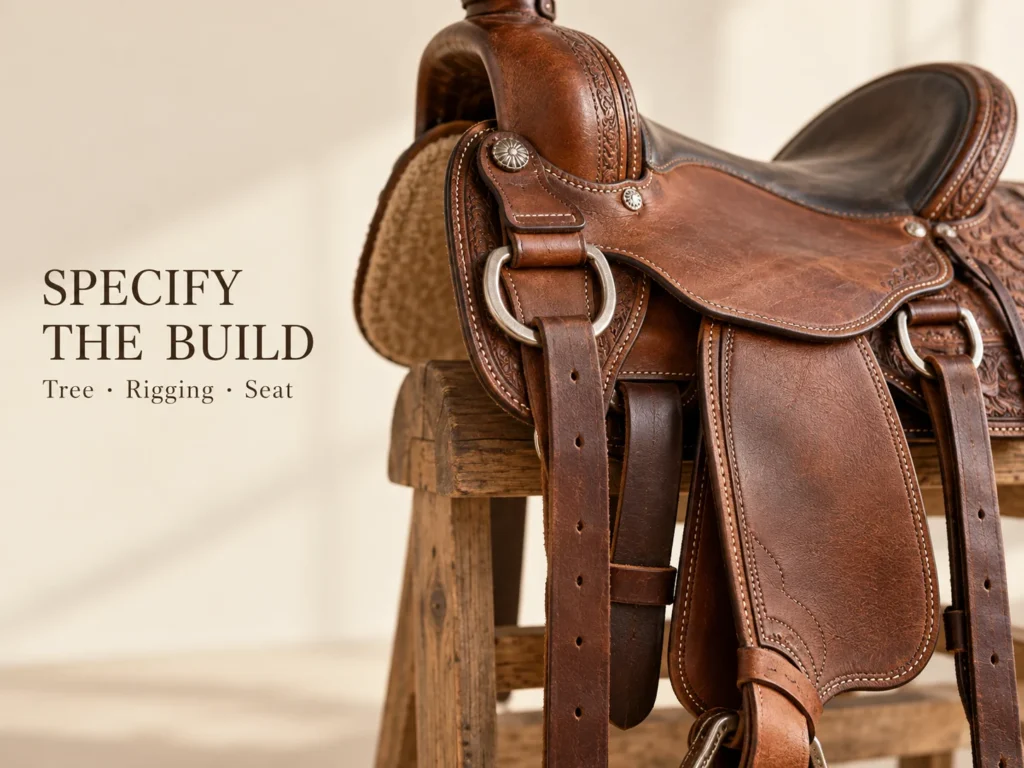
Evaluate horse fit and rider fit separately
Seat size helps describe the rider’s space. Tree shape and the complete saddle construction affect how the saddle sits on a horse. Neither question can be settled by the label “15-inch Western saddle” alone.
For the approval process, identify the intended horse types and rider group, then arrange appropriate physical fit evaluation. Record the saddle’s position, clearance, stability and contact in the conditions relevant to its intended use. If you sell through a fitter or specialist retailer, incorporate their observations into the approved specification.
Avoid presenting one tree option as fitting every horse. Retail product pages should give customers the measurements and fitting information available for that exact model, and explain how to seek an appropriate fit assessment.
Make sample approval a repeatable process
A good sample is a reference for production, inspection and future reorders. Keep it tied to a model code and revision date. Photograph the left side, right side, front, rear, top and underside in consistent light. Add close views of the horn, rigging, stirrup attachment, stitching, tooling and brand marks.
Compare the sample with the written brief:
- Are seat and overall dimensions within the agreed tolerance?
- Do the left and right sides match where symmetry is required?
- Are leather color, tooling and hardware consistent with approved references?
- Are all specified components and accessories included?
- Do straps, buckles and moving parts operate as intended?
- Does the packed saddle have adequate protection for the agreed shipping method?
A photograph is useful evidence of appearance, but it cannot confirm every hidden construction detail or replace physical fit review. Record any approved change in writing and give the revised sample a new version identifier.
Plan the first wholesale order carefully
HideOrax currently lists a standard minimum order of five Western saddles, sample development in 5–7 working days after specification confirmation, and typical bulk production in 15–25 working days after sample approval. Confirm current terms, materials, variation mix and shipping schedule in the actual quotation. HideOrax
For a first order, consider one clearly defined saddle model and a limited set of sizes and finishes supported by customer demand. Five saddles divided among several constructions, tree options and tooling patterns may require more sample work than the quantity suggests. Ask whether the minimum applies per model or to the combined order.
Calculate the delivered cost as well as the unit price. Confirm what the quotation includes: stirrups, cinch or other accessories, branding, packaging, inspection, export documentation and freight basis. This prevents two apparently similar quotes from being compared on different terms.
Build a coordinated private-label range
HideOrax offers private-label equestrian manufacturing with buyer-agreed dimensions, materials, colors, hardware, logos and packaging. For a Western collection, make each decision consistent across the saddle and any approved accessories.
A matching saddle pad or leather saddle bag can strengthen a retail range when it fits the intended saddle and customer. Approve the items together: color coordination alone does not establish physical compatibility. Keep separate model codes and specifications for every product.
Position the logo on an actual sample. Check its appearance after tooling or finishing and decide whether the retail carton, hangtag and product should carry the same brand presentation.
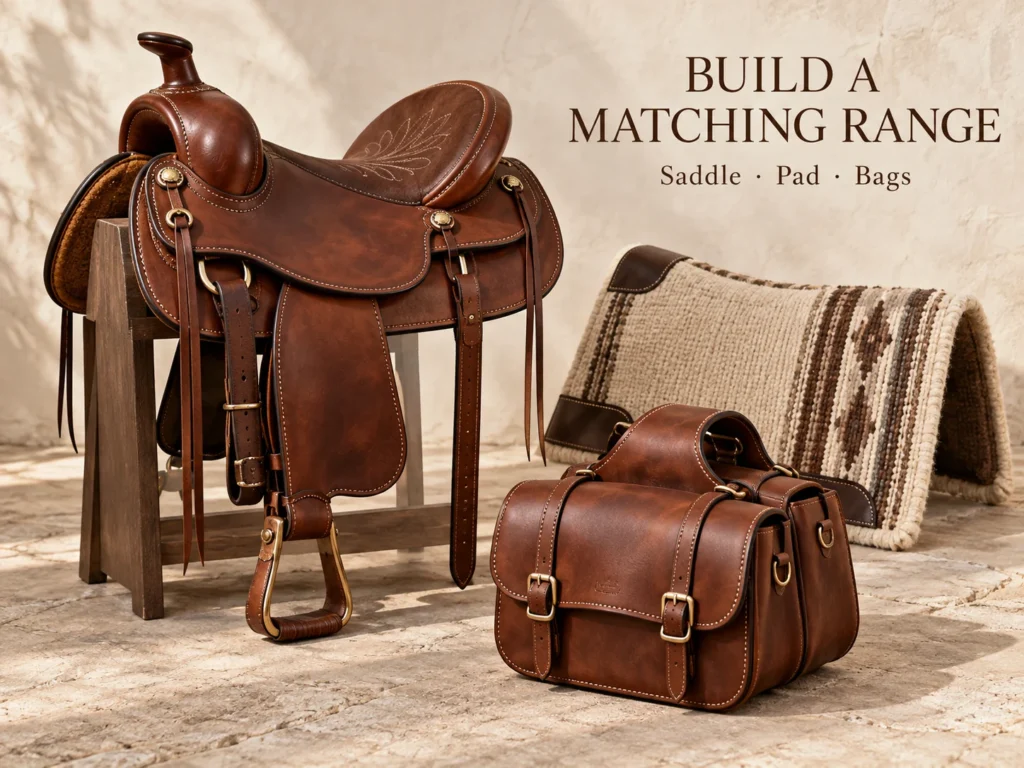
Present the range to US and European buyers
The USA has several Western riding segments, so a general “Western saddle” page may be too broad for a specialist buyer. Give roping, barrel, cutting and trail models their own names and specifications when you actually offer those designs. Use product photographs of the approved model, not a generic image of another style.
For buyers in the UK and Europe, retain the precise technical dimensions and provide measurements in inches and centimetres where useful. Translate product information for the countries you serve, including material and care details. A local-language listing should describe the same saddle that appears in the English specification.
Useful pages answer practical questions: the intended discipline, available seat and tree options, what accessories are included, how the model was sampled, and how a wholesale buyer can request a quote.
Western saddle wholesale quotation checklist
Send HideOrax:
- The intended discipline and target country.
- Reference photographs or a physical sample.
- Seat sizes, tree options and required measurements.
- Horn, cantle, skirt, fender, stirrup and rigging specifications.
- Leather, color, tooling, stitching and hardware choices.
- Underside materials and padding requirements.
- Branding and retail or export packaging details.
- Quantity per model, size and finish.
- Sample requirements, destination and target schedule.
- Any fit, testing or documentation requirements for the intended sales channel.
Mark which details are fixed and which you want the manufacturer to propose. This gives both sides a clearer route from the first quotation to an approved sample.
Frequently asked questions
What Western saddle types does HideOrax list?
HideOrax lists roping, barrel, cutting and trail saddle programs. The final design is developed to the buyer’s approved construction and finish specification.
Can I order a private-label Western saddle?
Yes. HideOrax lists buyer branding, labels and packaging as available options. Approve the logo position and finished appearance on a physical sample.
Is seat size enough to choose a saddle?
No. Seat size concerns part of the rider fit. The tree and complete saddle must also be evaluated for the intended horse and use.
What is HideOrax’s minimum order for Western saddles?
Its current product page states five saddles. Confirm how this applies to different models, sizes and finishes when requesting your quotation.
Can Western saddle bags be ordered with the saddles?
HideOrax has a separate saddle bag range. Specify the bag and test its attachment on the approved saddle model before presenting them as a matched set.
Choose the model before choosing the finish
Roping, barrel, cutting and trail saddles should begin as distinct buyer briefs. Once the intended rider, construction and fit requirements are clear, leather color, tooling and branding can be approved on a sample that represents the product you plan to sell.
Review HideOrax’s Western saddle manufacturing options and request a wholesale quote with your target discipline, sizes, reference design and quantity.