
A stirrup leather can look straightforward in a catalogue photo: a strap, holes and a buckle. Yet a small difference in the way its length is measured can change what a rider receives. For a wholesale buyer serving the United States and Europe, the product description, size chart and factory specification must all describe the same finished pair.
HideOrax lists traditional English, reinforced, mono and wide comfort stirrup leathers on its stirrup leathers manufacturer page. It offers customization of length, width, reinforcement, buckles and finish. This guide focuses on the decisions that make a wholesale order repeatable: measurement points, matched pairs, leather construction, hardware, labeling and sample approval.
First, decide which construction belongs in your range
Do not treat all stirrup leathers as a colour-and-length variation of one design. Each construction needs a clear reference sample and its own dimensions.
| Style | Range purpose | Specification questions |
|---|---|---|
| Traditional English | Classic adjustable pair for an English saddle line | How is length measured? What are the strap width, thickness, hole count and buckle dimensions? |
| Reinforced | A defined leather-and-reinforcement construction | What is the reinforcement material, where does it start and end, and how is it joined? |
| Mono | A single visible strap configuration, subject to the saddle design | How does the adjustment work, and is the mechanism compatible with the intended stirrup and saddle? |
| Wide comfort | A design with a wider lower section | What are the widths at both ends, the transition point and the finished thickness? |
HideOrax lists all four families. The exact design, materials and performance claims should be agreed from the buyer’s specification and approved sample. A phrase such as “reduced stretch” should be supported by the chosen construction and, if used as a measurable marketing claim, appropriate evidence for that finished product.
For a first private label range, select the styles your customers actually request. A traditional pair and one clearly differentiated design can be easier to photograph, stock and explain than four styles split into many colours and lengths.
Define length before choosing a size label
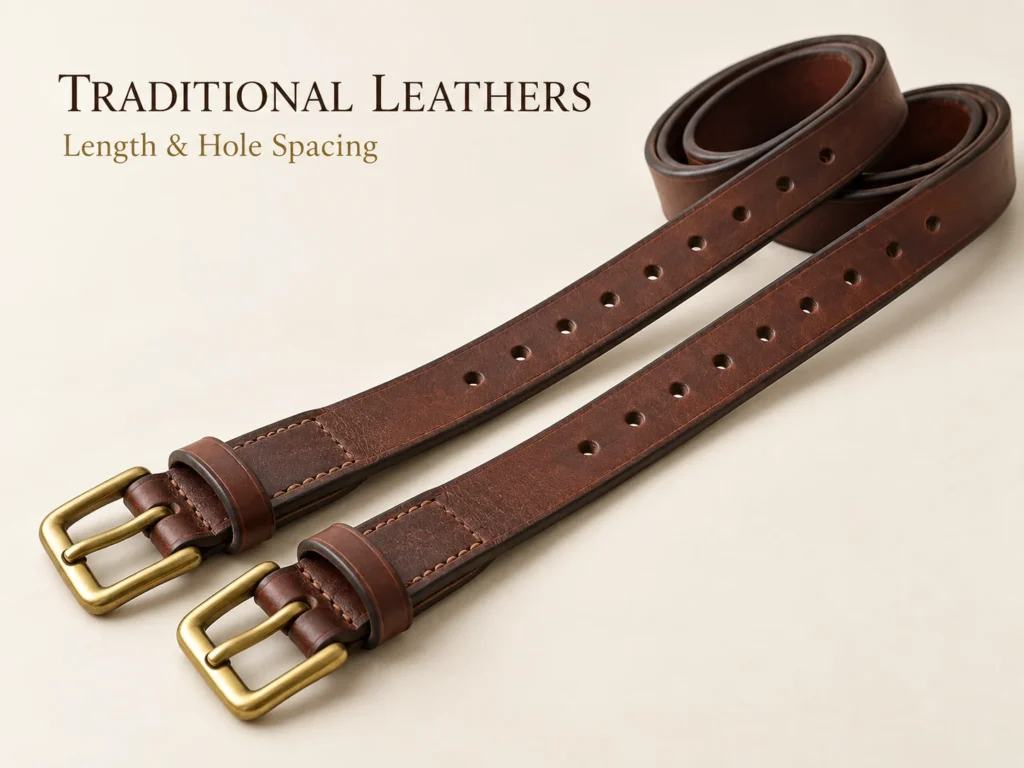
One supplier may measure from the top edge of the buckle to the strap end. Another may measure from the buckle bar to the last hole. Those are different values even for the same physical leather. A purchase order that says only “54 inch stirrup leathers” leaves room for a dispute.
Choose one measurement method and show it on an annotated photograph. A technical sheet can record:
- Finished overall length: The exact start and end points, including whether the buckle is counted.
- Usable adjustment range: The distance from the agreed buckle reference point to the first and last usable holes.
- Hole count and spacing: Centre-to-centre distance and the distance from each end to the nearest hole.
- Width and thickness: Where each measurement is taken, including any wider lower section.
- Pair tolerance: The permitted difference between the left and right finished pieces.
For a US listing, an inch size may be familiar. A European buyer may prefer centimetres. You can publish both, but keep one master unit on the production sheet and convert the other consistently. As a conversion example only, 54 inches equals 137.16 centimetres; this number is not a HideOrax size recommendation. The more important point is that both numbers must refer to the same two physical endpoints. If you round for customer-facing labels, keep the precise approved dimension in the factory specification.
Ask the supplier to photograph a sample beside a tape measure with the reference points marked. When the sample arrives, repeat the measurement using the same method. A common method across purchase orders, listings and customer support will prevent many avoidable size questions.
Match the left and right leathers as a pair
Retailers sell stirrup leathers as a pair, so inspect and quote them as a pair. Place both flat under the same light, align the buckle reference points, and compare the strap ends and every corresponding hole. Check whether buckle shape, hole spacing, edge finish and leather shade match.
Pair matching matters more than a beautiful photograph of one strap. A small difference can become obvious when two pieces are fitted to the same saddle. Set a written tolerance with the supplier rather than relying on “identical” as a subjective instruction. Record whether the size mark appears on one piece or both, and make sure the packaging says one pair if that is the unit offered to retailers.
For a range sold with English saddles or synthetic saddles, check the approved leather width and buckle profile with the intended saddle hardware. The sample should also be evaluated with the intended stirrup irons. Do not promise universal compatibility from a generic strap width.
Inspect leather, reinforcement and edge finish
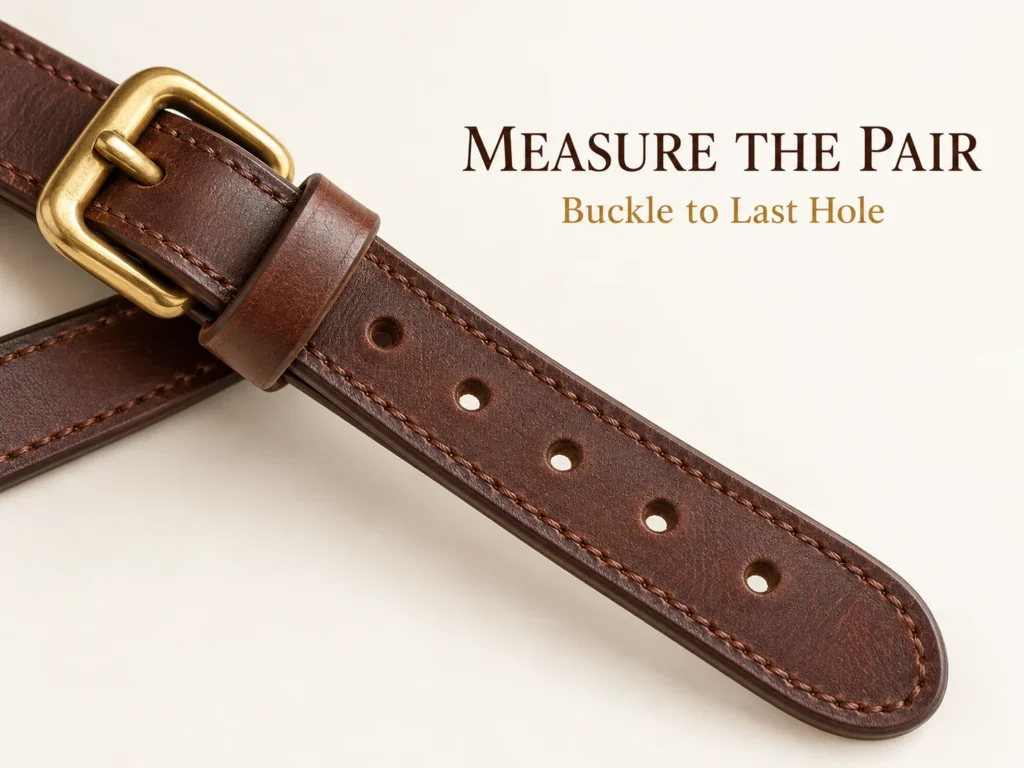
HideOrax’s page identifies full-grain leather with reinforcement options as its primary material approach. That is a starting point for a quotation, not a substitute for the actual sample specification. State the leather colour, surface finish, finished width, approximate thickness, edge treatment and expected variation between pairs.
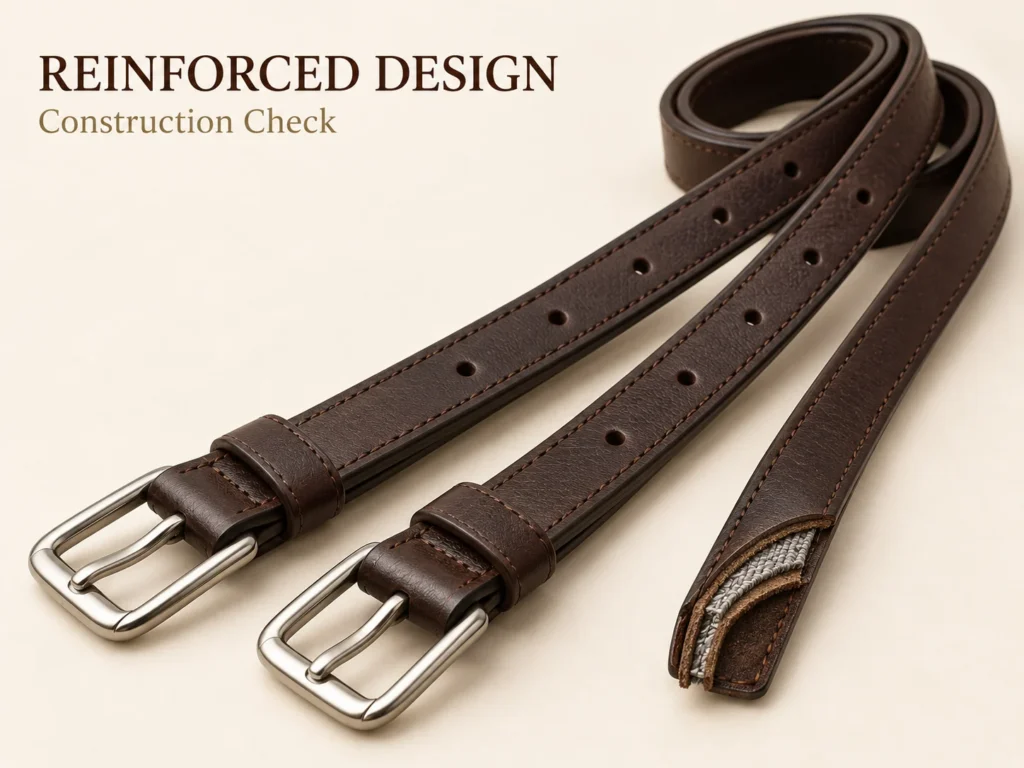
For reinforced designs, request a section drawing or sample showing the reinforcement material, its position and how the layers are joined. Inspect the areas near holes, buckles and the lower end, where construction changes may be visible. If your listing says the leathers resist stretch to a particular degree, request test evidence for the approved design; otherwise describe its construction without an unverified number.
Look at the leather under neutral light and flex the sample as intended during a practical review. Inspect edges for roughness, cracks in the finish, loose stitching or uneven thickness. Agree on the appearance of natural grain variation and colour tolerance before bulk production, especially if the leathers will be sold as a matching accessory to saddles or bridles.
A mono design and a wide lower section deserve separate samples. Do not assume that a material or reinforcement approved for a traditional pair behaves identically in those constructions.
Make the buckle and holes part of quality control
Buckles are working components. Identify their material and finish, internal width, bar shape, tongue shape and attachment method in the specification. Check that the punched holes are clean, evenly positioned and compatible with the buckle tongue. Inspect each buckle for rough edges and test adjustment through the full approved range.
The hole spacing should be a number on the technical sheet, not a visual guess. A useful inspection photograph places a ruler alongside the first, middle and last hole. Ask the supplier to note practical manufacturing tolerances for hole centres and buckle position. These checks are especially important when a retailer offers several lengths in the same product line.
If the design has a branded buckle or unusual hardware, approve it in a physical sample. A digital mockup cannot show its weight, operation or how it sits against the leather.
US and European product listings need the same underlying facts
Different market language should not create different physical specifications. Prepare a single approved master sheet and use it to write regional listings:
| Detail | US-facing presentation | Europe-facing presentation |
|---|---|---|
| Length | Inches prominent; centimetres optional | Centimetres prominent; inches optional where useful |
| Size chart | State exact measuring endpoints | State the same endpoints after unit conversion |
| Colour | Use a photograph and plain colour name | Keep the same approved colour reference |
| Package contents | State “one pair” and whether stirrups are included | State the same contents clearly in the relevant language |
| Care | Instructions for approved materials | Translate the same verified instructions |
The table describes a sensible presentation approach, not a fixed legal rule for every country. If you sell into more than one European language market, have your product and care text reviewed for the market in question. Ask your importer or adviser to confirm any applicable labeling, chemical, packaging or product obligations for the final materials and destination. Avoid putting an unverified “EU compliant” claim on the website or packaging.
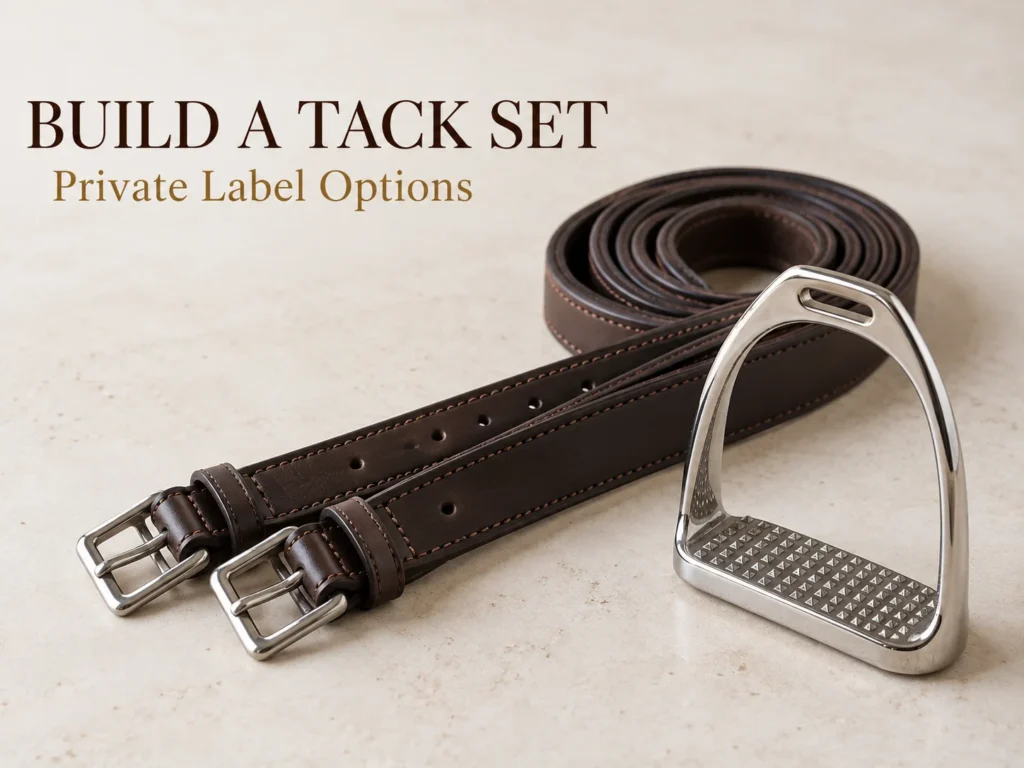
Also distinguish an actual stirrup leather from a stirrup iron in the product title and pictures. A buyer seeing both in a lifestyle image should not have to guess what is included in the order.
Develop private label details around the product
HideOrax lists logo stamping, size marks and private label packaging for stirrup leathers. Give the supplier a vector logo where possible, the desired stamp position, size and orientation, and a sample of any packaging artwork. A size mark should stay legible after finishing and should use the same measurement method as your retail chart.
If you offer matching saddles, choose a physical colour reference and compare approved samples together. “Dark brown” can cover noticeably different finishes. The HideOrax private label process starts with specification review, quotation and sample approval before bulk production. Use that sample to approve a complete retail unit: both leathers, labels, protection and carton presentation.
Approve the sample before bulk production
HideOrax currently lists a standard MOQ of 10 pairs, a sample estimate of 5–7 working days after specifications are confirmed, and a bulk estimate of 15–25 working days after sample approval. Confirm how the minimum applies to mixed lengths, colours and branding versions, as well as the live schedule for your particular order.
A short approval record can cover:
- Identity: Style, size, colour, sample date and revision number.
- Finished dimensions: Measurement endpoints, overall length, usable adjustment, width, thickness and hole spacing.
- Pair matching: Left and right length, hole positions, colour and edge finish.
- Construction: Leather, lining or reinforcement, stitching and finishing.
- Hardware: Buckle dimensions, finish, operation and attachment.
- Branding: Logo, size marks and labels.
- Presentation: One-pair pack, care information and carton requirements.
Note every correction with a photograph and a specific requested measurement or finish. If a revision changes the construction or fit, approve the updated physical sample before treating it as the bulk reference. Keep one signed-off specification version with the purchase order and share it with the inspector for repeat orders.
What should a stirrup leather RFQ include?
To receive a useful wholesale quotation, send:
- Style: traditional, reinforced, mono or wide comfort, with reference photographs or a physical sample.
- Intended saddle and stirrup pairing, if relevant.
- Finished dimensions with measurement endpoints, master unit, size grading and tolerances.
- Leather, reinforcement, buckle, stitch, edge and colour specifications.
- Quantity by pairs for each size, colour and logo version.
- Logo, size marks, hangtags, individual packing and carton requirements.
- Destination country, requested shipping terms, sample quantity and target order date.
Ask for itemized sample cost, unit price by variation, packaging and any tooling charge, lead time and what inspection evidence will accompany the order. HideOrax’s request a quote form can start that conversation; follow up with your measurement drawing and reference sample so both parties quote the same product.
Frequently asked questions
Are stirrup leathers sold in pairs?
The HideOrax product page quotes its minimum order in pairs. Make sure your retail listing and carton count also identify what one unit contains. Stirrups should be listed separately unless the specific set includes them.
What does “54 inches” mean on a stirrup leather?
The number alone is incomplete. State the start and end points used for the measurement, then use that method consistently on the production sheet and customer size chart. The example conversion is 54 inches = 137.16 centimetres; it does not establish a universal size convention.
Which styles does HideOrax offer?
Its published range lists traditional English, reinforced, mono and wide comfort stirrup leathers. Dimensions, materials and finishing are finalized to an approved buyer specification.
Can I order a custom length or hole spacing?
HideOrax says size grading, width and hole spacing can be made to an approved specification. Provide a dimensioned drawing and confirm the requested tolerance during sampling.
Can stirrup leathers be ordered with saddles and stirrups?
The site says stirrup leathers can be coordinated with saddle orders, and it also lists horse stirrups. Specify each product and the retail pack contents so the quotation is clear.
Turn a simple strap into a reliable product line
The strongest wholesale stirrup leather specification is one a supplier can manufacture, an inspector can measure, and a retailer can explain in either inches or centimetres. Choose the construction, define both measurement endpoints, approve a matched pair and retain a versioned sample record. Then ask HideOrax for a wholesale quotation with quantities broken down by style, length and colour.